Admit rate has ranged 51%–100% over the last 5 years — notably volatile, though the latest figure above (44%) falls outside that window. Source: IPEDS via Urban Institute.
Acceptance & SAT from Common Data Set / IPEDS; net price, earnings & graduation from the U.S. Dept. of Education College Scorecard. Figures lag ~1–2 years — verify with the school.
Morehouse College is a crucible for Black male leadership, producing icons from Martin Luther King Jr. to Spike Lee. This Atlanta HBCU pairs rigorous academics in business and STEM with an unapologetically brother-centric culture, where students debate in bowties and rally around homecoming step shows. The experience commands a significant investment, with an average net price after aid of $39,013 and a graduation rate of 59%, yet its 44-acre campus pulses with the professional opportunities of the city.
Admission requirements
Test-optional — scores considered if submitted
Required
High school transcript
Grade point average
Letters of recommendation
Considered (not required)
Class rank
Test scores (SAT/ACT)
College-prep program
TOEFL (non-native English)
Source: IPEDS Admissions survey (2022) via Urban Institute. Covers formal factors only — it does not reflect essays, extracurriculars, or other holistic criteria.
More details
Undergrad enrollment
2,844
In-state tuition
$32,893
Out-of-state tuition
$32,893
Type
Private, all-male HBCU
Location
Atlanta, GA
Graduation Rate
53%
Most Popular Majors
Business, Biology, Social Sciences
Student-Faculty Ratio
14:1
Avg Early-Career Salary
$36,427
Outcomes & value
Outcomes & value
Median earnings (10 yr)
$52,889
Value (earnings ÷ net price)
1.4×
Median debt at graduation
$25,000
Graduation rate
59%
First-year retention
87%
Reducing loan balance (3 yr)
31%
Pell (lower-income) share
45%
First-gen share (among federal-aid recipients)
20%
Financial health
3.0 / 3.0Meets the federal financial-responsibility standard
U.S. Dept. of Education Financial Responsibility Composite Score (FY2022-23). Scale −1.0 to 3.0; ≥1.5 meets the standard. Reported for private nonprofit & for-profit institutions only — public universities are state-backed and not scored, so this is a stability signal, not a ranking.
Top-earning majors
Median earnings by field of study (highest credential), ~2 years after completion.
Economics$59,417
Business Administration, Management and Operations$49,722
English Language and Literature, General$31,133
Political Science and Government$29,685
Sociology$25,774
Psychology, General$22,087
Campus & location
Campus safety
On-campus violent crimes (2024)
2
On-campus criminal offenses classed as violent (murder/non-negligent manslaughter, rape, robbery, aggravated assault) for the most recent reported year. Source: U.S. Dept. of Education Campus Safety and Security (Clery Act). Counts reflect what’s reported to the school, and urban campuses often report more partly due to non-student incidents nearby — read alongside campus size and setting, not as a standalone safety verdict.
Climate
Pleasant days / yr
101
Summer high
86°F
Winter low
39°F
Annual rain
65.3"
Annual snow
0.7"
Natural-hazard risk
Relatively High
Pleasant days counts days per year with a mean temperature of 55–75°F, a high at or below 90°F, a low at or above 45°F, and little precipitation — a transparent comfort measure, not a weighting we invented. Computed from Open-Meteo ERA5 daily history (2019–2023). Natural-hazard risk is the county’s composite rating from the FEMA National Risk Index.
Deep dive — research, future-scholar output & economic mobility▾
Research output
Institutional h-index
76
Scholarly works
1,465
Institutional research volume and impact from OpenAlex. The h-index reflects large research universities and will be low for teaching-focused liberal-arts colleges — not a measure of undergraduate quality.
Economic mobility
Mobility rate
3.1%
Bottom → top quintile
36%
From bottom quintile
9%
Mobility rate = the share of students who both start in the bottom household-income quintile and reach the top quintile; bottom → top is that chance conditional on starting at the bottom. Source: Opportunity Insights Mobility Report Cards (Chetty, Friedman, Saez, Turner & Yagan). Reflects 1980–82 birth cohorts, so it’s directional, not current.
Quick answers
What is the acceptance rate at Morehouse College?
Morehouse College's acceptance rate is approximately 44% (Atlanta, GA), based on the most recent figures we compiled from public and primary sources.
How much does Morehouse College cost?
At Morehouse College, the average net price (after aid) is about $39,013 per year. Actual cost varies with financial aid and residency.
How many undergraduates attend Morehouse College?
Morehouse College enrolls approximately 2,844 undergraduate students.
Where is Morehouse College located?
Morehouse College is located in Atlanta, GA.
Admissions
Morehouse is selective but not cutthroat, with hovering between 33-44%—lower than many liberal arts colleges but more accessible than elite Ivies. The middle 50% of admitted students score 18-25 on the ACT, with policies since 2021. Notably, the college enrolls about 650 first-year students annually, creating an intimate cohort. Applications require teacher recommendations and a writing sample, though early admission stats aren't publicly detailed.
With a 14:1 student-faculty ratio and 85% of courses taught by full-time professors, Morehouse emphasizes close mentorship. The curriculum leans into its identity: Africana Studies, (the most popular major), and dominate, but newer programs like signal a tech pivot. Interdisciplinary learning is baked in—think poli-sci majors analyzing Kente cloth patterns in art classes. The vibe is ; students cite professors who 'don’t let you fail' (per Instagram testimonials).
Earnings = median of students working ~10 years after entry; debt = median of graduates. Value divides 10-yr earnings by one year’s net price — read it as earnings per dollar of annual cost, not a full lifetime ROI; it favors lower-cost schools. Source: U.S. Dept. of Education College Scorecard. Figures lag ~2 years and reflect all students, not your intended major.
Biology, General
$18,771
Communication and Media Studies$14,442
Source: U.S. Dept. of Education College Scorecard (field-of-study earnings). Figures cover graduates who received federal aid and lag ~2 years; not all programs report data.
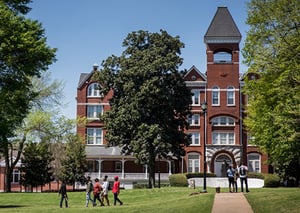
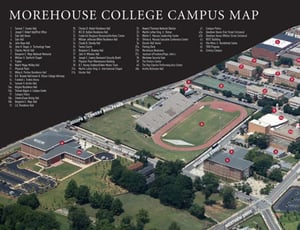
The 61-acre Atlanta campus thrums with Black excellence—debate teams practice in grand halls lined with oil portraits of alumni like Samuel L. Jackson. 55% of students live on-campus, many in traditional dorms with communal bathrooms that foster camaraderie. Traditions reign: Homecoming’s “GQ” fashion show and the “Crown Forum” lecture series are sacred. Over 80 clubs exist, but the Omega Psi Phi and Alpha Phi Alpha fraternities dominate social life. Atlanta’s AUC (Atlanta University Center) consortium means Spelman and Clark Atlanta parties are a short shuttle ride away.
Morehouse’s 53% graduation rate trails national averages, but its network punches above its weight. Alumni average $36,427 early-career salaries (rising to $72,901 by mid-career per U.S. News)—outearning many liberal arts grads. The career office touts pipelines to Fortune 500 companies and top law/med schools, though College Scorecard data shows 25% of students default on loans—a sobering counterpoint to the ‘Morehouse Mystique.’
Sticker price stings—$34,733 net cost after aid—but 74% of students receive assistance. The average aid package is $25,880, heavily weighted toward grants over loans. Payment plans and emergency funds exist, yet the $35,251 true average net price (per MeetYourClass) means many still graduate with debt. Pro tip: The ‘Andrew Young Scholarship’ for activists and STEM grants help offset costs.
Morehouse is the only HBCU dedicated solely to Black men, and it leans hard into that mission. Where else would a professor interrupt class to adjust a student’s tie? The ‘Morehouse Mystique’—a blend of Southern gentility, Black nationalism, and academic rigor—produces grads who lead with unshakable confidence. Its Atlanta location provides internships at CNN and the CDC, but the real value is the lifelong brotherhood: alumni donate at twice the rate of peer schools. Just know—it’s a culture, not just a college.
Morehouse College logo · sourceCollege Tour | Visit Morehouse College · sourceCampus Map | Morehouse College · sourceCollege Tour | Visit Morehouse College · source