Loading…
← All schools
MTI College
Sacramento, CAprivate forprofitcampus.edu/
Acceptance
63%
Avg net price
$21,740
Earnings (10 yr)
$45,328
Admit rate has ranged 80%–96% over the last 5 years — notably volatile, though the latest figure above (63%) falls outside that window. Source: IPEDS via Urban Institute.
Acceptance & SAT from Common Data Set / IPEDS; net price, earnings & graduation from the U.S. Dept. of Education College Scorecard. Figures lag ~1–2 years — verify with the school.
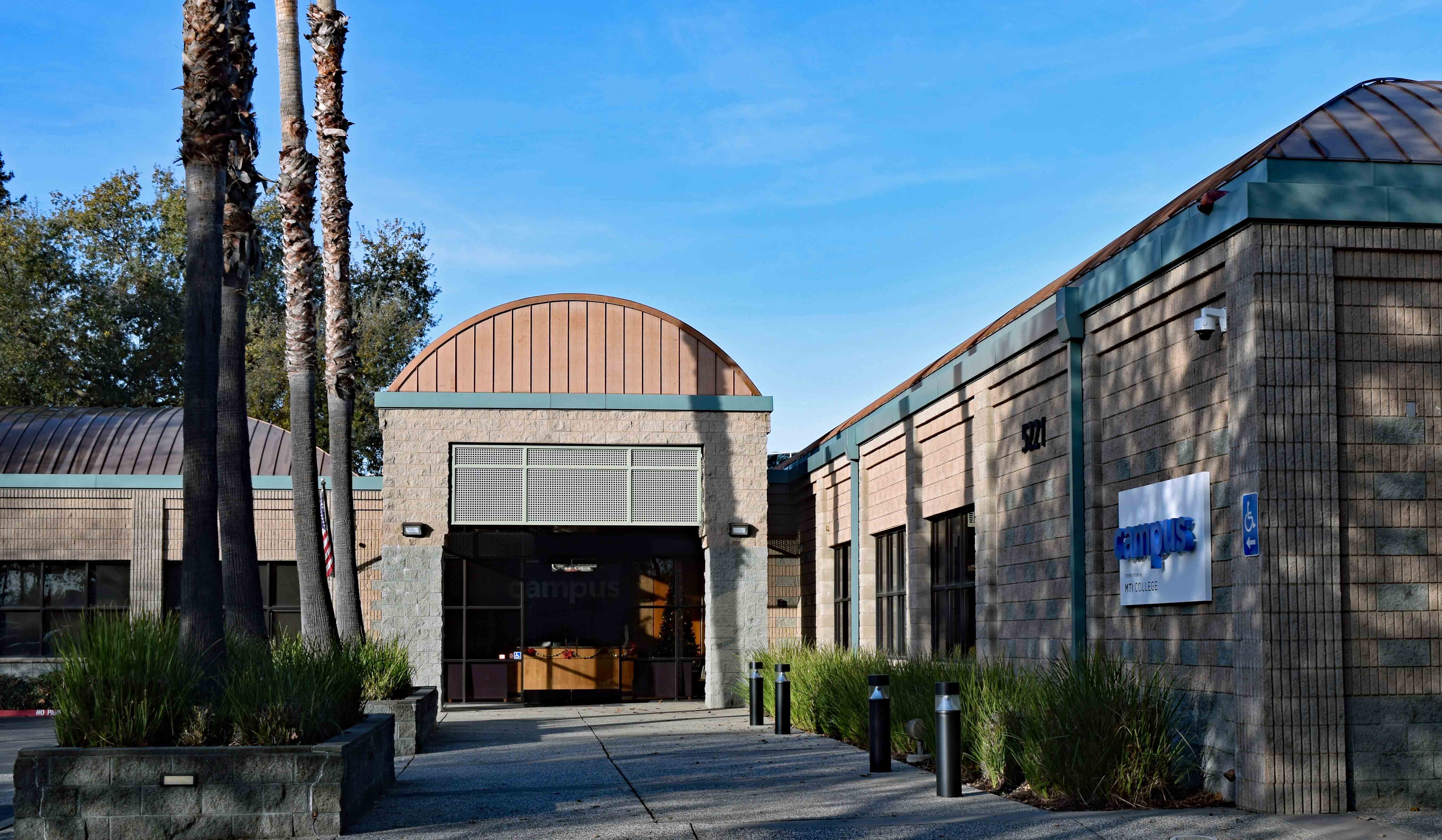
MTI College, now operating as 'Campus' in Sacramento, is a vocational institution that has carved out a distinct niche since 1965. It operates with the focused, pragmatic energy of a trade school, offering hands-on programs in fields like medical assisting, barbering, and information technology designed for direct workforce entry. With a moderately selective admissions process and a student body of just over a thousand, it prioritizes career outcomes over traditional campus life, a mission underscored by its recent rebranding aimed at lowering costs and barriers to entry.
Admission requirements
Test-blind — scores not considered
Required
- Letters of recommendation
- Demonstrated competencies
Source: IPEDS Admissions survey (2022) via Urban Institute. Covers formal factors only — it does not reflect essays, extracurriculars, or other holistic criteria.
More details
- Undergrad enrollment
- 2,000
- Focus
- Vocational/Career Training
- Setting
- Suburban (Sacramento, CA)
- Graduation Rate
- 74-77%
- Student-Faculty Ratio
- 20:1
- Median Earnings (10yr)
- $45,328
Outcomes & value
Outcomes & value
- Median earnings (10 yr)
- $45,328
- Value (earnings ÷ net price)
- 2.1×
- Median debt at graduation
- $8,836
- Reducing loan balance (3 yr)
- 47%
- Pell (lower-income) share
- 47%
- First-gen share (among federal-aid recipients)
- 48%
Earnings = median of students working ~10 years after entry; debt = median of graduates. Value divides 10-yr earnings by one year’s net price — read it as earnings per dollar of annual cost, not a full lifetime ROI; it favors lower-cost schools. Source: U.S. Dept. of Education College Scorecard. Figures lag ~2 years and reflect all students, not your intended major.
Financial health
-0.2 / 3.0Below the federal standard — financial stress
U.S. Dept. of Education Financial Responsibility Composite Score (FY2022-23). Scale −1.0 to 3.0; ≥1.5 meets the standard. Reported for private nonprofit & for-profit institutions only — public universities are state-backed and not scored, so this is a stability signal, not a ranking.
Campus & location
Campus safety
- On-campus violent crimes (2024)
- 0
On-campus criminal offenses classed as violent (murder/non-negligent manslaughter, rape, robbery, aggravated assault) for the most recent reported year. Source: U.S. Dept. of Education Campus Safety and Security (Clery Act). Counts reflect what’s reported to the school, and urban campuses often report more partly due to non-student incidents nearby — read alongside campus size and setting, not as a standalone safety verdict.
Climate
- Pleasant days / yr
- 105
- Summer high
- 95°F
- Winter low
- 40°F
- Annual rain
- 25.9"
- Natural-hazard risk
- Relatively High
Pleasant days counts days per year with a mean temperature of 55–75°F, a high at or below 90°F, a low at or above 45°F, and little precipitation — a transparent comfort measure, not a weighting we invented. Computed from Open-Meteo ERA5 daily history (2019–2023). Natural-hazard risk is the county’s composite rating from the FEMA National Risk Index.
Deep dive — research, future-scholar output & economic mobility
Research output
- Institutional h-index
- 8
- Scholarly works
- 57
Institutional research volume and impact from OpenAlex. The h-index reflects large research universities and will be low for teaching-focused liberal-arts colleges — not a measure of undergraduate quality.
Economic mobility
- Mobility rate
- 1.4%
- Bottom → top quintile
- 9%
- From bottom quintile
- 16%
Mobility rate = the share of students who both start in the bottom household-income quintile and reach the top quintile; bottom → top is that chance conditional on starting at the bottom. Source: Opportunity Insights Mobility Report Cards (Chetty, Friedman, Saez, Turner & Yagan). Reflects 1980–82 birth cohorts, so it’s directional, not current.
Quick answers
- What is the acceptance rate at MTI College?
- MTI College's acceptance rate is approximately 63% (Sacramento, CA), based on the most recent figures we compiled from public and primary sources.
- How much does MTI College cost?
- At MTI College, the average net price (after aid) is about $21,740 per year. Actual cost varies with financial aid and residency.
- How many undergraduates attend MTI College?
- MTI College enrolls approximately 2,000 undergraduate students.
- Where is MTI College located?
- MTI College is located in Sacramento, CA.
Admissions
MTI College operates with a moderately selective admissions process, a notable distinction in the world of trade and vocational schools where open admissions is often the norm. The institution admits 63% of applicants, a rate that is lower than the California state average of 81% for community colleges. This selectivity suggests a more structured entry process than many peer institutions. However, context is added by its rate—the percentage of admitted students who enroll—which is reported at 41%. This indicates that a significant portion of admitted students choose to attend elsewhere. Demographic data shows a diverse applicant pool, with women accepted at a slightly higher rate (64%) than men (63%). The admissions operation appears to be in a state of transition, as the school has recently rebranded from MTI College to 'Campus,' with a stated goal of creating a new model that 'lowers costs and barriers to students.'
Academics
The academic model at MTI College (Campus) is unapologetically vocational and career-focused. It offers a compact set of programs, with sources citing . The curriculum is designed to provide 'adequate training and preparation for careers' in specific fields. Top programs include , with a notable focus on . Beyond the beauty trades, degree programs are offered in studies. The institution also emphasizes 'hands-on programs' in . The student-to-faculty ratio is , which suggests class sizes are manageable for skills-based instruction. This is not a liberal arts college; the entire academic structure is built around delivering job-ready skills in a relatively short timeframe, aligning with its historical identity as a vocational trainer 'since 1965.'
Compare MTI College
vs Texas A&M University-Texarkanavs Asbury Universityvs Lincoln Universityvs Northwest Nazarene University
See colleges similar to MTI College →Sources
- [PDF] Common Data Set 2022-2023 - Tiffin University
- What is the Common Data Set? | College Raptor
- Common Data Set: Home
- Decoding the Common Data Set What You Need to Know for Your ...
- How to Use the Common Data Set in Your College Search
- Common Data Set (CDS) | Institutional Research
- MTI College Admissions - BigFuture College Search
- MTI College Admissions Statistics & Acceptance Rate
- MTI College | Data USA
- MTI College Admission, Acceptance Rate, SAT, ACT & GPA - Testbook