Admit rate has ranged 72%–82% over the last 5 years — notably volatile, though the latest figure above (66%) falls outside that window. Source: IPEDS via Urban Institute.
Acceptance & SAT from Common Data Set / IPEDS; net price, earnings & graduation from the U.S. Dept. of Education College Scorecard. Figures lag ~1–2 years — verify with the school.
Ner Israel Rabbinical College is not a typical liberal arts school; it is a world-renowned, 85-year-old Yeshiva in Pikesville, Maryland, offering a singular fusion of intensive Talmudic study with a pathway to secular undergraduate and graduate degrees. Founded in 1933, this Orthodox Jewish institution operates on a dual-track model where students immerse themselves in religious texts while also pursuing pre-professional programs, most notably a unique partnership for pre-medical and pre-dental studies. The environment is deeply religious and academically rigorous, with a small, tight-knit student body of about 280 undergraduates whose educational journey is defined more by spiritual and intellectual commitment than by conventional admissions metrics.
Admission requirements
Test-blind — scores not considered
Required
Letters of recommendation
College-prep program
Considered (not required)
High school transcript
Grade point average
Class rank
Source: IPEDS Admissions survey (2022) via Urban Institute. Covers formal factors only — it does not reflect essays, extracurriculars, or other holistic criteria.
More details
Undergrad enrollment
280
In-state tuition
$10,600
Out-of-state tuition
$10,600
Graduation Rate
24%
Demonstrated Interest
Not considered
Median Earnings (10yr)
$66,330
First-Year Retention Rate
80%
Outcomes & value
Outcomes & value
Median earnings (10 yr)
$66,330
Value (earnings ÷ net price)
4.9×
Graduation rate
24%
First-year retention
80%
Pell (lower-income) share
16%
Earnings = median of students working ~10 years after entry; debt = median of graduates. Value divides 10-yr earnings by one year’s net price — read it as earnings per dollar of annual cost, not a full lifetime ROI; it favors lower-cost schools. Source: U.S. Dept. of Education College Scorecard. Figures lag ~2 years and reflect all students, not your intended major.
Financial health
3.0 / 3.0Meets the federal financial-responsibility standard
U.S. Dept. of Education Financial Responsibility Composite Score (FY2022-23). Scale −1.0 to 3.0; ≥1.5 meets the standard. Reported for private nonprofit & for-profit institutions only — public universities are state-backed and not scored, so this is a stability signal, not a ranking.
Campus & location
Campus safety
On-campus violent crimes (2024)
0
Per 1,000 students
0.00
On-campus criminal offenses classed as violent (murder/non-negligent manslaughter, rape, robbery, aggravated assault) for the most recent reported year. Source: U.S. Dept. of Education Campus Safety and Security (Clery Act). Counts reflect what’s reported to the school, and urban campuses often report more partly due to non-student incidents nearby — read alongside campus size and setting, not as a standalone safety verdict.
Climate
Pleasant days / yr
90
Summer high
84°F
Winter low
30°F
Annual rain
59.5"
Annual snow
15.2"
Natural-hazard risk
Relatively Moderate
Pleasant days counts days per year with a mean temperature of 55–75°F, a high at or below 90°F, a low at or above 45°F, and little precipitation — a transparent comfort measure, not a weighting we invented. Computed from Open-Meteo ERA5 daily history (2019–2023). Natural-hazard risk is the county’s composite rating from the FEMA National Risk Index.
Quick answers
What is the acceptance rate at Ner Israel Rabbinical College?
Ner Israel Rabbinical College's acceptance rate is approximately 66% (Pikesville, MD), based on the most recent figures we compiled from public and primary sources.
How much does Ner Israel Rabbinical College cost?
At Ner Israel Rabbinical College, the average net price (after aid) is about $13,572 per year. Actual cost varies with financial aid and residency.
How many undergraduates attend Ner Israel Rabbinical College?
Ner Israel Rabbinical College enrolls approximately 280 undergraduate students.
Where is Ner Israel Rabbinical College located?
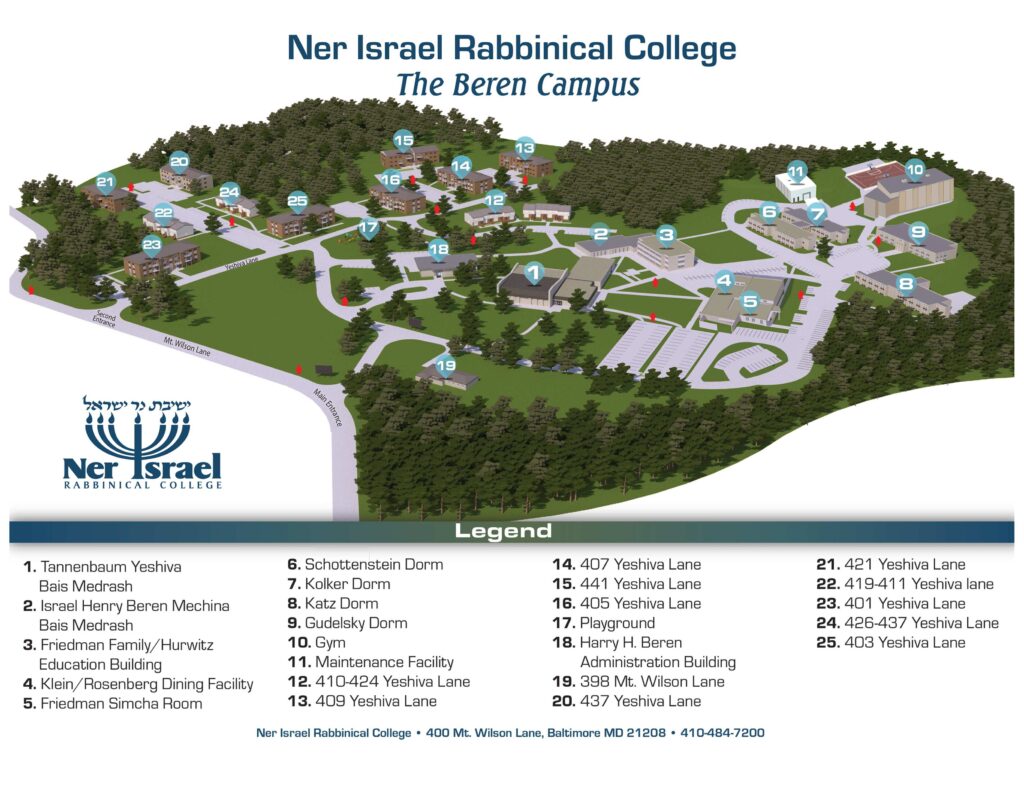
Ner Israel Rabbinical College is located in Pikesville, MD.
Admissions
Admissions at Ner Israel are best understood as a vetting process for religious commitment and academic readiness for Yeshiva life, rather than a competition over GPAs and test scores. The process is somewhat selective, with an of 66% based on 65 admissions from 99 applications. The college does not require SAT or ACT scores, and its published requirements focus squarely on alignment with its Orthodox Jewish mission. Applicants must submit a formal application (requestable by phone or email), a $100 fee, a photo, two letters of recommendation from their current rabbis, and an official high school transcript. Demonstrated interest is not a formal factor in admissions decisions. The primary gatekeepers are the letters from rabbinical mentors, which speak to the applicant's character, dedication to Torah study, and suitability for the intense, religiously-focused environment.
The academic model is a distinctive dual curriculum. The core and defining experience is the rigorous, immersive study of Talmud and Jewish law (Halacha) within the Yeshiva. Alongside this religious education, students can pursue accredited undergraduate degrees. The college offers a range of programs, including options in pre-medicine and pre-dentistry, business, and other fields, often described as providing 'many undergraduate and graduate degree options such as pre-med/dent, MBA amongst others.' A standout feature is a formal partnership with nearby Stevenson University designed to 'prepare students for graduate programs in health and medicine.' This collaboration provides Ner Israel students with a structured pathway to meet the science prerequisites for medical and dental school while maintaining their Yeshiva schedule. General education requirements exist but are tailored, with foreign language study required but math/science requirements not uniformly mandated for all students. The intellectual culture is one of deep textual analysis and debate, centered on religious scholarship first, with secular studies serving a complementary, career-preparatory role.
Life revolves almost entirely around the Yeshiva. With a total undergraduate enrollment of approximately 280 students, the community is intimate and all-enveloping. The campus is in Pikesville, Maryland, a suburb of Baltimore with a significant Orthodox Jewish community, which provides a supportive external environment. Housing is a central component of the experience, fostering a 24/7 religious and scholarly community. There are no traditional collegiate athletics or Greek life; instead, the rhythm of life is set by the daily prayer schedule, study sessions (seder), and observance of the Sabbath and Jewish holidays. Student reviews highlight the intense, focused atmosphere. Social and extracurricular life is built within this framework, through religious study groups, communal meals, and holiday celebrations. The partnership with Stevenson University also offers a portal to a more conventional campus setting for specific science coursework, but a student's primary identity and daily routine are rooted in the Ner Israel campus.
Outcomes reflect the dual-purpose mission of the college. A significant number of graduates continue into rabbinical roles, advanced Talmudic study (kollel), or Jewish education. For those pursuing secular careers, the data shows a strong return on investment. The median earnings ten years after entry are $66,330, a figure that compares favorably given the institution's . The first-year retention rate is a solid 80%, indicating students who enroll are generally committed to the unique program. The six-year graduation rate is 30%, a figure that must be interpreted in context: many students may extend their time in deep Talmudic study beyond the standard degree timeline or transfer to other Yeshivas. Earnings growth is notable, with reported earnings five years after graduation at $50,913. The college successfully prepares a cohort of students for high-earning professional fields like medicine, as evidenced by the Stevenson partnership and the strong median earnings figure.
The published full tuition for the 2025-2026 academic year is $23,600. However, the average —what students actually pay after grants and scholarships—is significantly lower. The college employs a need-sensitive financial aid model. Its official policy states that 'any student who is unable to pay full tuition may discuss his situation with the Financial Aid Administrator' and encourages filing the FAFSA. This indicates a case-by-case approach to making the Yeshiva education accessible. Aid likely comes from institutional funds, as the school is eligible for federal student aid programs and international student loans. Prospective students are advised to use the net price calculator and contact the financial aid office directly ([email protected]) to discuss their individual circumstances, as the gap between sticker price and net price can be substantial.
Ner Israel Rabbinical College stands out as a unique institution in American higher education: it is a premier Yeshiva that also functions as an accredited college. Its singularity lies in the seamless integration of two worlds. First, it is a fortress of traditional Orthodox Jewish scholarship, with an 85-year of producing rabbis, educators, and Torah scholars. Second, through innovative partnerships like the one with Stevenson University, it provides a legitimate, structured bridge for devout students to enter high-stakes secular professions like medicine and dentistry without compromising their religious education and observance. This dual-track model is not an afterthought but the core of its mission. It caters to a specific student—deeply religious, intellectually serious, and career-ambitious—offering a path almost nowhere else provides. The result is a small, intense community where the typical markers of college life are replaced by a total immersion in faith and learning, yet with a clear eye on professional and financial success in the wider world.
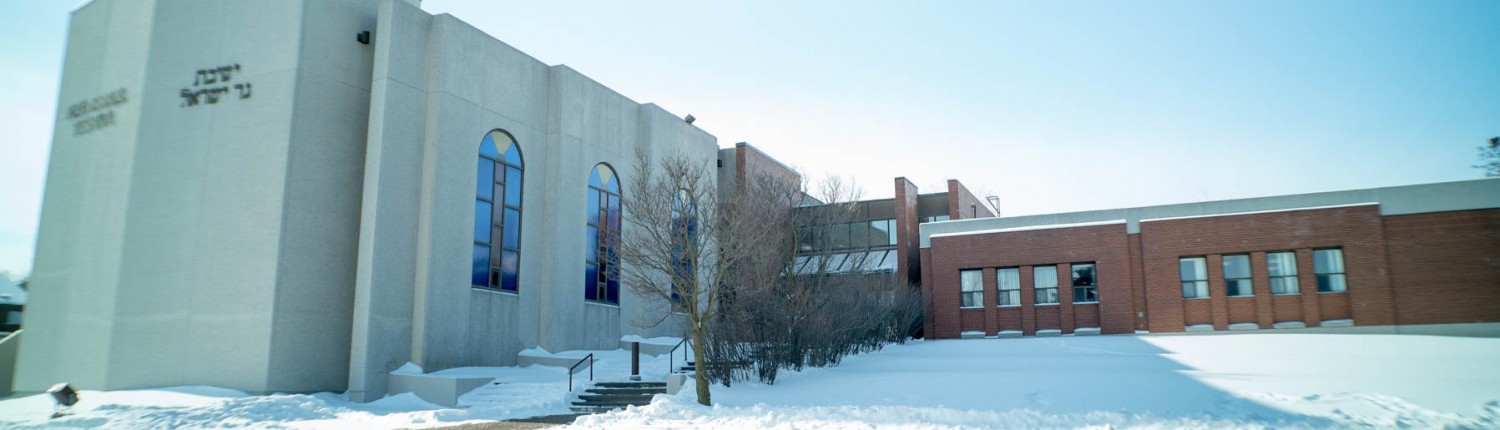
Ner Israel Rabbinical College seal · sourceNer Israel Rabbinical College - College Profile, Admissions & Programs | Cirkled In · sourceNer Yisroel Today - Ner Israel Rabbinical College · sourceNer Yisroel – Excellence in Higher Jewish Education · source