Loading…
← All schools
New Age Training
New York, NYprivate forprofitnewagetraining.com
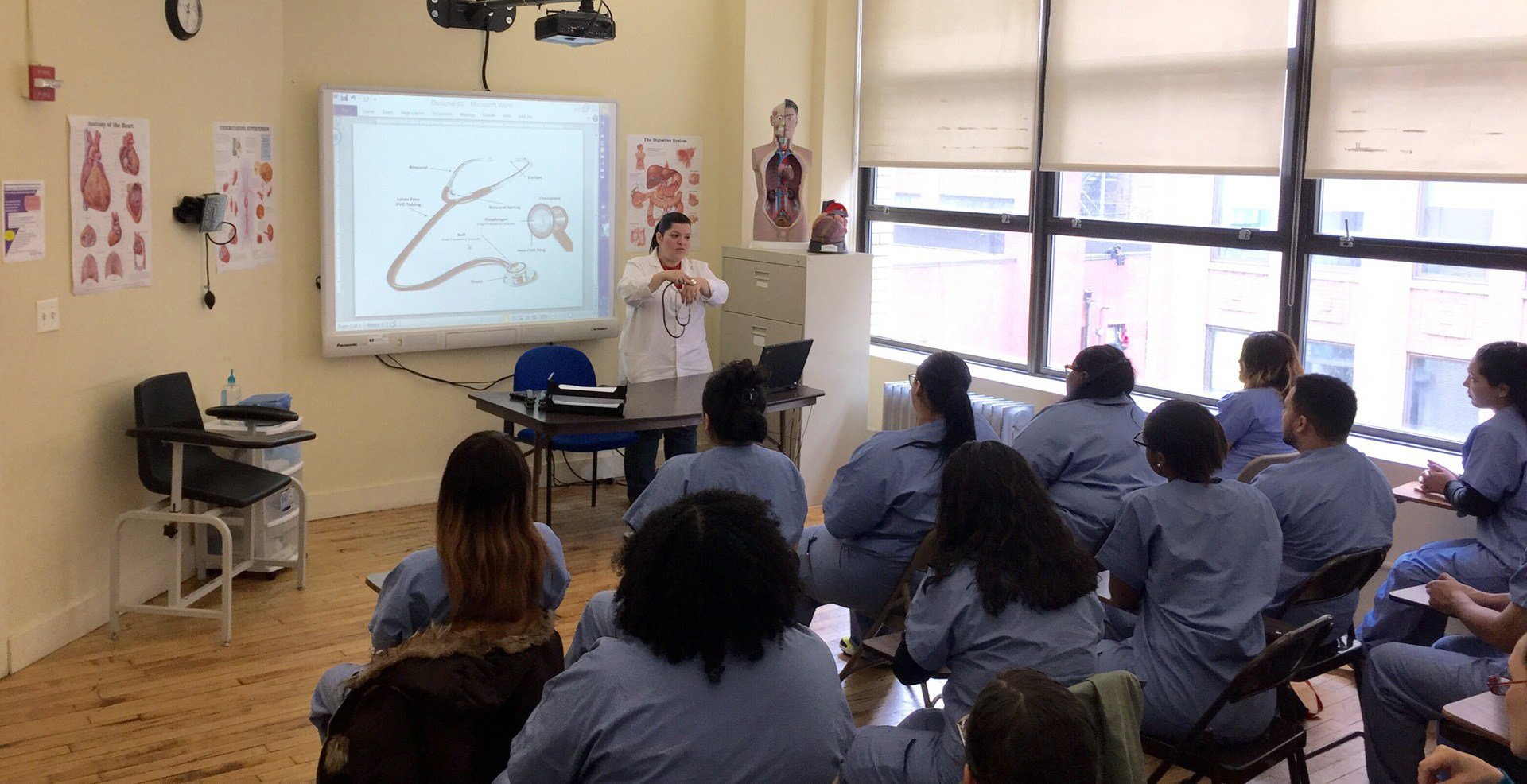
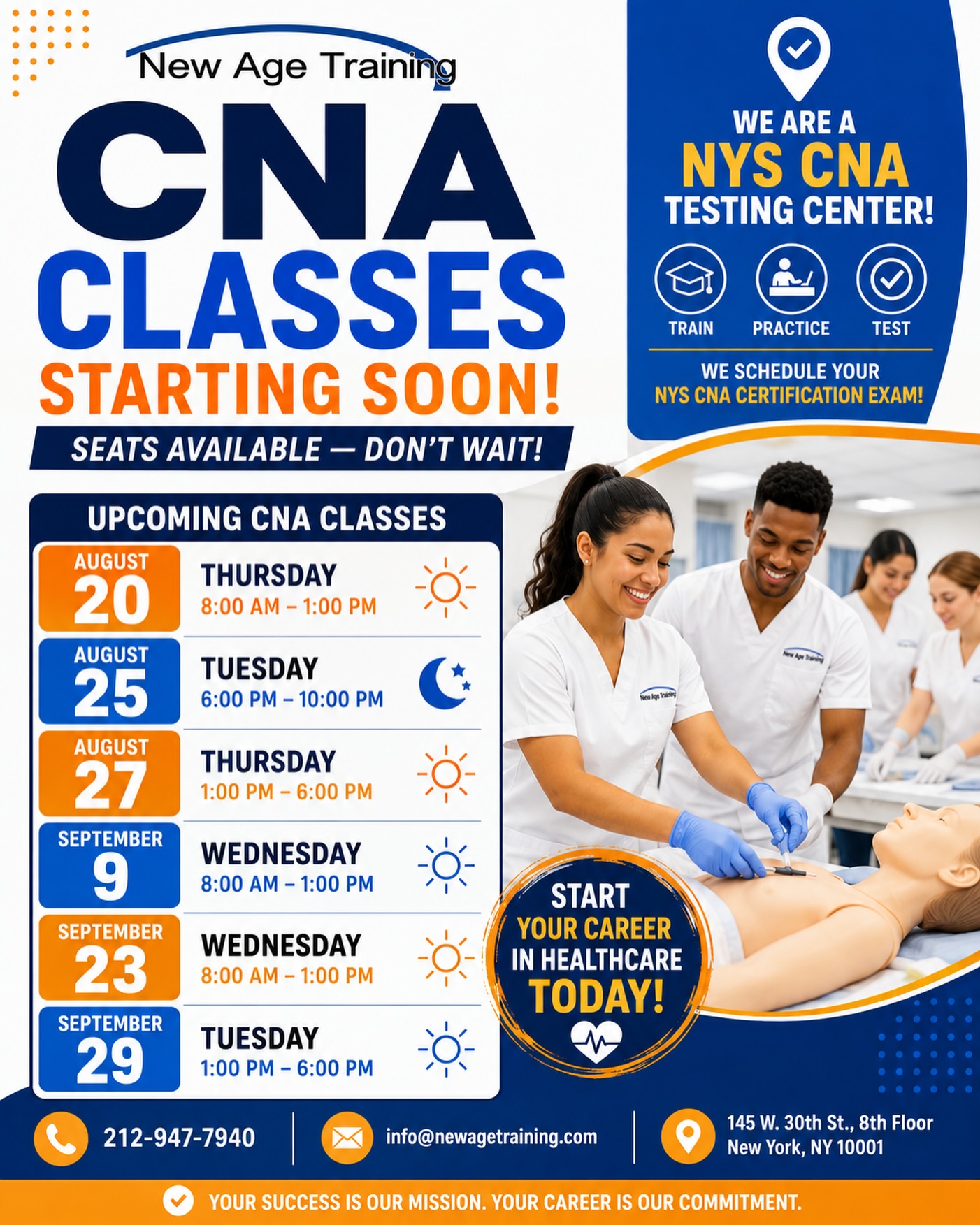
New Age Training is not a traditional university but a single-minded, accelerated career school in the heart of Manhattan, laser-focused on launching students into entry-level healthcare roles. Its entire identity is built around compressing practical, hands-on medical assistant and nursing aide training into a few intense months, with job placement assistance starting on day one. This is a school for career-changers and first-step seekers who want a fast, no-frills path to a clinical white coat.
More details
- Undergrad enrollment
- 187
- Location
- 145 W 30th St, 8th Floor, New York, NY
- Program Length
- ~9 months / 900 hours
- Graduation Rate
- 75%
- Single Major Offered
- Medical/Clinical Assistant
- Median Earnings (10yr)
- $31,997
Outcomes & value
Outcomes & value
- Median earnings (10 yr)
- $31,997
- Median debt at graduation
- $7,789
- Reducing loan balance (3 yr)
- 53%
- Pell (lower-income) share
- —
- First-gen share (among federal-aid recipients)
- 56%
Earnings = median of students working ~10 years after entry; debt = median of graduates. Value divides 10-yr earnings by one year’s net price — read it as earnings per dollar of annual cost, not a full lifetime ROI; it favors lower-cost schools. Source: U.S. Dept. of Education College Scorecard. Figures lag ~2 years and reflect all students, not your intended major.
Financial health
1.5 / 3.0Meets the federal financial-responsibility standard
U.S. Dept. of Education Financial Responsibility Composite Score (FY2022-23). Scale −1.0 to 3.0; ≥1.5 meets the standard. Reported for private nonprofit & for-profit institutions only — public universities are state-backed and not scored, so this is a stability signal, not a ranking.
Campus & location
Campus safety
- On-campus violent crimes (2024)
- 0
On-campus criminal offenses classed as violent (murder/non-negligent manslaughter, rape, robbery, aggravated assault) for the most recent reported year. Source: U.S. Dept. of Education Campus Safety and Security (Clery Act). Counts reflect what’s reported to the school, and urban campuses often report more partly due to non-student incidents nearby — read alongside campus size and setting, not as a standalone safety verdict.
Climate
- Pleasant days / yr
- 90
- Summer high
- 83°F
- Winter low
- 29°F
- Annual rain
- 54.4"
- Annual snow
- 18.3"
- Natural-hazard risk
- Relatively High
Pleasant days counts days per year with a mean temperature of 55–75°F, a high at or below 90°F, a low at or above 45°F, and little precipitation — a transparent comfort measure, not a weighting we invented. Computed from Open-Meteo ERA5 daily history (2019–2023). Natural-hazard risk is the county’s composite rating from the FEMA National Risk Index.
Quick answers
- How many undergraduates attend New Age Training?
- New Age Training enrolls approximately 187 undergraduate students.
- Where is New Age Training located?
- New Age Training is located in New York, NY.
Admissions
Admissions at New Age Training operates on an open-access model, fundamentally different from the selective gates of a traditional college. The school reports a 100% , reflecting a mission to provide career training to interested individuals rather than to curate a class based on academic pedigree. There is no available data on SAT/ACT requirements or high school GPA benchmarks, as the institution's focus is on vocational readiness. The application fee is $75. The enrolled student population is notably diverse, with 46.5% identifying as Black or African American, 37.4% as Hispanic or Latino, 4.81% as Asian, and 2.67% as White. The school does not publish a , and therefore factors like demonstrated interest, class rank, or recommendations are not defined in the same formalized way as at four-year institutions; the primary consideration appears to be an applicant's desire to pursue the specific healthcare careers offered.
Academics
Academic life is singular and concentrated: New Age Training offers exactly one program of study. Every student is training to become a Medical/Clinical Assistant, with an average of 196 students receiving this certificate annually. The curriculum is described as "VERY accelerated" by former students, packing approximately 900 total hours of training—including 650 classroom hours and a 250-hour externship—into a roughly 9-month timeframe. The instruction is intensely hands-on, focusing on proper technique and safety, and is designed to prepare students for specific national certification exams, including the Certified Clinical Medical Assistant (CCMA), Certified Phlebotomy Technician (CPT), and Certified EKG Technician (CET), as well as AHA BLS/CPR certification. Classes are small and intimate, with teachers noted as being "pretty good." The school's stated mission is to provide students with "all of the necessary skills and tools to pursue careers in" healthcare, and academic support services are geared entirely toward certification exam readiness, helping students review key course content and access extra practice materials.
Compare New Age Training
See colleges similar to New Age Training →Sources
- [PDF] Common Data Set 2024-2025 - The City College of New York
- Student Services & Other Resources - New Age Training
- Common Data Set: Home
- [PDF] Common Data Set 2023 – 2024 - Institutional Research and Analytics
- Decoding the Common Data Set What You Need to Know for Your ...
- Common Data Set - University Decision Support
- [PDF] catalog 2025 - New Age Training
- New Age Training - Niche
- New Age Training Admissions - BigFuture College Search
- [PDF] Policies & Procedures - New Age Training