Admit rate has ranged 80%–88% over the last 5 years — notably volatile. Source: IPEDS via Urban Institute.
Acceptance & SAT from Common Data Set / IPEDS; net price, earnings & graduation from the U.S. Dept. of Education College Scorecard. Figures lag ~1–2 years — verify with the school.
Nichols College is a small, AACSB-accredited business school in Dudley, Massachusetts, with a history stretching back to 1815, but its identity is firmly rooted in the present-day pragmatism of career preparation. The campus culture is built on collaboration and 'learning by doing,' with a sharp focus on turning out graduates who are ready to work. While its admissions are accessible, the experience is defined by personalized attention, a 16:1 student-faculty ratio, and a relentless emphasis on post-graduation success.
Admission requirements
Test-optional — scores considered if submitted
Required
High school transcript
Grade point average
Letters of recommendation
TOEFL (non-native English)
Considered (not required)
Test scores (SAT/ACT)
College-prep program
Source: IPEDS Admissions survey (2022) via Urban Institute. Covers formal factors only — it does not reflect essays, extracurriculars, or other holistic criteria.
More details
Undergrad enrollment
1,163
In-state tuition
$42,705
Out-of-state tuition
$42,705
Graduation Rate
63%
On-Campus Students
71%
Student-Faculty Ratio
16:1
Median Earnings (10yr)
$58,063
First-Year Retention Rate
72%
Post-Graduation Success Rate
95%
Average Financial Aid Package
$30,000
Students Receiving Grant/Scholarship Aid
98%
Outcomes & value
Outcomes & value
Median earnings (10 yr)
$58,063
Value (earnings ÷ net price)
1.8×
Median debt at graduation
$27,000
Graduation rate
63%
First-year retention
72%
Reducing loan balance (3 yr)
67%
Pell (lower-income) share
26%
First-gen share (among federal-aid recipients)
32%
Financial health
2.0 / 3.0Meets the federal financial-responsibility standard
U.S. Dept. of Education Financial Responsibility Composite Score (FY2022-23). Scale −1.0 to 3.0; ≥1.5 meets the standard. Reported for private nonprofit & for-profit institutions only — public universities are state-backed and not scored, so this is a stability signal, not a ranking.
Top-earning majors
Median earnings by field of study (highest credential), ~2 years after completion.
Business/Managerial Economics$55,964
Accounting and Related Services$51,169
Finance and Financial Management Services$50,717
Business Administration, Management and Operations$48,432
Marketing$46,478
Business/Commerce, General$45,956
Campus & location
Campus safety
On-campus violent crimes (2024)
6
Per 1,000 students
4.31
On-campus criminal offenses classed as violent (murder/non-negligent manslaughter, rape, robbery, aggravated assault) for the most recent reported year. Source: U.S. Dept. of Education Campus Safety and Security (Clery Act). Counts reflect what’s reported to the school, and urban campuses often report more partly due to non-student incidents nearby — read alongside campus size and setting, not as a standalone safety verdict.
Climate
Pleasant days / yr
91
Summer high
81°F
Winter low
24°F
Annual rain
50.1"
Annual snow
34"
Natural-hazard risk
Relatively Moderate
Pleasant days counts days per year with a mean temperature of 55–75°F, a high at or below 90°F, a low at or above 45°F, and little precipitation — a transparent comfort measure, not a weighting we invented. Computed from Open-Meteo ERA5 daily history (2019–2023). Natural-hazard risk is the county’s composite rating from the FEMA National Risk Index.
Deep dive — research, future-scholar output & economic mobility▾
Research output
Institutional h-index
37
Scholarly works
364
Institutional research volume and impact from OpenAlex. The h-index reflects large research universities and will be low for teaching-focused liberal-arts colleges — not a measure of undergraduate quality.
Economic mobility
Mobility rate
2.3%
Bottom → top quintile
52%
From bottom quintile
4%
Mobility rate = the share of students who both start in the bottom household-income quintile and reach the top quintile; bottom → top is that chance conditional on starting at the bottom. Source: Opportunity Insights Mobility Report Cards (Chetty, Friedman, Saez, Turner & Yagan). Reflects 1980–82 birth cohorts, so it’s directional, not current.
Quick answers
What is the acceptance rate at Nichols College?
Nichols College's acceptance rate is approximately 81% (Dudley, MA), based on the most recent figures we compiled from public and primary sources.
What SAT score do you need for Nichols College?
Admitted students at Nichols College typically score 1028–1236 on the SAT (the middle-50% range). Scores outside this band are still admitted, especially with strong applications.
How much does Nichols College cost?
At Nichols College, the average net price (after aid) is about $33,036 per year. Actual cost varies with financial aid and residency.
How many undergraduates attend Nichols College?
Nichols College enrolls approximately 1,163 undergraduate students.
Where is Nichols College located?
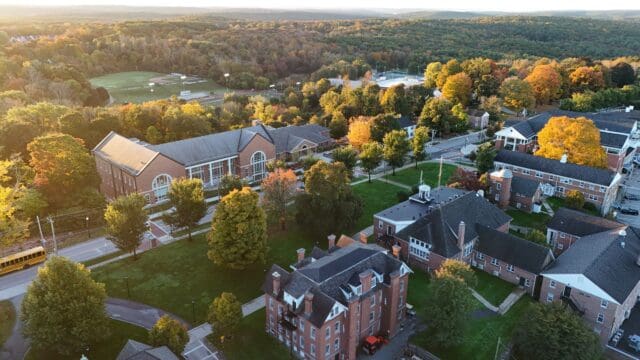
Nichols College is located in Dudley, MA.
Admissions
Nichols College operates with a straightforward, rolling admissions process that is notably transparent and fast-moving. The school is less selective, admitting a significant majority of its applicants. Admission decisions are promised within 10 days of a completed application, signaling an efficient, student-friendly approach. The college seeks students whose academic profile aligns with its strengths, with a middle 50% SAT range that reflects a broad academic preparedness. While the overall is high, there is a notable difference for students who apply early, with an early acceptance rate significantly higher than the regular decision pool. The admissions process does not appear to prioritize or heavily weigh demonstrated interest in the same way some highly selective institutions do, focusing instead on the applicant's academic record and readiness for its business-focused curriculum.
Rolling Decisions & Speed: The admissions office commits to providing a decision within 10 days of a completed application.
Selectivity Profile: The institution is characterized as "less selective" or "somewhat selective."
Early Decision Advantage: Students who apply via an early decision plan see a markedly higher chance of admission compared to the overall pool.
Earnings = median of students working ~10 years after entry; debt = median of graduates. Value divides 10-yr earnings by one year’s net price — read it as earnings per dollar of annual cost, not a full lifetime ROI; it favors lower-cost schools. Source: U.S. Dept. of Education College Scorecard. Figures lag ~2 years and reflect all students, not your intended major.
Criminal Justice and Corrections$39,729
Hospitality Administration/Management$38,289
Source: U.S. Dept. of Education College Scorecard (field-of-study earnings). Figures cover graduates who received federal aid and lag ~2 years; not all programs report data.
Academics at Nichols are unapologetically geared toward professional readiness, anchored by an AACSB-accredited business school—a mark of quality that fewer than 6% of the world's business programs achieve. The curriculum is built on a core that strengthens writing, research, and critical thinking, applied directly to market-driven majors. The most popular programs are in Business/Commerce, Sport Management, Psychology, and Marketing, with distinctive offerings like Criminal Psychology highlighting its interdisciplinary approach. The small size of the college is its greatest academic asset: a 16:1 student-faculty ratio and small class sizes enable close, mentoring relationships with professors. The pedagogy emphasizes "learning by doing," with opportunities for students to spend a semester building their own business. This is not a liberal arts college in the traditional sense; it's a professional training ground where collaboration and practical application are the cornerstones of the classroom experience.
Life on the wooded Dudley campus is intensely communal, with 71% of students living in college-owned, -operated, or -affiliated housing. The Office of Student Life orchestrates a full calendar of year-round events, traditions, and dozens of student clubs, all designed to foster connection and involvement from day one. The administration explicitly aims to cultivate an environment emphasizing equity, well-being, diverse perspectives, and inclusivity, with a dedicated Office of Student Belonging. This focus on a supportive, collaborative campus culture is a recurring theme, presented as integral to student success. The vibe is active and participatory rather than passive; students are expected to engage. The small size ensures that faces become familiar quickly, and the line between classroom and community is deliberately blurred, reinforcing the idea that professional development happens everywhere.
The entire Nichols proposition is validated by its outcomes. The college prominently advertises a 95% post-graduation success rate, framing its value explicitly around career launch. Federal data supports solid earning potential for graduates, with median earnings rising significantly in the years after graduation. The graduation rate itself is a point of institutional focus, described as "average" and placing Nichols in the top 40% nationally. First-year retention—a key indicator of student satisfaction and institutional support—stands at a healthy level. These numbers collectively paint a picture of a college that effectively shepherds its students through to degree completion and into the workforce with competitive financial prospects. The outcomes are the ultimate metric for a school built on the promise of return on investment.
Nichols College leverages financial aid aggressively to make its private education accessible. A overwhelming 98% of students receive financial aid through scholarships and grants that do not need to be repaid, with average aid packages reported at $30,000. This results in a significant reduction from the sticker price for most families. The college encourages all applicants to use its Calculator to estimate their individual cost. The financial aid policy is standard for institutions of its type, with eligibility tied to enrollment status. While the college does not advertise a "no-loan" policy or a commitment to meet 100% of demonstrated need without loans—a feature of wealthier, more endowed institutions—its high percentage of aided students and substantial average grant package indicate a concerted effort to provide merit and need-based discounts to attract and support its student body.
Nichols College stands out for its single-minded, no-nonsense focus on converting a college education into a career. It is not trying to be everything to everyone. Its identity is crystal clear: a small, AACSB-accredited business school where the professional preparation is hands-on, the faculty attention is personalized, and the proof is in the placement. The 16:1 ratio and "learning by doing" ethos aren't marketing slogans but the operational core. While it lacks the sprawling graduate programs or vast research infrastructure of a university, it offers something arguably more valuable to a certain student: clarity of purpose. The high early decision and 10-day decision turnaround reflect a confident, efficient institution that knows the students it wants and moves quickly to secure them. In a landscape of expensive uncertainty, Nichols bets everything on a transparent proposition—invest here, work hard here, and you will leave here ready to work.
Nichols College seal · sourceDirections to Nichols College | Campus Map & Parking Info · sourceNichols College - Profile, Rankings and Data | US News Best Colleges · sourceMap - Nicholls State University · source

.gif)