Loading…
← All schools
Northern Oklahoma College
Tonkawa, OKpublicwww.noc.edu/
Avg net price
$5,625
Earnings (10 yr)
$37,566
Acceptance & SAT from Common Data Set / IPEDS; net price, earnings & graduation from the U.S. Dept. of Education College Scorecard. Figures lag ~1–2 years — verify with the school.
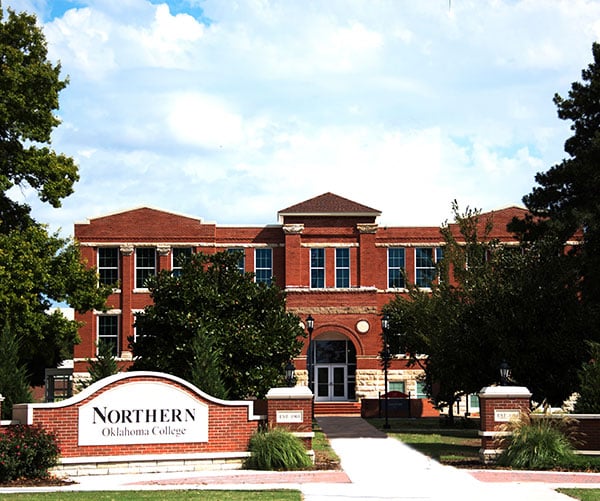
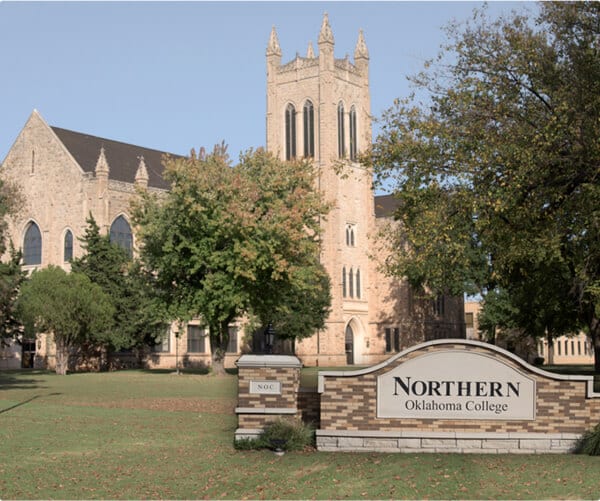
Northern Oklahoma College is a public, open-access community college in Tonkawa that serves as a pragmatic launchpad for a diverse student body—parents, full-time workers, first-generation students—seeking an affordable, supportive on-ramp to higher education. It’s less about selectivity and more about accessibility, offering a straightforward path to an associate degree with a focus on career-ready skills and transfer preparation. The vibe is unpretentious, student-centered, and community-focused, where campus life is built around academic support and simple, straightforward fun.
More details
- Undergrad enrollment
- 1,941
- In-state tuition
- $5,083
- Out-of-state tuition
- $12,202
- Student-Faculty Ratio
- 17:1
- Highest Degree Offered
- Associate
- Median Earnings (10yr)
- $37,566
- Placement Tests Required
- ACT/SAT (for course placement)
- First-Year Retention Rate
- 67%
- Percent Receiving Grant/Scholarship Aid
- 79%
Outcomes & value
Outcomes & value
- Median earnings (10 yr)
- $37,566
- Value (earnings ÷ net price)
- 6.7×
- Median debt at graduation
- $11,000
- Reducing loan balance (3 yr)
- 45%
- Pell (lower-income) share
- 34%
- First-gen share (among federal-aid recipients)
- 41%
Earnings = median of students working ~10 years after entry; debt = median of graduates. Value divides 10-yr earnings by one year’s net price — read it as earnings per dollar of annual cost, not a full lifetime ROI; it favors lower-cost schools. Source: U.S. Dept. of Education College Scorecard. Figures lag ~2 years and reflect all students, not your intended major.
Campus & location
Campus safety
- On-campus violent crimes (2024)
- 10
On-campus criminal offenses classed as violent (murder/non-negligent manslaughter, rape, robbery, aggravated assault) for the most recent reported year. Source: U.S. Dept. of Education Campus Safety and Security (Clery Act). Counts reflect what’s reported to the school, and urban campuses often report more partly due to non-student incidents nearby — read alongside campus size and setting, not as a standalone safety verdict.
Climate
- Pleasant days / yr
- 75
- Summer high
- 91°F
- Winter low
- 30°F
- Annual rain
- 32.5"
- Annual snow
- 7.6"
- Natural-hazard risk
- Relatively Low
Pleasant days counts days per year with a mean temperature of 55–75°F, a high at or below 90°F, a low at or above 45°F, and little precipitation — a transparent comfort measure, not a weighting we invented. Computed from Open-Meteo ERA5 daily history (2019–2023). Natural-hazard risk is the county’s composite rating from the FEMA National Risk Index.
Deep dive — research, future-scholar output & economic mobility
Research output
- Institutional h-index
- 9
- Scholarly works
- 37
Institutional research volume and impact from OpenAlex. The h-index reflects large research universities and will be low for teaching-focused liberal-arts colleges — not a measure of undergraduate quality.
Economic mobility
- Mobility rate
- 1.4%
- Bottom → top quintile
- 10%
- From bottom quintile
- 14%
Mobility rate = the share of students who both start in the bottom household-income quintile and reach the top quintile; bottom → top is that chance conditional on starting at the bottom. Source: Opportunity Insights Mobility Report Cards (Chetty, Friedman, Saez, Turner & Yagan). Reflects 1980–82 birth cohorts, so it’s directional, not current.
Quick answers
- How much does Northern Oklahoma College cost?
- At Northern Oklahoma College, the average net price (after aid) is about $5,625 per year. Actual cost varies with financial aid and residency.
- How many undergraduates attend Northern Oklahoma College?
- Northern Oklahoma College enrolls approximately 1,941 undergraduate students.
- Where is Northern Oklahoma College located?
- Northern Oklahoma College is located in Tonkawa, OK.
Admissions
Northern Oklahoma College operates on an open admissions policy, meaning virtually all applicants who meet basic requirements are admitted. Sources indicate an of 100%, reflecting its mission of broad accessibility. The process is straightforward: applicants must submit an online application and placement test results (ACT or SAT scores), which are required for course placement for all incoming freshmen. There is no mention of an Early Decision program or that demonstrated interest is a considered factor in admissions decisions, aligning with its open-access nature. The college serves a high proportion of non-traditional students, including working adults and college-goers, for whom the barrier to entry is intentionally low.
Academics
NOC is exclusively a two-year institution, offering three types of associate degrees: Associate in Arts, Associate in Science, and Associate in Applied Science. The academic structure uses 'Meta Majors' to help students choose a general area of study, such as STEM, Social Sciences, or Arts/Humanities, before declaring a specific program. The student-to-faculty ratio is reported as 17-to-1, suggesting the potential for more personalized attention than at larger institutions. The college markets itself as providing the 'same high-quality education you'll find at four-year institutions' but within a more engaging and supportive learning environment designed to help students translate coursework into real-world skills. Program offerings are career-focused, with the Associate in Applied Science degrees geared toward direct workforce entry.
Compare Northern Oklahoma College
vs University of Puerto Ricovs Alcorn State Universityvs Louisiana State University-Shreveportvs Florida Polytechnic University
See colleges similar to Northern Oklahoma College →Sources
- Common Data Set Explorer 2026: Compare 100 Colleges
- Common Data Set 2022-2023 - Administration Offices
- The University of Oklahoma Common Data Set 2025-2026
- Common Data Set: Home
- Common Data Set Repository
- Is there a common data set for graduate schools?
- ACT | Northern Oklahoma College
- Northern Oklahoma College
- Admissions | Northern Oklahoma College
- Northern Oklahoma College - Tuition and Acceptance Rate
- Northern Oklahoma College SAT Scores, ACT ...