Admit rate has ranged 70%–79% over the last 5 years — notably volatile. Source: IPEDS via Urban Institute.
Acceptance & SAT from Common Data Set / IPEDS; net price, earnings & graduation from the U.S. Dept. of Education College Scorecard. Figures lag ~1–2 years — verify with the school.
Oklahoma City University (OCU) is a private liberal arts university with a surprisingly accessible admissions process (77% acceptance rate) and a strong emphasis on the performing arts, health professions, and business. Its tight-knit campus culture thrives on Greek life and proximity to Oklahoma City's vibrant neighborhoods, while its 11:1 student-faculty ratio ensures close mentorship. OCU stands out for aggressively discounting its $55K sticker price—99% of students receive aid, bringing the average net cost down to $23K.
Admission requirements
Test-optional — scores considered if submitted
Required
High school transcript
Grade point average
Letters of recommendation
TOEFL (non-native English)
Considered (not required)
Class rank
Test scores (SAT/ACT)
Source: IPEDS Admissions survey (2022) via Urban Institute. Covers formal factors only — it does not reflect essays, extracurriculars, or other holistic criteria.
More details
Undergrad enrollment
1,514
In-state tuition
$35,648
Out-of-state tuition
$35,648
Location
Urban (Oklahoma City neighborhoods)
Top Majors
Performing Arts, Health Professions, Business
Student-Faculty Ratio
11:1
4-Year Graduation Rate
50%
Greek Life Participation
Significant (core to social life)
Outcomes & value
Outcomes & value
Median earnings (10 yr)
$54,655
Value (earnings ÷ net price)
2.4×
Median debt at graduation
$20,835
Graduation rate
65%
First-year retention
84%
Reducing loan balance (3 yr)
72%
Pell (lower-income) share
24%
First-gen share (among federal-aid recipients)
27%
Top-earning majors
Median earnings by field of study (highest credential), ~2 years after completion.
Registered Nursing, Nursing Administration, Nursing Research and Clinical Nursing$63,898
Liberal Arts and Sciences, General Studies and Humanities$39,009
Teacher Education and Professional Development, Specific Subject Areas$32,925
Music$25,194
Drama/Theatre Arts and Stagecraft$24,421
Dance
Campus & location
Campus safety
On-campus violent crimes (2024)
5
Per 1,000 students
1.69
On-campus criminal offenses classed as violent (murder/non-negligent manslaughter, rape, robbery, aggravated assault) for the most recent reported year. Source: U.S. Dept. of Education Campus Safety and Security (Clery Act). Counts reflect what’s reported to the school, and urban campuses often report more partly due to non-student incidents nearby — read alongside campus size and setting, not as a standalone safety verdict.
Climate
Pleasant days / yr
82
Summer high
91°F
Winter low
33°F
Annual rain
36.7"
Annual snow
7.7"
Natural-hazard risk
Relatively High
Pleasant days counts days per year with a mean temperature of 55–75°F, a high at or below 90°F, a low at or above 45°F, and little precipitation — a transparent comfort measure, not a weighting we invented. Computed from Open-Meteo ERA5 daily history (2019–2023). Natural-hazard risk is the county’s composite rating from the FEMA National Risk Index.
Deep dive — research, future-scholar output & economic mobility▾
Research output
Institutional h-index
179
Scholarly works
5,985
Institutional research volume and impact from OpenAlex. The h-index reflects large research universities and will be low for teaching-focused liberal-arts colleges — not a measure of undergraduate quality.
Economic mobility
Mobility rate
1.5%
Bottom → top quintile
21%
From bottom quintile
7%
Mobility rate = the share of students who both start in the bottom household-income quintile and reach the top quintile; bottom → top is that chance conditional on starting at the bottom. Source: Opportunity Insights Mobility Report Cards (Chetty, Friedman, Saez, Turner & Yagan). Reflects 1980–82 birth cohorts, so it’s directional, not current.
Quick answers
What is the acceptance rate at Oklahoma City University?
Oklahoma City University's acceptance rate is approximately 77% (Oklahoma City, OK), based on the most recent figures we compiled from public and primary sources.
What SAT score do you need for Oklahoma City University?
Admitted students at Oklahoma City University typically score 1050–1260 on the SAT (the middle-50% range). Scores outside this band are still admitted, especially with strong applications.
How much does Oklahoma City University cost?
At Oklahoma City University, the average net price (after aid) is about $22,857 per year. Actual cost varies with financial aid and residency.
How many undergraduates attend Oklahoma City University?
Oklahoma City University enrolls approximately 1,514 undergraduate students.
Where is Oklahoma City University located?
Oklahoma City University is located in Oklahoma City, OK.
Admissions
With a 77% acceptance rate, Oklahoma City University is one of the more accessible private universities in the region, admitting roughly 3 out of 4 applicants. since at least 2024, OCU reports middle-50% ranges of 1040–1300 SAT and 21–27 ACT scores for those who submit them. The university draws a geographically diverse student body, with undergraduates from 45 states and 36 countries, though its total enrollment remains modest at 1,400 undergrads and an equal number of graduate students. Notably, OCU practices rolling admissions with no strict application deadline, offering flexibility for late deciders.
Earnings = median of students working ~10 years after entry; debt = median of graduates. Value divides 10-yr earnings by one year’s net price — read it as earnings per dollar of annual cost, not a full lifetime ROI; it favors lower-cost schools. Source: U.S. Dept. of Education College Scorecard. Figures lag ~2 years and reflect all students, not your intended major.
$20,824
Source: U.S. Dept. of Education College Scorecard (field-of-study earnings). Figures cover graduates who received federal aid and lag ~2 years; not all programs report data.
OCU bills itself as a top liberal arts and sciences university, offering 70+ undergraduate majors and 20 graduate programs, including niche offerings like a PhD in Nursing and performance-focused degrees through its acclaimed Wanda L. Bass School of Music. The most popular majors cluster in three areas:
Visual and Performing Arts (a particular strength, with ties to OKC’s thriving arts scene)
Health Professions (notably nursing and physical therapy, the latter boasting a 100% licensure exam pass rate for recent cohorts)
Business and Management
With an 11:1 student-faculty ratio, classes skew small, and the university emphasizes mentorship. Its Adult Studies Program caters to working professionals with flexible scheduling.
Life at OCU orbits around Greek life (which emphasizes leadership, scholarship, and philanthropy) and the energy of Oklahoma City’s downtown districts, just minutes from campus. Key traits:
68% of students live on campus, creating a residential vibe
Active intramural sports scene complements varsity athletics (the Stars compete in NAIA)
Proximity to OKC’s music venues, museums, and Bricktown entertainment district blurs town-gown boundaries
Fraternities and sororities anchor social life, with chapters committed to community service (one student notes they ‘host social events and provide opportunities for community involvement’)
OCU’s 4-year graduation rate sits at 50%, rising to 63% over six years—solid for a regional private university, though below elite benchmarks. Career outcomes vary by program:
Physical therapy graduates excel, with 96.5% licensure pass rates (Class of 2023)
The university reports $26,838 average grant aid, reducing financial strain
Forbes estimates mid-career alumni salaries around $45,408, though discipline-specific data is sparse
Transfer students graduate at lower rates, per federal data, suggesting OCU thrives most with traditional undergrads who engage early with support services.
The average net price drops to $23,143 after grants and scholarships
The university awards $34+ million annually in merit and performance scholarships
Notably, OCU provides a Net Price Calculator to demystify costs, and its aid packages lean heavily on grants rather than loans. For context, the average aid package totals $29,548, making OCU far more affordable than its private peers—if you qualify for merit awards.
OCU punches above its weight in performing arts and health sciences, leveraging Oklahoma City’s cultural assets (like the OKC Philharmonic) for real-world training. Its test-optional policy and high aid awards make private education accessible to mid-tier students, while the 11:1 faculty ratio ensures mentorship rare at similarly priced institutions. The campus vibe blends Greek life traditions with urban energy—think jazz majors jamming in practice rooms by day, then catching indie shows in the Plaza District by night. For students seeking a small-college feel with big-city perks, OCU delivers—provided they maximize its generous scholarships.
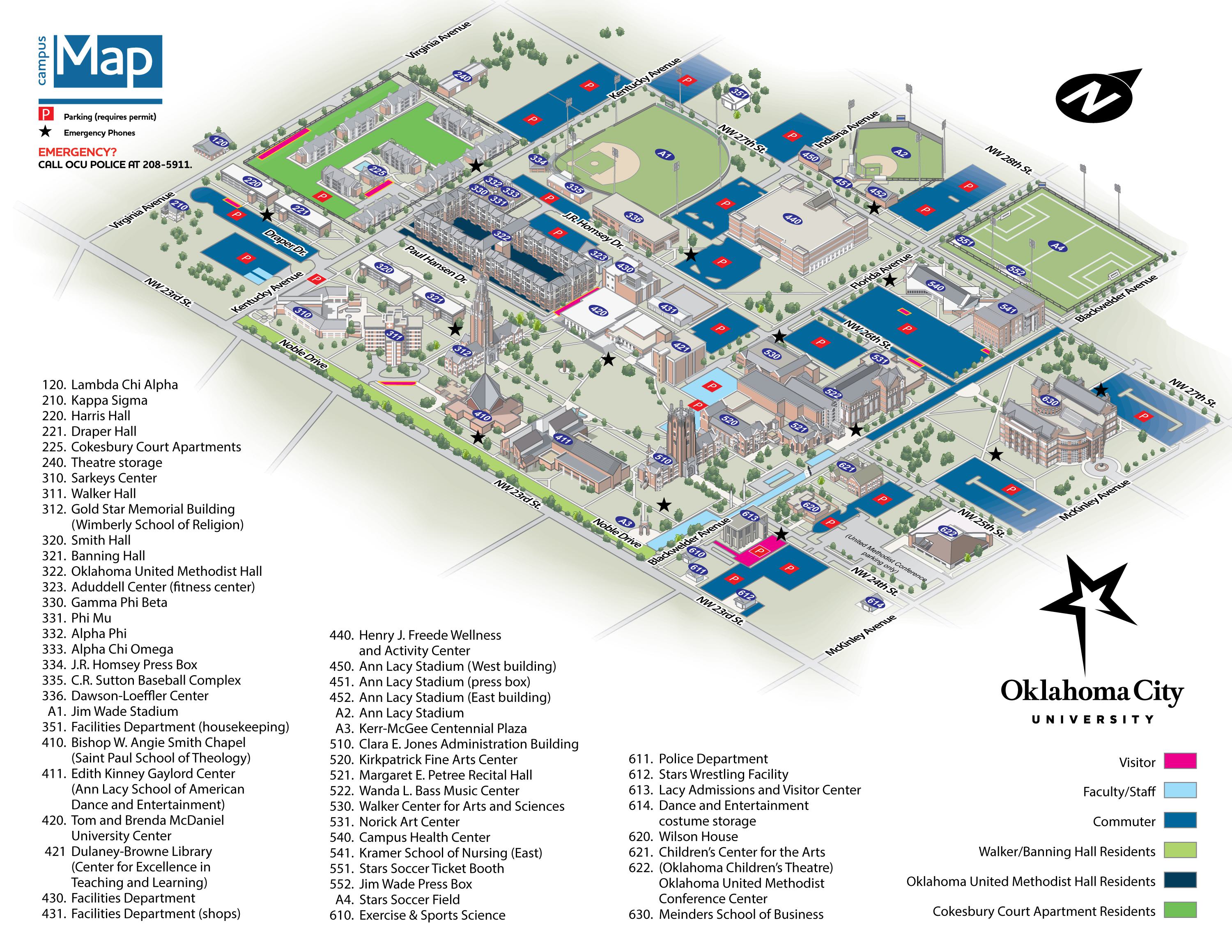
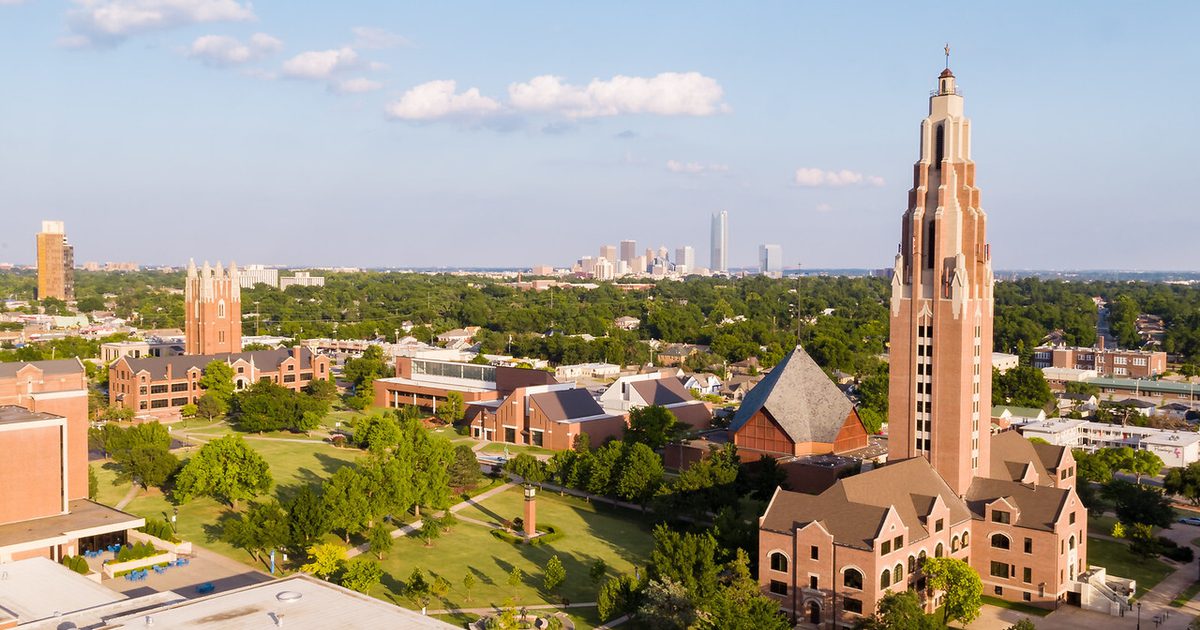
Oklahoma City University logo · sourceOklahoma City University | Visit Oklahoma City University · sourceOklahoma City University | Map · sourceOklahoma City University | Educating OKC Since 1904 · source
.jpg?width=1600)