Loading…
← All schools
Orange Technical College-South Campus
Orlando, FLpublicwww.orangetechcollege.net/
Avg net price
$9,215
Earnings (10 yr)
$33,350
Acceptance & SAT from Common Data Set / IPEDS; net price, earnings & graduation from the U.S. Dept. of Education College Scorecard. Figures lag ~1–2 years — verify with the school.
Orange Technical College-South Campus is a no-frills, high-access trade school in Orlando that operates with the direct, practical ethos of a workforce pipeline. It’s where you go not for a traditional college experience, but to get certified, get skilled, and get to work—fast. The campus buzzes with activity focused on transportation, logistics, and advanced manufacturing, serving a student body where the vast majority are part-timers fitting education around their lives.
More details
- Undergrad enrollment
- 1,124
- Faculty Ratio
- 14 to 1
- Graduation Rate (2yr)
- 34%
- Graduation Rate (3yr)
- 47%
- Median Earnings (10yr)
- $33,350
- Federal Grant Recipients
- 74%
Outcomes & value
Outcomes & value
- Median earnings (10 yr)
- $33,350
- Value (earnings ÷ net price)
- 3.6×
- Pell (lower-income) share
- 9%
- First-gen share (among federal-aid recipients)
- 44%
Earnings = median of students working ~10 years after entry; debt = median of graduates. Value divides 10-yr earnings by one year’s net price — read it as earnings per dollar of annual cost, not a full lifetime ROI; it favors lower-cost schools. Source: U.S. Dept. of Education College Scorecard. Figures lag ~2 years and reflect all students, not your intended major.
Campus & location
Campus safety
- On-campus violent crimes (2024)
- 0
On-campus criminal offenses classed as violent (murder/non-negligent manslaughter, rape, robbery, aggravated assault) for the most recent reported year. Source: U.S. Dept. of Education Campus Safety and Security (Clery Act). Counts reflect what’s reported to the school, and urban campuses often report more partly due to non-student incidents nearby — read alongside campus size and setting, not as a standalone safety verdict.
Climate
- Pleasant days / yr
- 129
- Summer high
- 89°F
- Winter low
- 55°F
- Annual rain
- 72.4"
- Natural-hazard risk
- Relatively High
Pleasant days counts days per year with a mean temperature of 55–75°F, a high at or below 90°F, a low at or above 45°F, and little precipitation — a transparent comfort measure, not a weighting we invented. Computed from Open-Meteo ERA5 daily history (2019–2023). Natural-hazard risk is the county’s composite rating from the FEMA National Risk Index.
Quick answers
- How much does Orange Technical College-South Campus cost?
- At Orange Technical College-South Campus, the average net price (after aid) is about $9,215 per year. Actual cost varies with financial aid and residency.
- How many undergraduates attend Orange Technical College-South Campus?
- Orange Technical College-South Campus enrolls approximately 1,124 undergraduate students.
- Where is Orange Technical College-South Campus located?
- Orange Technical College-South Campus is located in Orlando, FL.
Admissions
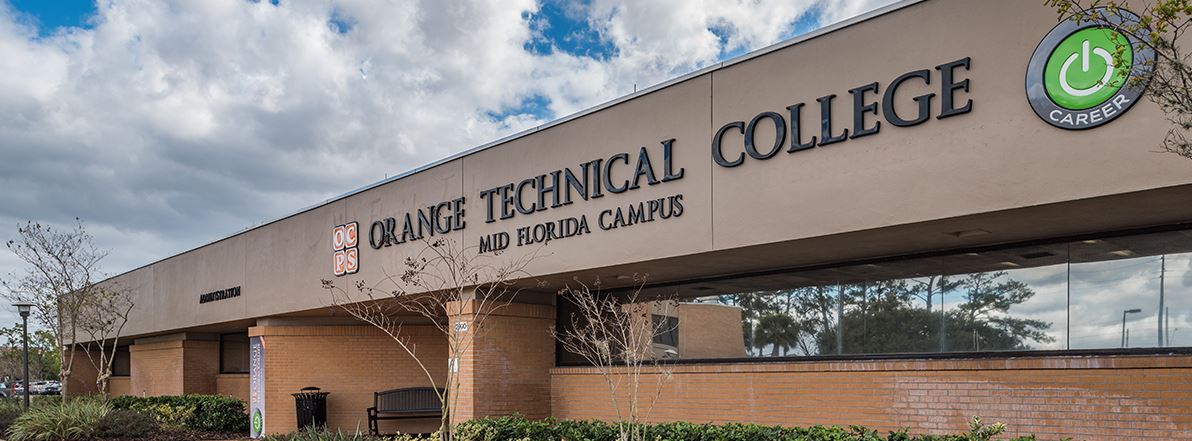
Admissions at Orange Technical College-South Campus is designed for accessibility, not selectivity. The process is straightforward, centered on providing assistance with registration, career information, and aptitude assessments rather than crafting a competitive applicant profile. While specific for the South Campus are not detailed in the provided sources, data for its sister campus suggests an open-access model, with the Orange Technical College - Mid-Florida Campus reporting a 100% acceptance rate. The school's total enrollment was 3,608 students in 2024, though only 383 of those were full-time—a clear indicator that this institution serves a population primarily seeking part-time, career-focused training. All new students are required to complete a New Student Orientation covering campus policies, conduct, safety, and resources.
Academics
The academic mission is unambiguous: equip students with real-world skills and industry credentials for meaningful careers. Programs are concentrated in high-demand technical fields, with a particular emphasis on transportation, logistics, and advanced manufacturing. The school offers credentials up to the level of "at least 2, but less than 4 academic yrs," primarily focusing on associate degrees and certificates. A faculty-to-student ratio of 14 to 1 suggests the potential for more direct instruction in technical settings. Beyond its core career training programs, the campus also hosts a range of foundational offerings, including ESOL classes, GED preparation, and CTE Adult Education, reflecting a commitment to serving the broader Orlando community at multiple entry points.
Compare Orange Technical College-South Campus
vs Florida Polytechnic Universityvs University of Virginia's College at Wisevs University of Arkansas at Pine Bluffvs University of Puerto Rico at Cayey
See colleges similar to Orange Technical College-South Campus →Sources
- Orange Technical College-South Campus
- Admissions Home
- Orange Technical College-South Campus Student Distribution Data
- OTC South Campus
- Student Data Disclosure
- Admissions
- Orange Technical College-South Campus
- Orange Technical College-South Campus
- Orange Technical College-East Campus - Institution Data Profile
- Orange Technical College - OTC HOME
- Orange Technical College-South Campus College Degrees Details