Admit rate has ranged 61%–74% over the last 5 years — notably volatile. Source: IPEDS via Urban Institute.
Acceptance & SAT from Common Data Set / IPEDS; net price, earnings & graduation from the U.S. Dept. of Education College Scorecard. Figures lag ~1–2 years — verify with the school.
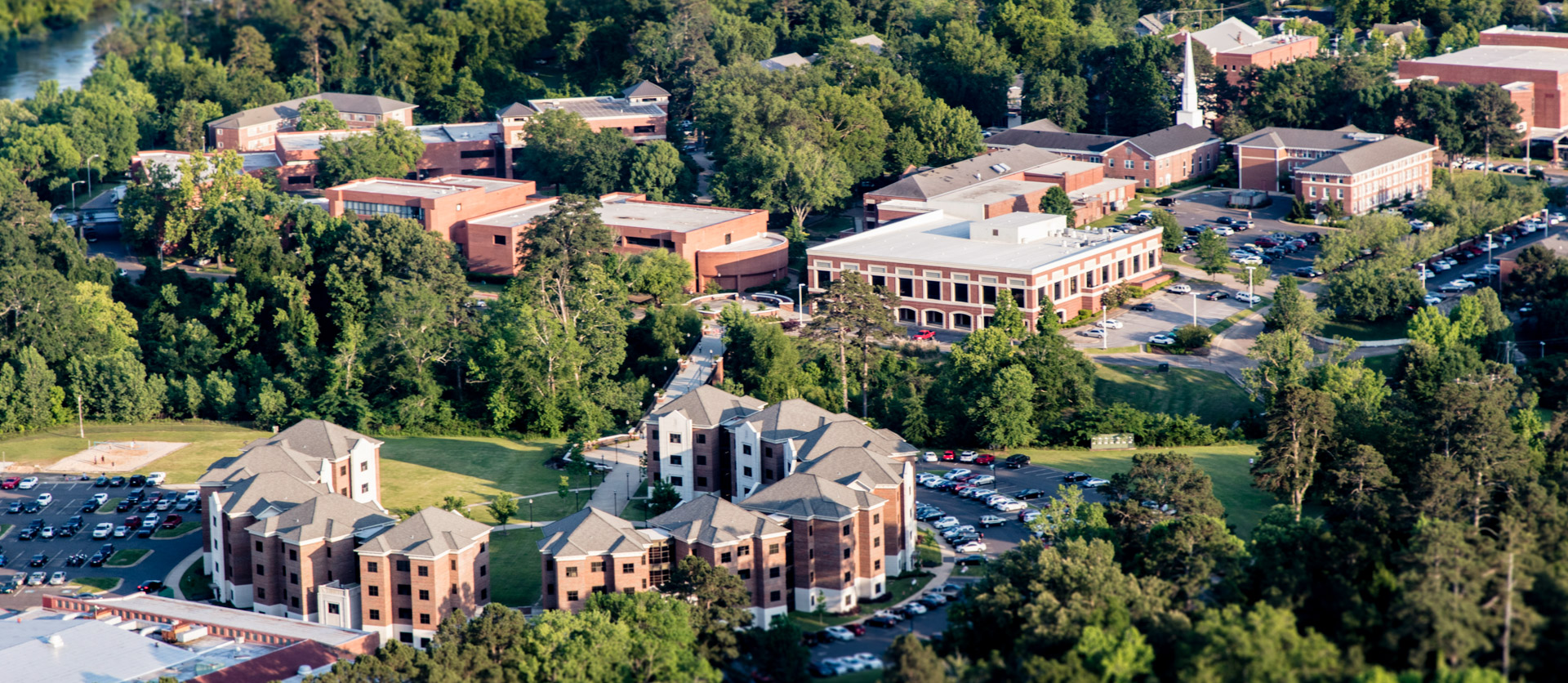
Ouachita Baptist University carves out a distinct identity as a small, residential Christian liberal arts college in Arkadelphia, Arkansas, where faith, community, and tradition are woven into the fabric of daily life. Its character is defined by a tight-knit, on-campus culture—over 90% of students live in university housing—and a unique system of longstanding social clubs that replace national Greek life. While offering a broad curriculum across eight schools, Ouachita maintains a notably personal scale with a 13:1 student-to-faculty ratio, fostering close mentorship within a Baptist framework.
Admission requirements
Test-optional — scores considered if submitted
Required
High school transcript
TOEFL (non-native English)
Considered (not required)
Grade point average
Class rank
Letters of recommendation
Test scores (SAT/ACT)
Source: IPEDS Admissions survey (2022) via Urban Institute. Covers formal factors only — it does not reflect essays, extracurriculars, or other holistic criteria.
More details
Undergrad enrollment
1,602
In-state tuition
$34,500
Out-of-state tuition
$34,500
No-Loan Policy
No policy indicated
Meets Full Need
No policy indicated
On-Campus Housing
93%
Demonstrated Interest
Not considered
Early Decision/Action
Offered
Median Earnings (10yr)
$51,673
Six-Year Graduation Rate
64%
Student-to-Faculty Ratio
13:1
First-Year Retention Rate
78%
Outcomes & value
Outcomes & value
Median earnings (10 yr)
$51,673
Value (earnings ÷ net price)
2.3×
Median debt at graduation
$21,050
Graduation rate
61%
First-year retention
83%
Reducing loan balance (3 yr)
69%
Pell (lower-income) share
23%
First-gen share (among federal-aid recipients)
24%
Financial health
2.6 / 3.0Meets the federal financial-responsibility standard
U.S. Dept. of Education Financial Responsibility Composite Score (FY2022-23). Scale −1.0 to 3.0; ≥1.5 meets the standard. Reported for private nonprofit & for-profit institutions only — public universities are state-backed and not scored, so this is a stability signal, not a ranking.
Top-earning majors
Median earnings by field of study (highest credential), ~2 years after completion.
Finance and Financial Management Services$44,776
Teacher Education and Professional Development, Specific Levels and Methods$37,748
Communication and Media Studies$37,208
Design and Applied Arts$37,208
Management Sciences and Quantitative Methods$36,726
Music
Campus & location
Campus safety
On-campus violent crimes (2024)
0
Per 1,000 students
0.00
On-campus criminal offenses classed as violent (murder/non-negligent manslaughter, rape, robbery, aggravated assault) for the most recent reported year. Source: U.S. Dept. of Education Campus Safety and Security (Clery Act). Counts reflect what’s reported to the school, and urban campuses often report more partly due to non-student incidents nearby — read alongside campus size and setting, not as a standalone safety verdict.
Climate
Pleasant days / yr
80
Summer high
92°F
Winter low
38°F
Annual rain
56"
Annual snow
2.4"
Natural-hazard risk
Very Low
Pleasant days counts days per year with a mean temperature of 55–75°F, a high at or below 90°F, a low at or above 45°F, and little precipitation — a transparent comfort measure, not a weighting we invented. Computed from Open-Meteo ERA5 daily history (2019–2023). Natural-hazard risk is the county’s composite rating from the FEMA National Risk Index.
Deep dive — research, future-scholar output & economic mobility▾
Research output
Institutional h-index
44
Scholarly works
625
Institutional research volume and impact from OpenAlex. The h-index reflects large research universities and will be low for teaching-focused liberal-arts colleges — not a measure of undergraduate quality.
Economic mobility
Mobility rate
2.4%
Bottom → top quintile
26%
From bottom quintile
9%
Mobility rate = the share of students who both start in the bottom household-income quintile and reach the top quintile; bottom → top is that chance conditional on starting at the bottom. Source: Opportunity Insights Mobility Report Cards (Chetty, Friedman, Saez, Turner & Yagan). Reflects 1980–82 birth cohorts, so it’s directional, not current.
Quick answers
What is the acceptance rate at Ouachita Baptist University?
Ouachita Baptist University's acceptance rate is approximately 68% (Arkadelphia, AR), based on the most recent figures we compiled from public and primary sources.
What SAT score do you need for Ouachita Baptist University?
Admitted students at Ouachita Baptist University typically score 1070–1280 on the SAT (the middle-50% range). Scores outside this band are still admitted, especially with strong applications.
How much does Ouachita Baptist University cost?
At Ouachita Baptist University, the average net price (after aid) is about $22,409 per year. Actual cost varies with financial aid and residency.
How many undergraduates attend Ouachita Baptist University?
Ouachita Baptist University enrolls approximately 1,602 undergraduate students.
Where is Ouachita Baptist University located?
Ouachita Baptist University is located in Arkadelphia, AR.
Admissions
Ouachita Baptist University operates with a moderately selective admissions process, offering a pathway for a broad range of academically prepared students. The university reports a rate—the percentage of admitted students who enroll—of approximately 29% to 35%, indicating that many admitted students choose other options. For the class entering in recent cycles, the middle 50% of admitted students who submitted test scores had an SAT range of 1070–1280 and an ACT range of 22–28. The university states minimum admission criteria of a 3.0 GPA on a 4.0 scale paired with a minimum ACT composite score of 20 or an SAT score of 1030. Ouachita offers both Early Action and Early Decision application options, though specific for these plans are not detailed in the provided sources. The admissions office does not appear to track or consider demonstrated interest as a formal factor in its evaluation process, focusing instead on academic credentials.
Earnings = median of students working ~10 years after entry; debt = median of graduates. Value divides 10-yr earnings by one year’s net price — read it as earnings per dollar of annual cost, not a full lifetime ROI; it favors lower-cost schools. Source: U.S. Dept. of Education College Scorecard. Figures lag ~2 years and reflect all students, not your intended major.
$28,598
Teacher Education and Professional Development, Specific Subject Areas$27,439
Sports, Kinesiology, and Physical Education/Fitness$25,967
Source: U.S. Dept. of Education College Scorecard (field-of-study earnings). Figures cover graduates who received federal aid and lag ~2 years; not all programs report data.
Ouachita structures its academic offerings into eight distinct schools: Business, Christian Studies, Education, Performing Arts, Humanities, Natural Sciences, and Social Sciences. The university provides over 60 academic programs, with popular majors for recent graduates heavily concentrated in Business, Management, Marketing, and Related Support Services (18%) and Health Professions and Related Programs (13%). The academic environment is characterized by close faculty interaction, supported by a 13:1 student-to-faculty ratio. This intimate scale is reflected in frequent lab and discussion section sizes of 10-19 students. The university's curriculum is rooted in the liberal arts, aiming to provide broad preparation that extends beyond the classroom. Retention rates are strong, with a first-year retention rate of 78% reported for the 2022-2023 academic year.
Life at Ouachita is intensely residential and communal, creating a classic, all-encompassing college experience in a small-town Arkansas setting. A defining 93% of students live in college-owned, -operated, or -affiliated housing, making the campus the undeniable center of social gravity. The university fosters this community through a unique tradition: a system of longstanding, local social clubs that serve as the cornerstone of student social life, replacing national fraternities and sororities. These clubs are central to the campus culture, which has been informally characterized by some as having a "ring by spring" ethos and a socially close-knit, sometimes insular, atmosphere. The Office of Student Life explicitly aims to facilitate connections among students and between students and the university, curating a vibrant, intentionally structured campus community.
Ouachita Baptist University reports very high success rates for its graduates in securing employment or continuing their education shortly after commencement. For the class of 2022, the university announced a 99% placement rate, meaning nearly all graduates were employed or furthering their education. In terms of earnings, data shows median earnings for graduates six years after entry are approximately $41,697 to $49,862. More granular data indicates earnings one year after graduation average around $32,385, rising to about $48,168 five years after graduation. The university's four-year graduation rate is 58%, with 63% graduating within five years and 64% within six years, reflecting a trajectory where many students complete their degrees on a slightly extended timeline.
Attending Ouachita requires a significant financial commitment, but the university provides substantial institutional aid to offset the sticker price. The comprehensive financial aid program includes both merit-based and , with students receiving over $42 million in total scholarships, grants, loans, and work-study annually. A large majority—nearly 57%—of students receive some form of financial aid, with the average aid package totaling $31,657. The university offers a Calculator to help families estimate their actual cost, and it encourages students to submit the FAFSA to unlock federal, state, and institutional aid opportunities. Federal Work-Study is available for undergraduates who demonstrate financial need, though the program is described as having limited funding. The sources provided do not indicate that Ouachita has a "no-loan" policy or a commitment to meet 100% of demonstrated financial need without loans.
Ouachita Baptist University stands out for its unwavering commitment to a specific, immersive type of collegiate experience—one that is unapologetically residential, deeply communal, and explicitly Christian. Its identity isn't found in cutthroat selectivity or urban energy, but in the deliberate cultivation of a close-knit, tradition-bound community on a beautiful Arkansas campus. The replacement of national Greek life with homegrown social clubs is a perfect metaphor for the OBU ethos: it’s a self-contained world with its own customs and rhythms, fostering intense loyalty and a powerful sense of belonging for those who buy in. This is not a place for the anonymous or the disengaged; it’s for students seeking a defined path where faith, friendship, and faculty mentorship are expected pillars of daily life. The remarkably high post-graduation placement rate suggests this insulated environment effectively prepares students for the next step, whether a job or graduate school, leveraging the strong networks formed within its distinctive community.
Ouachita Baptist University seal · sourceMaps & Directions · sourceOuachita Baptist University · sourceMyLiaison - Ouachita Baptist University · source