Admit rate has ranged 33%–71% over the last 5 years — notably volatile. Source: IPEDS via Urban Institute.
Acceptance & SAT from Common Data Set / IPEDS; net price, earnings & graduation from the U.S. Dept. of Education College Scorecard. Figures lag ~1–2 years — verify with the school.
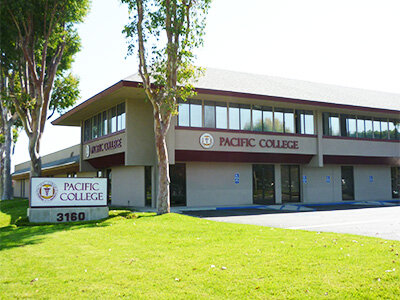
Pacific College in Costa Mesa, California, is a specialized institution laser-focused on healthcare education, offering a tightly curated set of programs in nursing and health administration. With a small, hands-on environment defined by a 7:1 student-faculty ratio, it operates more like a professional training ground than a traditional liberal arts college, delivering strong career outcomes for graduates entering the medical field. Its identity is rooted in a practical, integrative approach to health sciences, appealing directly to students with clear vocational aims.
Admission requirements
Test-blind — scores not considered
Required
High school transcript
Considered (not required)
TOEFL (non-native English)
Source: IPEDS Admissions survey (2022) via Urban Institute. Covers formal factors only — it does not reflect essays, extracurriculars, or other holistic criteria.
More details
Undergrad enrollment
225
Graduation Rate
63%
Number of Majors
4-5
Student-Faculty Ratio
7:1
Median Earnings (10yr)
$70,064
Outcomes & value
Outcomes & value
Median earnings (10 yr)
$70,064
Value (earnings ÷ net price)
2.4×
Median debt at graduation
$22,469
Graduation rate
63%
Reducing loan balance (3 yr)
53%
Pell (lower-income) share
28%
First-gen share (among federal-aid recipients)
63%
Earnings = median of students working ~10 years after entry; debt = median of graduates. Value divides 10-yr earnings by one year’s net price — read it as earnings per dollar of annual cost, not a full lifetime ROI; it favors lower-cost schools. Source: U.S. Dept. of Education College Scorecard. Figures lag ~2 years and reflect all students, not your intended major.
Financial health
2.9 / 3.0Meets the federal financial-responsibility standard
U.S. Dept. of Education Financial Responsibility Composite Score (FY2022-23). Scale −1.0 to 3.0; ≥1.5 meets the standard. Reported for private nonprofit & for-profit institutions only — public universities are state-backed and not scored, so this is a stability signal, not a ranking.
Top-earning majors
Median earnings by field of study (highest credential), ~2 years after completion.
Registered Nursing, Nursing Administration, Nursing Research and Clinical Nursing$101,406
Source: U.S. Dept. of Education College Scorecard (field-of-study earnings). Figures cover graduates who received federal aid and lag ~2 years; not all programs report data.
On-campus criminal offenses classed as violent (murder/non-negligent manslaughter, rape, robbery, aggravated assault) for the most recent reported year. Source: U.S. Dept. of Education Campus Safety and Security (Clery Act). Counts reflect what’s reported to the school, and urban campuses often report more partly due to non-student incidents nearby — read alongside campus size and setting, not as a standalone safety verdict.
Climate
Pleasant days / yr
267
Summer high
82°F
Winter low
47°F
Annual rain
15.4"
Natural-hazard risk
Very High
Pleasant days counts days per year with a mean temperature of 55–75°F, a high at or below 90°F, a low at or above 45°F, and little precipitation — a transparent comfort measure, not a weighting we invented. Computed from Open-Meteo ERA5 daily history (2019–2023). Natural-hazard risk is the county’s composite rating from the FEMA National Risk Index.
Quick answers
What is the acceptance rate at Pacific College?
Pacific College's acceptance rate is approximately 56% (Costa Mesa, CA), based on the most recent figures we compiled from public and primary sources.
How much does Pacific College cost?
At Pacific College, the average net price (after aid) is about $29,363 per year. Actual cost varies with financial aid and residency.
How many undergraduates attend Pacific College?
Pacific College enrolls approximately 225 undergraduate students.
Where is Pacific College located?
Pacific College is located in Costa Mesa, CA.
Admissions
Pacific College maintains a moderately selective admissions process, accepting just over half of its applicants. The is 56%, positioning it as more accessible than highly competitive national universities but selective within its niche of health-focused schools. While specific SAT/ACT ranges for Pacific College are not detailed in the provided sources, admissions data for similarly named institutions suggest a broad middle range, with one source for a different 'Pacific University' listing an SAT range of 1183–1480 and an ACT range of 23–32. The college offers early decision or early action options, a strategic advantage for committed applicants as early decision acceptance rates are generally two to five times higher than regular decision rates at selective schools. The importance of 'demonstrated interest'—a factor tracked by many colleges in the —is not explicitly stated for Pacific College in the provided snippets, leaving it as a potential but unconfirmed consideration in the review process.
Key factors in admission decisions, as outlined in the Common Data Set framework used by many institutions, typically include the rigor of secondary school record, class rank, academic GPA, standardized test scores, and the application essay. Pacific College's specific weighting of these factors is not detailed in the available sources.
Academic life at Pacific College is defined by its concentrated, career-oriented curriculum. The college offers a narrow but deep selection of programs, with sources indicating between 4 and 5 total majors. The entire academic portfolio is centered on healthcare:
Registered Nursing/Registered Nurse
Health/Health Care Administration/Management
Family Practice Nurse/Nursing (Nurse Practitioner)
Business Administration and Management, General
The program list from the college's own website confirms this focus, highlighting a Family Nurse Practitioner Master of Science, an RN-to-BSN Completion Bachelor of Science, and a Registered Nursing Associate of Science. This lack of academic breadth is a deliberate feature, not a bug; students come here for professional preparation, not a wide-ranging exploration of the liberal arts.
The intimate scale of the college fosters close interaction between students and instructors. The student-to-faculty ratio is notably low, reported as 7:1 by one source and 9:1 by another. However, this proximity comes with a caveat: only 11% of instructors are full-time, which is close to the national average for similar institutions but means a significant portion of teaching is done by adjunct professionals working in the field.
With a total undergraduate enrollment of just 285 students, Pacific College is a small, close-knit community. The vibe is less about sprawling campus traditions and more about a shared, focused purpose among students training for healthcare careers. Descriptions of student life at similarly named institutions emphasize a 'warm and close-knit community atmosphere where students form meaningful relationships with both peers and professors,' which likely reflects the environment at this intimate Costa Mesa campus. The college promotes a culture of 'loving kindness and community support,' aligning with the holistic, integrative health values it teaches. There's little mention of a typical residential college experience—no data on Greek life or NCAA sports in the provided sources—suggesting student life revolves largely around academic cohorts and professional preparation rather than a broad array of extracurriculars. For many students, this is a trade-off: a less conventional 'college experience' in exchange for direct, pragmatic training for a specific career path.
Pacific College's raison d'être is clear: to launch graduates into healthcare careers with strong earning potential. The outcomes data supports this mission. The graduation rate is 63%. More importantly, the median earnings ten years after entry are $70,064, a figure that places graduates in the top tier nationally for post-college income. Other sources report similar strong earnings, with the federal College Scorecard noting median earnings of $73,359 and Niche.com reporting earnings of $64,219 five years after graduation. One analysis even notes that the graduation rate for female students is notably high at 81%, placing them in the top 15% nationally. The college itself tracks student achievement metrics like retention rates, indicating an institutional focus on student progression and completion. For a student investing in a healthcare degree, Pacific College delivers a quantifiable return, positioning its alumni for financial stability in a high-demand field.
The average after aid for students attending Pacific College is $29,363. This figure represents the estimated annual cost after grants and scholarships are applied. The college provides a net price calculator on its website to help families get a personalized estimate. Financial aid is available, and the college's policy encourages students to first pursue grants and scholarships, then exhaust federal loan options before considering private student loans. There is no indication in the provided sources that Pacific College has a 'no-loan' policy or that it meets 100% of demonstrated financial need for all admitted students without loans. The financial aid office assists students in navigating the costs of tuition and fees, but the institution appears to follow a standard aid model rather than the generous, loan-free packages offered by some wealthier liberal arts colleges and universities.
Pacific College stands out for its unapologetic specialization. It is not trying to be everything to everyone. In a higher education landscape crowded with universities boasting hundreds of majors, Pacific College offers a handful, all sharply focused on the high-growth healthcare sector. This creates a uniquely purposeful environment where every student, professor, and campus resource is aligned toward the same goal: producing skilled, effective healthcare professionals. The ultra-low student-to-faculty ratio of 7:1 ensures that this training is hands-on and personal, a critical advantage in fields like nursing. The college's philosophy extends beyond technical skill, incorporating a stated culture of 'loving kindness and community support' that reflects the holistic, patient-centered values of integrative medicine. For a student who knows they want a career in nursing or health administration, Pacific College offers a direct, efficient, and outcomes-focused path, bypassing the distractions of a more generalized undergraduate experience. Its strength is its clarity of mission.
Pacific College seal · sourceCampus Locations — Pacific College · sourceAbout Pacific University | Pacific University · sourceCampus Locations — Pacific College · source