Admit rate has ranged 5%–40% over the last 5 years — notably volatile. Source: IPEDS via Urban Institute.
Acceptance & SAT from Common Data Set / IPEDS; net price, earnings & graduation from the U.S. Dept. of Education College Scorecard. Figures lag ~1–2 years — verify with the school.
Pacific Oaks College is a small, mission-driven institution in Pasadena that operates on a different wavelength than most colleges. Its entire identity is built around a singular, progressive philosophy: applying principles of social justice, respect for diversity, and anti-bias education to its core fields of human development, education, and psychology. This isn't a place for sprawling Greek life or big-time sports; it's a tight-knit, largely adult and online community where coursework is intensely applied, and the 'power of community' is the central tenet.
Admission requirements
Test-optional — scores considered if submitted
Required
High school transcript
Grade point average
Class rank
Letters of recommendation
Considered (not required)
Test scores (SAT/ACT)
College-prep program
TOEFL (non-native English)
Source: IPEDS Admissions survey (2022) via Urban Institute. Covers formal factors only — it does not reflect essays, extracurriculars, or other holistic criteria.
More details
Undergrad enrollment
312
In-state tuition
$32,520
Out-of-state tuition
$32,520
Campus Setting
Urban (Pasadena, CA)
Top Graduate Fields
Education (29.8%), Community & Social Services (13.8%)
Median Earnings (10yr)
$52,485
Graduation Rate (4-yr midpoint)
62%
Outcomes & value
Outcomes & value
Median earnings (10 yr)
$52,485
Median debt at graduation
$29,105
Reducing loan balance (3 yr)
49%
Pell (lower-income) share
57%
First-gen share (among federal-aid recipients)
58%
Endowment / student
$11,748
Earnings = median of students working ~10 years after entry; debt = median of graduates. Value divides 10-yr earnings by one year’s net price — read it as earnings per dollar of annual cost, not a full lifetime ROI; it favors lower-cost schools. Source: U.S. Dept. of Education College Scorecard. Figures lag ~2 years and reflect all students, not your intended major.
Financial health
3.0 / 3.0Meets the federal financial-responsibility standard
U.S. Dept. of Education Financial Responsibility Composite Score (FY2022-23). Scale −1.0 to 3.0; ≥1.5 meets the standard. Reported for private nonprofit & for-profit institutions only — public universities are state-backed and not scored, so this is a stability signal, not a ranking.
Top-earning majors
Median earnings by field of study (highest credential), ~2 years after completion.
Teacher Education and Professional Development, Specific Levels and Methods$39,927
Human Development, Family Studies, and Related Services$37,883
Source: U.S. Dept. of Education College Scorecard (field-of-study earnings). Figures cover graduates who received federal aid and lag ~2 years; not all programs report data.
Campus & location
Campus safety
On-campus violent crimes (2024)
0
Per 1,000 students
0.00
On-campus criminal offenses classed as violent (murder/non-negligent manslaughter, rape, robbery, aggravated assault) for the most recent reported year. Source: U.S. Dept. of Education Campus Safety and Security (Clery Act). Counts reflect what’s reported to the school, and urban campuses often report more partly due to non-student incidents nearby — read alongside campus size and setting, not as a standalone safety verdict.
Climate
Pleasant days / yr
207
Summer high
87°F
Winter low
45°F
Annual rain
24.5"
Natural-hazard risk
Very High
Pleasant days counts days per year with a mean temperature of 55–75°F, a high at or below 90°F, a low at or above 45°F, and little precipitation — a transparent comfort measure, not a weighting we invented. Computed from Open-Meteo ERA5 daily history (2019–2023). Natural-hazard risk is the county’s composite rating from the FEMA National Risk Index.
Deep dive — research, future-scholar output & economic mobility▾
Research output
Institutional h-index
34
Scholarly works
234
Institutional research volume and impact from OpenAlex. The h-index reflects large research universities and will be low for teaching-focused liberal-arts colleges — not a measure of undergraduate quality.
Quick answers
What is the acceptance rate at Pacific Oaks College?
Pacific Oaks College's acceptance rate is approximately 34% (Pasadena, CA), based on the most recent figures we compiled from public and primary sources.
How many undergraduates attend Pacific Oaks College?
Pacific Oaks College enrolls approximately 312 undergraduate students.
Where is Pacific Oaks College located?
Pacific Oaks College is located in Pasadena, CA.
Admissions
Pacific Oaks employs a rolling admissions process, accepting students year-round with three start dates for campus-based programs and six for online students, offering significant flexibility for non-traditional and working learners. The admissions landscape for Pacific Oaks is notably inconsistent across public sources, with reported varying widely from 10% to 34.4%. Per the canonical figures provided, the official acceptance rate is 34%. The college does not require SAT or ACT scores for admission, though they are considered if submitted, and a high school GPA is required. The process appears geared toward accessibility and fit with the college's specific mission, rather than hyper-selectivity based on standardized metrics. Notably, the provided sources do not contain a specific to Pacific Oaks College that would clarify the relative importance of factors like demonstrated interest, making it difficult to ascertain the precise weight given to various application components.
The academic focus at Pacific Oaks is narrow, deep, and unmistakably practical. All programs—bachelor's, master's, and certificates—revolve around education, human development, and related helping professions. The curriculum is offered both on the Pasadena campus and online, with online degrees spanning education, human development, business and management, psychology, and social work, including teacher credentialing. This structure caters explicitly to career-changers and professionals seeking advancement. The college's pedagogy is infused with its core values, emphasizing respect for diverse communities and the application of theory to real-world challenges. While specific popular majors aren't detailed in the provided snippets, the institution reports that its graduates find success in fields like Education (29.8%), Community and Social Services (13.8%), and Business Development (13.6%). Qualified undergraduates may have the opportunity to take graduate-level classes.
With a total undergraduate enrollment of just 346 students (as of fall 2023), Pacific Oaks is an intimate, urban campus where the idea of community isn't a brochure cliché but the operational foundation. The college explicitly champions 'The Power of Community,' which it defines as respecting the communities students come from and valuing their unique perspectives and experiences. The Pasadena campus is situated in the San Gabriel Valley, within walking distance of museums, art galleries, and theaters, offering cultural amenities without the feel of a large, insular university campus. Student life is not characterized by traditional residential college features; there is no mention of Greek life or athletics in the provided sources. The environment appears tailored for adult learners and those pursuing their education online, with a dynamic that combines professional preparation with a deep respect for individual values.
Outcomes data for Pacific Oaks graduates reflect its professional orientation. The graduation rate is reported as 62% (for a 4-year midpoint) by the College Scorecard, with other sources citing 60% for 4-year and 61% for 6-year rates. Earnings potential grows over time: one source reports earnings one year after graduation at $36,427, which increases to $50,732 five years post-graduation. Another source lists a higher 1-year figure of $43,527. Per the canonical figures, the median earnings ten years after entry are $52,485. The college highlights that its alumni find success in applied fields, with nearly 30% in Education and another 14% in Community and Social Services. This trajectory suggests graduates often enter mission-driven careers with strong growth potential as they gain experience.
Pacific Oaks encourages all prospective students to apply for financial aid regardless of their circumstances and directs them to complete the FAFSA. The college offers institutional scholarships for new students and donor scholarships for current students. A notable feature of its aid philosophy is flexibility: students are "never required to accept the full amount of any aid offered," and the college advises that accepting less in loans means less to repay later—a pragmatic approach for its likely debt-conscious adult learner population. The provided sources do not specify whether Pacific Oaks has a policy of meeting full demonstrated financial need or a no-loan threshold for low-income families. Students are directed to use a Calculator to get personalized estimates of grant and scholarship aid.
Pacific Oaks College stands out because it is a philosophy made manifest as a college. Its entire existence is built around a progressive, anti-bias educational model applied to human services fields. This isn't a liberal arts college with a side of activism; the activism and the deep respect for diverse lived experience are the curriculum. It serves a specific niche: the working adult, the career-changer, the educator or counselor seeking not just another credential but a values-aligned professional toolkit. The rolling admissions, multiple start dates, and robust online offerings are all engineered for this population. The result is a small, focused institution where the 'campus' can be a classroom in Pasadena or a laptop anywhere, unified by a commitment to applying the 'power of community' to solve real human problems.
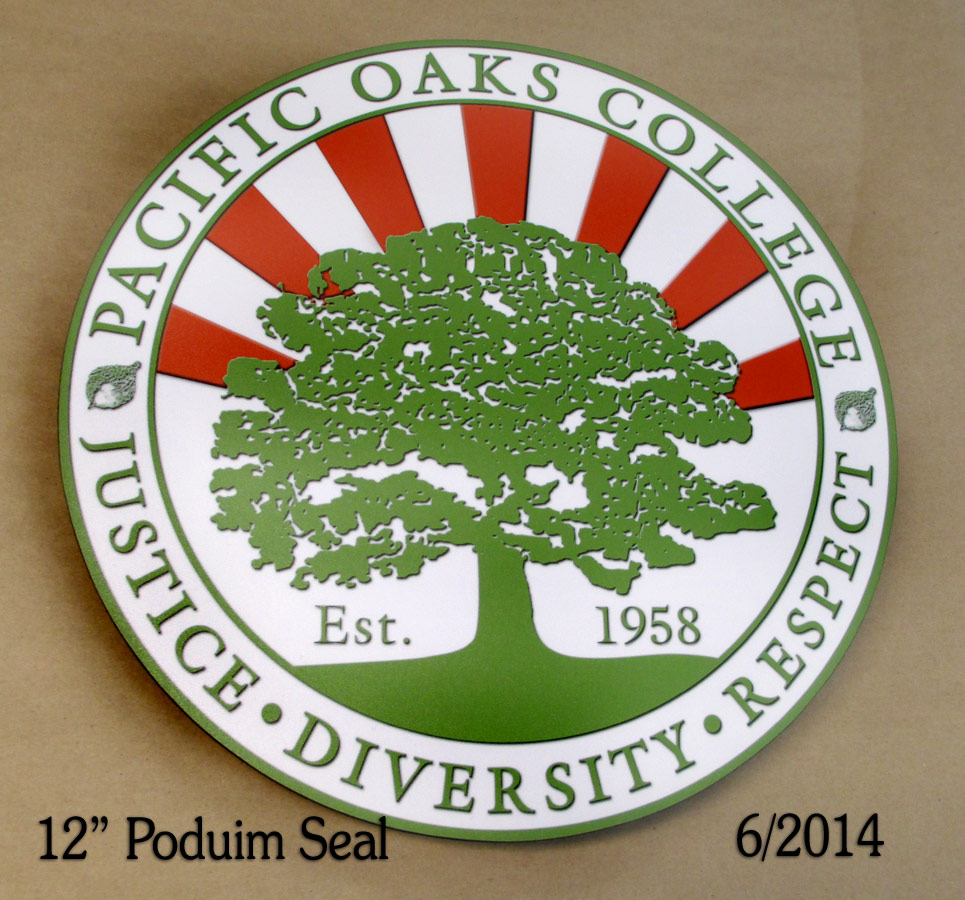
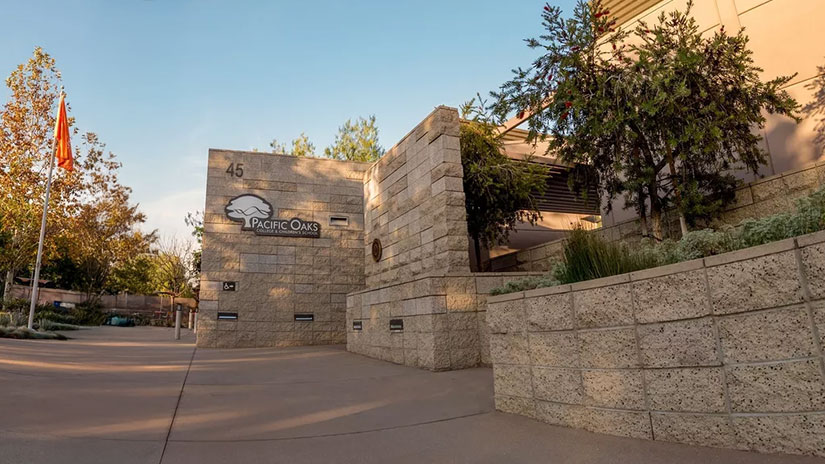
Pacific Oaks College seal · sourceAbout Pacific Oaks College & Children's School | The Community Solution · sourceAbout Pacific Oaks College & Children's School | The Community Solution · sourcePacific Oaks College - Santa Monica College · source