Admit rate has ranged 76%–88% over the last 5 years — notably volatile. Source: IPEDS via Urban Institute.
Acceptance & SAT from Common Data Set / IPEDS; net price, earnings & graduation from the U.S. Dept. of Education College Scorecard. Figures lag ~1–2 years — verify with the school.
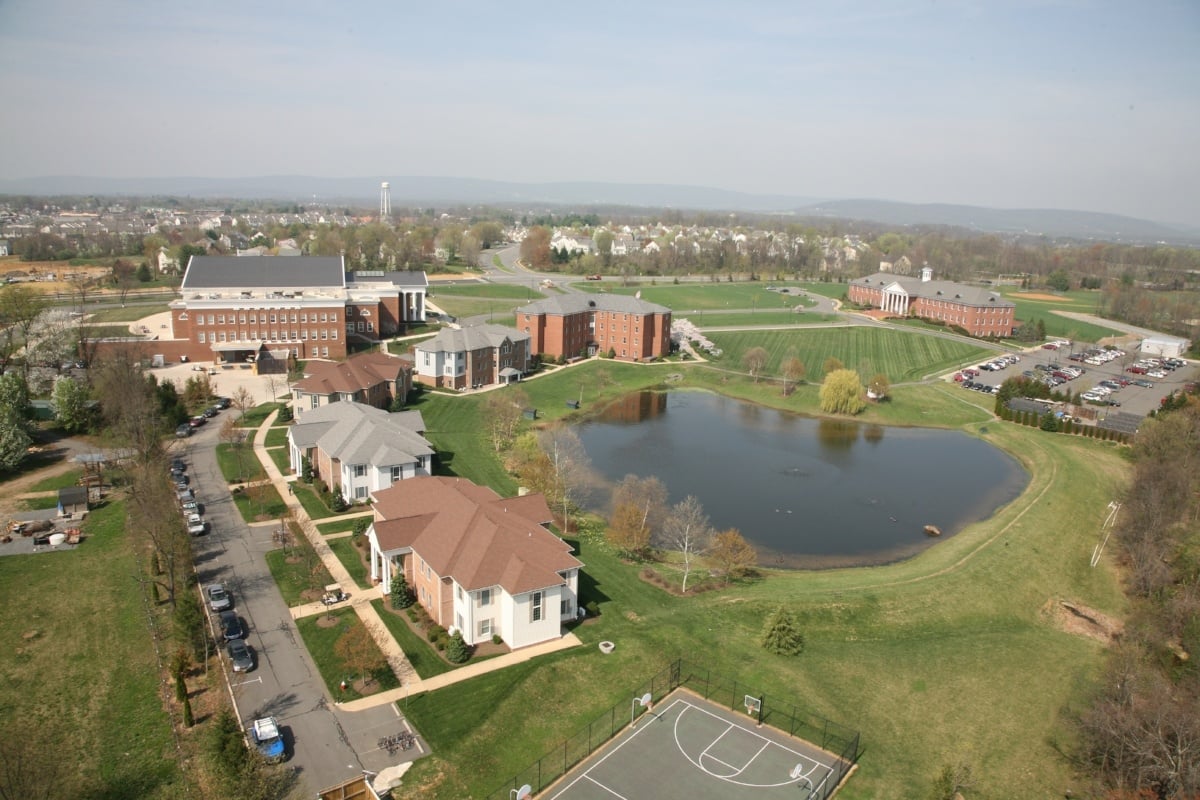
Patrick Henry College is a small, fiercely focused Christian liberal arts college in Purcellville, Virginia, built for a specific kind of student: one who seeks a rigorous, classically grounded education explicitly aligned with a biblical worldview and the principles of the American founding. With an enrollment of just over 400, it cultivates an intense, residential community where spiritual life and academic ambition are inseparable, and where the goal is to send graduates into the arenas of law, government, journalism, and business as conservative Christian influencers. It’s less a typical college and more a mission-driven training ground.
Admission requirements
Test scores required
Required
High school transcript
Grade point average
Test scores (SAT/ACT)
Considered (not required)
Class rank
Letters of recommendation
College-prep program
Demonstrated competencies
TOEFL (non-native English)
Source: IPEDS Admissions survey (2022) via Urban Institute. Covers formal factors only — it does not reflect essays, extracurriculars, or other holistic criteria.
More details
Undergrad enrollment
395
In-state tuition
$28,425
Out-of-state tuition
$28,425
Graduation Rate
74%
Graduates with Any Debt
27%
First-Year Retention Rate
87-88%
Early Application Incentive
Fee waiver through Nov 1, priority housing/course reg
Students in College Housing
88%
Students Receiving Financial Aid
~99%
Credits Taught by Full-Time Faculty
96-97%
Outcomes & value
Outcomes & value
Graduation rate
74%
First-year retention
88%
Pell (lower-income) share
—
Earnings = median of students working ~10 years after entry; debt = median of graduates. Value divides 10-yr earnings by one year’s net price — read it as earnings per dollar of annual cost, not a full lifetime ROI; it favors lower-cost schools. Source: U.S. Dept. of Education College Scorecard. Figures lag ~2 years and reflect all students, not your intended major.
Campus & location
Climate
Pleasant days / yr
87
Summer high
86°F
Winter low
30°F
Annual rain
45.3"
Annual snow
14.6"
Natural-hazard risk
Relatively Low
Pleasant days counts days per year with a mean temperature of 55–75°F, a high at or below 90°F, a low at or above 45°F, and little precipitation — a transparent comfort measure, not a weighting we invented. Computed from Open-Meteo ERA5 daily history (2019–2023). Natural-hazard risk is the county’s composite rating from the FEMA National Risk Index.
Deep dive — research, future-scholar output & economic mobility▾
Research output
Institutional h-index
28
Scholarly works
99
Institutional research volume and impact from OpenAlex. The h-index reflects large research universities and will be low for teaching-focused liberal-arts colleges — not a measure of undergraduate quality.
Quick answers
What is the acceptance rate at Patrick Henry College?
Patrick Henry College's acceptance rate is approximately 77% (Purcellville, VA), based on the most recent figures we compiled from public and primary sources.
What SAT score do you need for Patrick Henry College?
Admitted students at Patrick Henry College typically score 1240–1420 on the SAT (the middle-50% range). Scores outside this band are still admitted, especially with strong applications.
How many undergraduates attend Patrick Henry College?
Patrick Henry College enrolls approximately 395 undergraduate students.
Where is Patrick Henry College located?
Patrick Henry College is located in Purcellville, VA.
Admissions
Patrick Henry College is accessible but academically serious, admitting about three-quarters of its applicants. The college reported 266 applications for a recent cycle, admitting 206 for an of 77.4%. While selective in a traditional sense, PHC’s selectivity is more about ideological and cultural fit than raw numbers; the admissions office is looking for students who align with its distinct mission. The academic profile of admitted students is strong, with an average high school GPA of 3.86. The college encourages early action, waiving its application fee through November 1st and offering priority consideration for housing and course registration to early admits. Demonstrated interest is a factor in admissions, as indicated by resources that track which colleges consider it in the . The middle 50% SAT range for admitted students is 1240–1420, signaling that the academic bar, while not ultra-competitive by Ivy League standards, is solidly in the range of a good regional liberal arts college.
The curriculum is a deliberate fusion of classical liberal arts training and pre-professional tracks aimed at influencing public life. Every student completes a demanding core in the humanities, including rhetoric, theology, and a study of the American founding, before specializing. The most popular majors reflect this mission-driven focus: Political Science and Government, Business/Managerial Economics, and Strategic Intelligence. Other key programs include Journalism & Digital Media, Environmental Science & Stewardship, and Classical Liberal Arts. The college boasts that 96-97% of credits are taught by full-time professors, ensuring a high degree of faculty contact and mentorship in a very small setting. This is not a place for academic exploration divorced from worldview; the education is intentionally structured to equip students "for Christ and for Liberty," as the college's motto states, preparing them for careers in law, public policy, media, and business from a distinctly conservative Christian perspective.
Life at PHC is all-in, residential, and governed by a shared covenant. With an enrollment of 436 students, most live in the college's colonial-style residence halls—about 88% of the student body resides in college-owned or -affiliated housing. The campus culture is immersive and intentional, emphasizing spiritual growth alongside academic rigor. Students commit to community standards that govern personal conduct. Spiritual life is central, with structured opportunities for Bible study, chapel services, and mentorship. The college supports athletics and student organizations, but the social fabric is tightly woven by the shared mission and small size. Campus safety is emphasized, with guidelines advising students not to walk alone in the dark and offering escort services. This creates a close-knit, sheltered environment that is ideal for students who want their college years to be a continuation of a like-minded, faith-based community, but may feel insular to those seeking a more diverse or secular experience.
PHC succeeds in retaining and graduating its tightly matched student body. The first-year retention rate is high, reported at 87-88%, well above the national average. The four-year graduation rate is 65%, with 69% graduating within six years. Post-graduate earnings data shows progression: graduates report median earnings of $36,427 one year after graduation, which grows to $45,519 after five years. A notably low 27% of graduating students have borrowed any type of loan, suggesting many students graduate with minimal debt, a significant advantage. The outcomes reflect the college's focus: graduates are primed for entry into fields like law, government, intelligence, and journalism, often with a clear sense of purpose and a network of similarly driven alumni.
The sticker price is significant, with an annual tuition cost of $41,275. However, PHC is aggressive with scholarships, making the —the average out-of-pocket cost after grants and scholarships—far more manageable. The average net price is reported between $25,869 and $27,056 per year. Crucially, almost every student receives aid: approximately 99% of the student body benefits from one or more scholarships, and 98% of undergraduates receive financial aid. The college offers a variety of scholarship options and assists students with understanding loan packages, noting that private student loans often range from $5,000 to $15,000 per year for those who need to borrow. While the sources do not specify a "no-loan" policy or a commitment to meet 100% of demonstrated need without loans, the high percentage of aided students and the relatively low borrowing rate (27%) indicate a strong institutional commitment to affordability through grants and scholarships.
Patrick Henry College is singular in American higher education. It is not merely a Christian college; it is a purpose-built institution for conservative, evangelical Christians who see their vocation as engaging and reshaping American culture and governance from a biblical foundation. Its three declared distinctives are non-negotiable pillars: High Academic Rigor, Fidelity to the Spirit of the American Founding, and an unwavering Christian worldview. This fusion creates a unique environment where a student might analyze Federalist Papers in the morning, attend a chapel service at noon, and intern for a conservative think tank or media outlet in the afternoon. The scale is tiny—just over 400 students—which allows for a 96-97% full-time faculty teaching rate and an intensely communal life bound by shared beliefs. It's a college for a specific tribe, offering a rigorous, classical liberal arts education laser-focused on producing the next generation of Christian leaders in law, policy, and media. For those who fit its mold, it's a powerful and focused launchpad. For everyone else, it's an intriguing anomaly.
Patrick Henry College seal · sourceFriends of Patrick Henry College | Patrick Henry College (PHC) · sourcePatrick Henry College - Profile, Rankings and Data | US News Best Colleges · sourcePatrick Henry College - Wikipedia · source