Loading…
← All schools
Pennsylvania Gunsmith School
Pittsburgh, PAprivate forprofitpagunsmith.edu
Avg net price
$31,452
Earnings (10 yr)
$40,747
Acceptance & SAT from Common Data Set / IPEDS; net price, earnings & graduation from the U.S. Dept. of Education College Scorecard. Figures lag ~1–2 years — verify with the school.
Pennsylvania Gunsmith School is a singular institution: a tiny, hyper-focused trade school in Pittsburgh that has been training master craftsmen in firearms since 1949. With an open admissions policy and a single, intensive program, it operates more like a guild apprenticeship than a traditional college, producing graduates with a 92% completion rate who enter a niche, hands-on trade. This is not a place for general education or campus life; it's a direct pipeline to a specific, skilled profession.
More details
- Undergrad enrollment
- 64
- Graduation Rate
- 92%
- Single Major Offered
- Gunsmithing/Gunsmith
- Median Earnings (10yr)
- $40,747
- Student-to-Faculty Ratio
- 15:1
- First-Year Retention Rate
- 93%
Outcomes & value
Outcomes & value
- Median earnings (10 yr)
- $40,747
- Value (earnings ÷ net price)
- 1.3×
- Reducing loan balance (3 yr)
- 69%
- Pell (lower-income) share
- 34%
Earnings = median of students working ~10 years after entry; debt = median of graduates. Value divides 10-yr earnings by one year’s net price — read it as earnings per dollar of annual cost, not a full lifetime ROI; it favors lower-cost schools. Source: U.S. Dept. of Education College Scorecard. Figures lag ~2 years and reflect all students, not your intended major.
Financial health
1.8 / 3.0Meets the federal financial-responsibility standard
U.S. Dept. of Education Financial Responsibility Composite Score (FY2022-23). Scale −1.0 to 3.0; ≥1.5 meets the standard. Reported for private nonprofit & for-profit institutions only — public universities are state-backed and not scored, so this is a stability signal, not a ranking.
Campus & location
Campus safety
- On-campus violent crimes (2024)
- 0
On-campus criminal offenses classed as violent (murder/non-negligent manslaughter, rape, robbery, aggravated assault) for the most recent reported year. Source: U.S. Dept. of Education Campus Safety and Security (Clery Act). Counts reflect what’s reported to the school, and urban campuses often report more partly due to non-student incidents nearby — read alongside campus size and setting, not as a standalone safety verdict.
Climate
- Pleasant days / yr
- 97
- Summer high
- 82°F
- Winter low
- 27°F
- Annual rain
- 40.4"
- Annual snow
- 21.5"
- Natural-hazard risk
- Relatively High
Pleasant days counts days per year with a mean temperature of 55–75°F, a high at or below 90°F, a low at or above 45°F, and little precipitation — a transparent comfort measure, not a weighting we invented. Computed from Open-Meteo ERA5 daily history (2019–2023). Natural-hazard risk is the county’s composite rating from the FEMA National Risk Index.
Quick answers
- How much does Pennsylvania Gunsmith School cost?
- At Pennsylvania Gunsmith School, the average net price (after aid) is about $31,452 per year. Actual cost varies with financial aid and residency.
- How many undergraduates attend Pennsylvania Gunsmith School?
- Pennsylvania Gunsmith School enrolls approximately 64 undergraduate students.
- Where is Pennsylvania Gunsmith School located?
- Pennsylvania Gunsmith School is located in Pittsburgh, PA.
Admissions
Admissions at Pennsylvania Gunsmith School is defined by its open-access, first-come-first-served policy. The school reports a 100% and explicitly states it has an open admissions policy. There is no mention of standardized test requirements (SAT/ACT) being considered, and sources indicate acceptance rate information is not available or that scores are 'N/A' for enrolled students. The process is driven by capacity: with total enrollment around 64-68 undergraduate students, demand for small classes fills quickly. The school advises prospective students to call the admissions department immediately upon deciding to enroll to secure an available opening. There is no Early Decision program mentioned in the provided sources that directly pertain to PGS's policy.
Academics
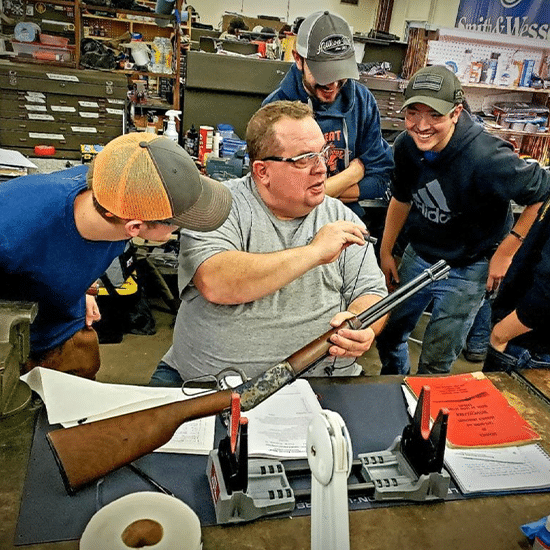
The academic experience is brutally simple: one major, one mission. Every student enrolls in the Gunsmithing/Gunsmith program, a comprehensive curriculum covering intricate repairs, restorations, advanced customization, and modifications. The program is intensive and hands-on, with a student-to-faculty ratio of 15:1. Academic standards are clear: students must maintain a cumulative GPA of at least 2.0 to be in good standing. The structure leads to high completion rates; the school reports a 92% graduation rate for its cohort and a 67% on-time completion rate. This is a trade school in the purest sense, focused entirely on developing the precise skills needed for a career as a gunsmith.
Compare Pennsylvania Gunsmith School
See colleges similar to Pennsylvania Gunsmith School →Sources
- Common Data Set | Office of Planning, Assessment, and ... - opair
- Pennsylvania Gunsmith School Admissions, Costs & Campus Insights
- Common Data Set: Home
- Pennsylvania Gunsmith School - Data USA
- Common Data Set - GradGPT
- [PDF] Common Data Set 2021-2022 - Amazon S3
- Pennsylvania Gunsmith School Admissions - BigFuture
- Pennsylvania Gunsmith School
- Pennsylvania Gunsmith School Statistics
- Pennsylvania Gunsmith School: Enrollment, Tuition and ...
- Pennsylvania Gunsmith School Acceptance Rate, SAT, ...