Loading…
← All schools
Porter & Chester Institute
Bridgeport, CTprivate forprofitwww.porterchester.edu/
Avg net price
$18,348
Earnings (10 yr)
$41,588
Acceptance & SAT from Common Data Set / IPEDS; net price, earnings & graduation from the U.S. Dept. of Education College Scorecard. Figures lag ~1–2 years — verify with the school.
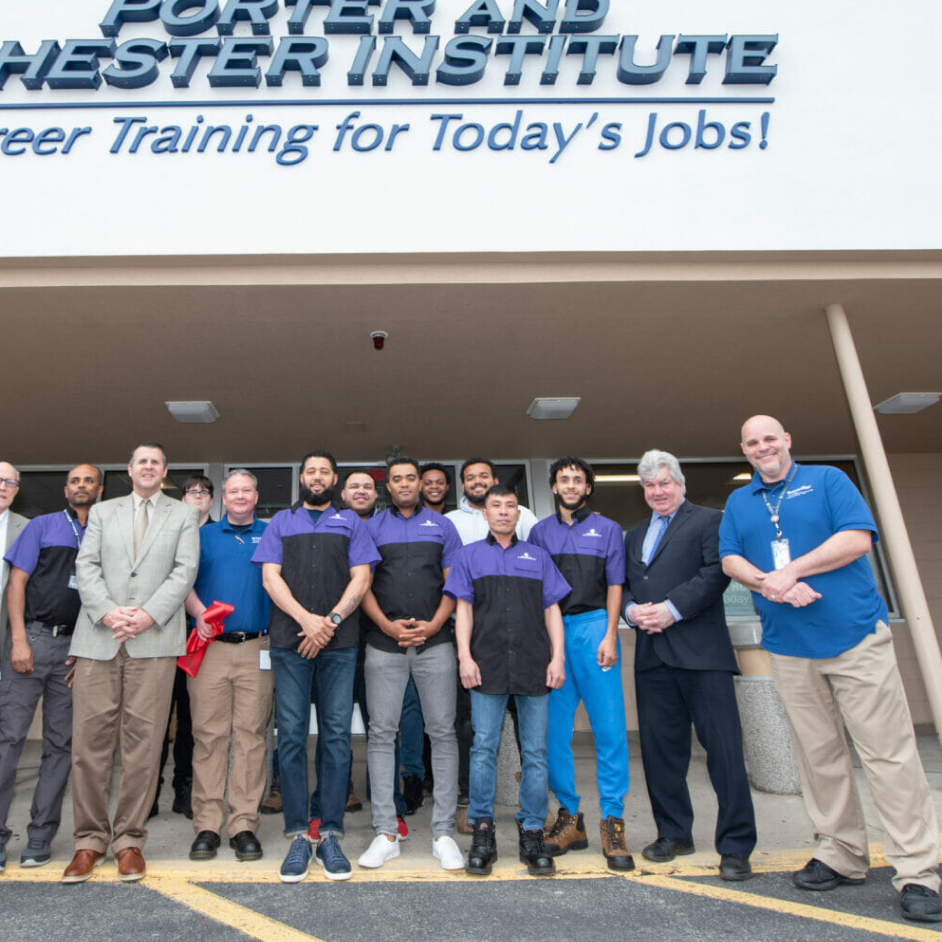
Porter & Chester Institute is a career-focused trade school with a distinctly practical, no-frills approach to education. Operating across multiple campuses in Connecticut and Massachusetts, it offers hands-on training in fields like electrical work, medical assisting, and automotive technology, designed for students aiming to enter the workforce quickly. Its identity is built on flexibility, with rolling admissions and hybrid learning models, and a clear-eyed focus on the technical skills that lead directly to employment.
More details
- Undergrad enrollment
- 1,373
- In-state tuition
- $14,349
- Out-of-state tuition
- $14,349
- Setting
- Urban
- Class Start Terms
- Spring, Summer, Fall, Winter
- Student-Faculty Ratio
- 15:1
- Median Earnings (10yr)
- $41,588
- First-Year Retention Rate
- 61%
Outcomes & value
Outcomes & value
- Median earnings (10 yr)
- $41,588
- Value (earnings ÷ net price)
- 2.3×
- Median debt at graduation
- $12,000
- Reducing loan balance (3 yr)
- 38%
- Pell (lower-income) share
- 57%
- First-gen share (among federal-aid recipients)
- 54%
Earnings = median of students working ~10 years after entry; debt = median of graduates. Value divides 10-yr earnings by one year’s net price — read it as earnings per dollar of annual cost, not a full lifetime ROI; it favors lower-cost schools. Source: U.S. Dept. of Education College Scorecard. Figures lag ~2 years and reflect all students, not your intended major.
Campus & location
Campus safety
- On-campus violent crimes (2024)
- 0
On-campus criminal offenses classed as violent (murder/non-negligent manslaughter, rape, robbery, aggravated assault) for the most recent reported year. Source: U.S. Dept. of Education Campus Safety and Security (Clery Act). Counts reflect what’s reported to the school, and urban campuses often report more partly due to non-student incidents nearby — read alongside campus size and setting, not as a standalone safety verdict.
Climate
- Pleasant days / yr
- 94
- Summer high
- 81°F
- Winter low
- 27°F
- Annual rain
- 57.2"
- Annual snow
- 23.6"
Pleasant days counts days per year with a mean temperature of 55–75°F, a high at or below 90°F, a low at or above 45°F, and little precipitation — a transparent comfort measure, not a weighting we invented. Computed from Open-Meteo ERA5 daily history (2019–2023).
Quick answers
- How much does Porter & Chester Institute cost?
- At Porter & Chester Institute, the average net price (after aid) is about $18,348 per year. Actual cost varies with financial aid and residency.
- How many undergraduates attend Porter & Chester Institute?
- Porter & Chester Institute enrolls approximately 1,373 undergraduate students.
- Where is Porter & Chester Institute located?
- Porter & Chester Institute is located in Bridgeport, CT.
Admissions
Admissions at Porter & Chester Institute are designed for accessibility and speed, reflecting its mission as a career training provider. The process is non-selective and operates on a rolling basis year-round, with students able to begin classes in the Spring, Summer, Fall, or Winter. Sources indicate an of 100%, underscoring its open admissions policy. The institute does not require or emphasize standardized test scores like the SAT or ACT for admission. This approach creates a low-barrier entry point for students seeking vocational training, prioritizing program readiness and career goals over traditional academic metrics. The admissions office is focused on guiding applicants through the process of enrolling in a specific trade program rather than curating a competitive freshman class.
Academics
The academic experience is tightly focused on career-specific, hands-on training. Porter & Chester Institute offers 11 major programs, with the most popular being Electrician, Medical/Clinical Assistant, and Licensed Practical/Vocational Nurse Training. The curriculum is explicitly designed to deliver the technical skills needed for immediate employment in fields like automotive repair, computers, skilled trades, and healthcare. Instruction takes place in an industry-modeled environment, with a student-to-faculty ratio of 15:1, allowing for direct supervision of practical work. Programs are intensive and career-oriented, with a notable 61% first-year retention rate. The institute promotes a hybrid learning model that combines online and on-campus instruction, offering flexibility for students who may be balancing work or other commitments while training.
Compare Porter & Chester Institute
See colleges similar to Porter & Chester Institute →Sources
- Common Data Set & Undergraduate Profile
- Common Data Set: Home
- Common Data Set: Your Key to Smarter College Decisions
- Decoding the Common Data Set What You Need to Know for Your College ...
- How To Use a Common Data Set
- Common Data Set | Office of Planning, Assessment, and Institutional ...
- Class Profile
- Admissions - Porter And Chester Institute - BigFuture - College Board
- Porter & Chester Institute - Waterbury
- Porter & Chester Institute of Hamden | College Scorecard
- Porter And Chester Institute Acceptance Rate, SAT, GPA & ACT ...