Admit rate has ranged 59%–75% over the last 5 years — notably volatile. Source: IPEDS via Urban Institute.
Acceptance & SAT from Common Data Set / IPEDS; net price, earnings & graduation from the U.S. Dept. of Education College Scorecard. Figures lag ~1–2 years — verify with the school.
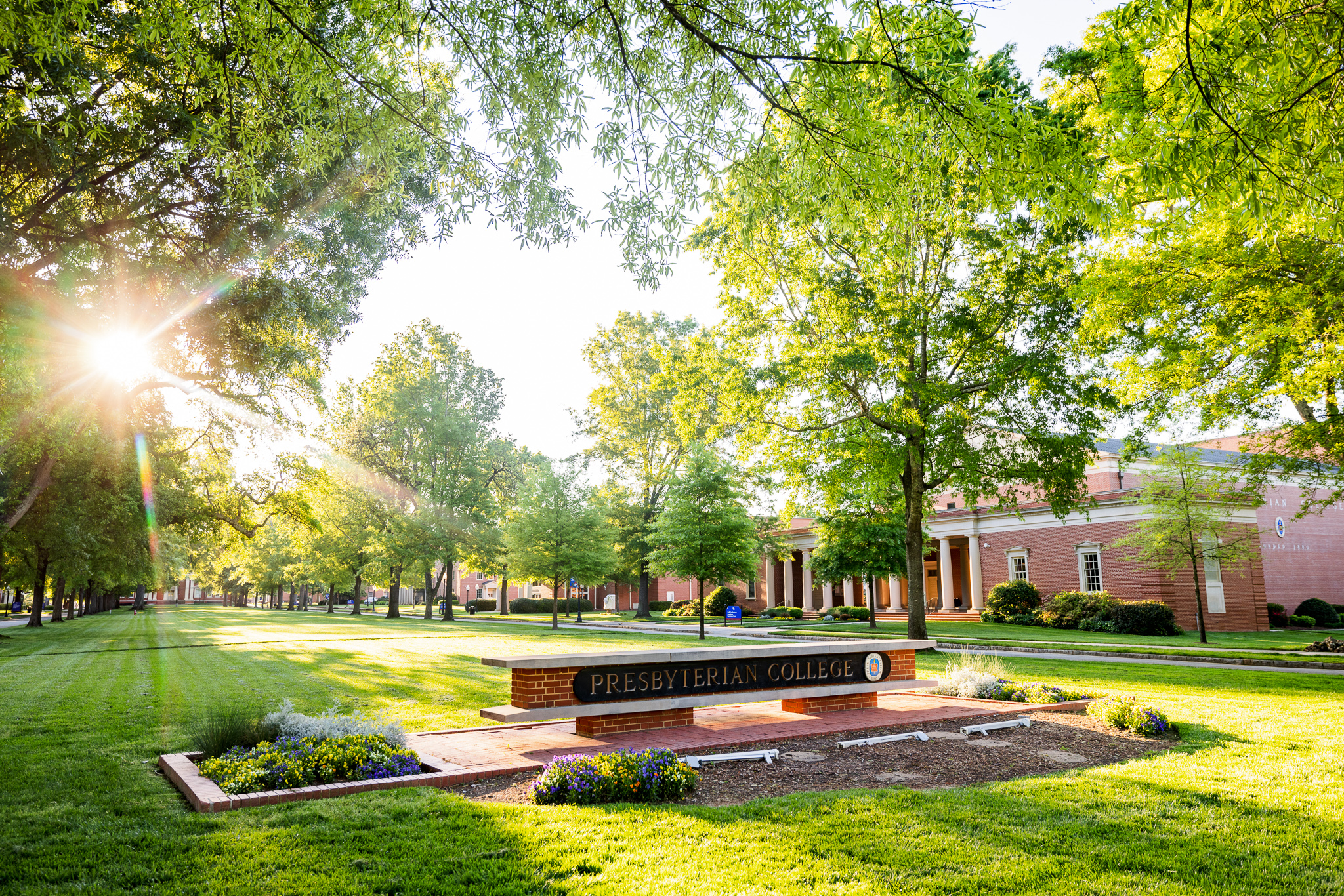
Presbyterian College is a small, private liberal arts school in Clinton, South Carolina, that operates with a distinctly Southern, community-first ethos. It's a place where the campus is beautiful, the student body is heavily athletic, and the academic offering is broad—over 90 majors and minors—but the graduation rate tells a story of a college still working to fully translate opportunity into completion. For students who thrive in a tight-knit, supportive environment, PC offers a personalized path, though its financial aid policy stops short of guaranteeing to meet full need.
Admission requirements
Test-optional — scores considered if submitted
Required
High school transcript
Grade point average
College-prep program
Considered (not required)
Class rank
Letters of recommendation
Test scores (SAT/ACT)
TOEFL (non-native English)
Source: IPEDS Admissions survey (2022) via Urban Institute. Covers formal factors only — it does not reflect essays, extracurriculars, or other holistic criteria.
More details
Undergrad enrollment
852
In-state tuition
$44,910
Out-of-state tuition
$44,910
Total Cost
$67,450
Graduation Rate
51%
Meets Full Need
No
On-Campus Housing
89% of students
Athlete Population
~65% of student body
Average Financial Aid Package
$37,000
Median Earnings (6yr after entry)
$44,387
Students Receiving Grant/Scholarship Aid
100%
Post-Grad Success (employed/grad school in 6 mos)
Outcomes & value
Outcomes & value
Median earnings (10 yr)
$60,194
Value (earnings ÷ net price)
2.9×
Median debt at graduation
$26,000
Graduation rate
51%
First-year retention
80%
Reducing loan balance (3 yr)
73%
Pell (lower-income) share
33%
First-gen share (among federal-aid recipients)
20%
Financial health
2.2 / 3.0Meets the federal financial-responsibility standard
U.S. Dept. of Education Financial Responsibility Composite Score (FY2022-23). Scale −1.0 to 3.0; ≥1.5 meets the standard. Reported for private nonprofit & for-profit institutions only — public universities are state-backed and not scored, so this is a stability signal, not a ranking.
Top-earning majors
Median earnings by field of study (highest credential), ~2 years after completion.
Business Administration, Management and Operations$42,363
Mathematics$36,312
Teacher Education and Professional Development, Specific Levels and Methods$33,518
English Language and Literature, General$25,194
Political Science and Government$24,035
Psychology, General
Campus & location
Campus safety
On-campus violent crimes (2024)
5
Per 1,000 students
4.57
On-campus criminal offenses classed as violent (murder/non-negligent manslaughter, rape, robbery, aggravated assault) for the most recent reported year. Source: U.S. Dept. of Education Campus Safety and Security (Clery Act). Counts reflect what’s reported to the school, and urban campuses often report more partly due to non-student incidents nearby — read alongside campus size and setting, not as a standalone safety verdict.
Climate
Pleasant days / yr
105
Summer high
89°F
Winter low
39°F
Annual rain
46.4"
Annual snow
1"
Natural-hazard risk
Relatively Low
Pleasant days counts days per year with a mean temperature of 55–75°F, a high at or below 90°F, a low at or above 45°F, and little precipitation — a transparent comfort measure, not a weighting we invented. Computed from Open-Meteo ERA5 daily history (2019–2023). Natural-hazard risk is the county’s composite rating from the FEMA National Risk Index.
Deep dive — research, future-scholar output & economic mobility▾
Research output
Institutional h-index
81
Scholarly works
1,043
Institutional research volume and impact from OpenAlex. The h-index reflects large research universities and will be low for teaching-focused liberal-arts colleges — not a measure of undergraduate quality.
Economic mobility
Mobility rate
1.2%
Bottom → top quintile
41%
From bottom quintile
3%
Mobility rate = the share of students who both start in the bottom household-income quintile and reach the top quintile; bottom → top is that chance conditional on starting at the bottom. Source: Opportunity Insights Mobility Report Cards (Chetty, Friedman, Saez, Turner & Yagan). Reflects 1980–82 birth cohorts, so it’s directional, not current.
Quick answers
What is the acceptance rate at Presbyterian College?
Presbyterian College's acceptance rate is approximately 68% (Clinton, SC), based on the most recent figures we compiled from public and primary sources.
What SAT score do you need for Presbyterian College?
Admitted students at Presbyterian College typically score 980–1200 on the SAT (the middle-50% range). Scores outside this band are still admitted, especially with strong applications.
How much does Presbyterian College cost?
At Presbyterian College, the average net price (after aid) is about $20,528 per year. Actual cost varies with financial aid and residency.
How many undergraduates attend Presbyterian College?
Presbyterian College enrolls approximately 852 undergraduate students.
Where is Presbyterian College located?
Presbyterian College is located in Clinton, SC.
Admissions
Presbyterian College is a selective but accessible institution, with an admissions process that is notably more forgiving for those who apply early. The college does not have an open admission policy for all students; it practices selective admission, particularly for out-of-state applicants and some specific programs. The most significant strategic advantage for applicants is the Early Decision round, where the is substantially higher—80.3% compared to the overall rate. The college considers a range of factors in its decisions, with high school GPA being a critical benchmark; the average GPA for admitted freshmen is around 3.22 to 3.26. Test scores remain a part of the picture, with the middle 50% of admitted students scoring between 980 and 1200 on the SAT. Notably, the rate—the percentage of admitted students who enroll—is low, reported at just 11%, indicating that PC is often a safety or backup choice for many of the students it accepts.
Earnings = median of students working ~10 years after entry; debt = median of graduates. Value divides 10-yr earnings by one year’s net price — read it as earnings per dollar of annual cost, not a full lifetime ROI; it favors lower-cost schools. Source: U.S. Dept. of Education College Scorecard. Figures lag ~2 years and reflect all students, not your intended major.
$22,824
Biology, General$16,663
Source: U.S. Dept. of Education College Scorecard (field-of-study earnings). Figures cover graduates who received federal aid and lag ~2 years; not all programs report data.
PC grounds its identity in a transformative liberal arts education, challenging students to think critically, communicate effectively, and solve complex problems. The curriculum is expansive for a school of its size, offering over 90 majors, minors, pre-professional, and graduate programs. This allows for significant customization of a student's degree path. The most popular fields of study reflect a blend of traditional liberal arts and professional preparation: Business, Management, Marketing, Biological and Biomedical Sciences, and Social Sciences are among the top draws. History is a notably strong program, while Physical Sciences, Education, and Computer Science also attract dedicated cohorts. The academic structure is designed to drive deeper connections across disciplines, supporting the college's mission to prepare students for diverse careers and graduate studies.
Life at PC is defined by its close-knit, residential community. The vast majority of students (89%) live in college-owned, -operated, or -affiliated housing, creating a campus-centric experience. A defining characteristic of the student body is its athletic participation; it's estimated that about 65% of students are athletes, which heavily influences the social and community fabric. Students are encouraged to get involved through a variety of clubs, volunteer opportunities, and spiritual life events, including campus-wide worship and outreach programs. The college actively strives to create a just campus where all voices are heard and experiences are valued. The overall vibe, as described by students, is one of strong community and alumni support set on a beautiful campus, though the small size and high percentage of athletes mean the social scene can feel insular to some.
Post-graduation outcomes are a mixed picture at Presbyterian College. On the positive side, the college reports a strong track record of graduates quickly entering the workforce or further education: over the last five years, 95% of graduates were employed or in graduate school within six months of graduation. The median salary for graduates six years after starting is reported as $44,387. However, the college's internal goals reveal a focus on improving graduation rates, setting an "acceptable threshold" of a 56% four-year graduation rate and a 63% six-year rate. These targets indicate the institution is actively working to support students through to completion, acknowledging that persistence is a key area for development.
With a total annual cost of $67,450, Presbyterian College leverages significant institutional aid to improve affordability. The college offers over $27 million in scholarships and loans, with the average financial aid package for incoming students amounting to $37,000. This aid is a mix of guaranteed merit scholarships—which can be as high as $30,000—and need-based assistance. As a result, 100% of full-time beginning undergraduates receive some form of grant or scholarship aid, bringing the average down to approximately $20,528. It's important to note that while PC makes every attempt to cover financial need with all aid sources, its official policy states it "does not guarantee to meet all financial need for students." The financial aid office provides parent loan options for those who need to borrow beyond the aid package, allowing a parent to borrow up to $20,000 per year per student.
Presbyterian College stands out for its potent combination of a classic liberal arts curriculum and a deeply communal, almost familial, campus culture. Its defining feature is the sheer proportion of student-athletes, which creates a unique environment where discipline, teamwork, and school spirit are pervasive values. This isn't a campus of detached intellectuals; it's a place where academic pursuit is woven into an active, engaged community life. The college's commitment is evident in its broad academic menu—offering surprising range for a small school—and its aggressive use of merit scholarships to attract students. However, it also stands out for its transparency regarding the challenges it faces, openly publishing goals to improve graduation rates. PC is best suited for students who want a supportive, face-to-face education in a beautiful Southern setting and who will proactively engage with the resources provided to cross the finish line.
Presbyterian College seal · sourceAbout PC | Presbyterian College · sourcePresbyterian College - SC Picture Project · sourceRequest Information | Presbyterian College · source