Admit rate has ranged 65%–71% over the last 5 years, though the latest figure above (62%) falls outside that window. Source: IPEDS via Urban Institute.
Acceptance & SAT from Common Data Set / IPEDS; net price, earnings & graduation from the U.S. Dept. of Education College Scorecard. Figures lag ~1–2 years — verify with the school.
Queens University of Charlotte is a small, private institution that leverages its location in a booming Southern metropolis as its defining feature. It offers a pragmatic, career-focused education where internships are mandatory and connections to the Charlotte business community are a major selling point. The vibe is traditional—a historic, tree-lined campus with apartment-style dorms and skyline views—but the academic approach is decidedly hands-on, aiming to turn out graduates who are immediately employable in the region's dominant industries like health professions and business.
Admission requirements
Test-optional — scores considered if submitted
Required
High school transcript
Grade point average
College-prep program
Considered (not required)
Class rank
Letters of recommendation
Test scores (SAT/ACT)
TOEFL (non-native English)
Source: IPEDS Admissions survey (2022) via Urban Institute. Covers formal factors only — it does not reflect essays, extracurriculars, or other holistic criteria.
More details
Undergrad enrollment
1,211
In-state tuition
$45,846
Out-of-state tuition
$45,846
Campus Setting
Historic, tree-lined in Charlotte
Popular Majors
Health Professions, Business
Graduation Rate
61%
Mandatory Internships
Yes, 100% complete one
Median Earnings (10yr)
$57,673
Students Receiving Aid
98%
Graduates Employed/Grad School
97%
Outcomes & value
Outcomes & value
Median earnings (10 yr)
$57,673
Value (earnings ÷ net price)
1.9×
Median debt at graduation
$25,000
Graduation rate
61%
First-year retention
74%
Reducing loan balance (3 yr)
58%
Pell (lower-income) share
24%
First-gen share (among federal-aid recipients)
22%
Top-earning majors
Median earnings by field of study (highest credential), ~2 years after completion.
Registered Nursing, Nursing Administration, Nursing Research and Clinical Nursing$58,152
Business Administration, Management and Operations$40,821
Communication and Media Studies$37,424
Teacher Education and Professional Development, Specific Levels and Methods$37,208
Sports, Kinesiology, and Physical Education/Fitness$35,594
Campus & location
Campus safety
On-campus violent crimes (2024)
0
Per 1,000 students
0.00
On-campus criminal offenses classed as violent (murder/non-negligent manslaughter, rape, robbery, aggravated assault) for the most recent reported year. Source: U.S. Dept. of Education Campus Safety and Security (Clery Act). Counts reflect what’s reported to the school, and urban campuses often report more partly due to non-student incidents nearby — read alongside campus size and setting, not as a standalone safety verdict.
Climate
Pleasant days / yr
105
Summer high
88°F
Winter low
38°F
Annual rain
44.5"
Annual snow
1.7"
Natural-hazard risk
Relatively High
Pleasant days counts days per year with a mean temperature of 55–75°F, a high at or below 90°F, a low at or above 45°F, and little precipitation — a transparent comfort measure, not a weighting we invented. Computed from Open-Meteo ERA5 daily history (2019–2023). Natural-hazard risk is the county’s composite rating from the FEMA National Risk Index.
Deep dive — research, future-scholar output & economic mobility▾
Research output
Institutional h-index
104
Scholarly works
3,036
Institutional research volume and impact from OpenAlex. The h-index reflects large research universities and will be low for teaching-focused liberal-arts colleges — not a measure of undergraduate quality.
Economic mobility
Mobility rate
2.6%
Bottom → top quintile
38%
From bottom quintile
7%
Mobility rate = the share of students who both start in the bottom household-income quintile and reach the top quintile; bottom → top is that chance conditional on starting at the bottom. Source: Opportunity Insights Mobility Report Cards (Chetty, Friedman, Saez, Turner & Yagan). Reflects 1980–82 birth cohorts, so it’s directional, not current.
Quick answers
What is the acceptance rate at Queens University of Charlotte?
Queens University of Charlotte's acceptance rate is approximately 62% (Charlotte, NC), based on the most recent figures we compiled from public and primary sources.
What SAT score do you need for Queens University of Charlotte?
Admitted students at Queens University of Charlotte typically score 1140–1340 on the SAT (the middle-50% range). Scores outside this band are still admitted, especially with strong applications.
How much does Queens University of Charlotte cost?
At Queens University of Charlotte, the average net price (after aid) is about $30,857 per year. Actual cost varies with financial aid and residency.
How many undergraduates attend Queens University of Charlotte?
Queens University of Charlotte enrolls approximately 1,211 undergraduate students.
Where is Queens University of Charlotte located?
Queens University of Charlotte is located in Charlotte, NC.
Admissions
Queens University of Charlotte operates with a moderately selective admissions process, where over half of all applicants are admitted. The university provides clear, attainable benchmarks for automatic consideration: a 3.5 unweighted core GPA and an SAT score of at least 480 on the Evidence-Based Reading and Writing section or an ACT English score of 18. While the initiative is a key source for its admissions data, the specific weighting of factors like demonstrated interest is not detailed in the provided sources. The admissions office can be contacted via email at [email protected] or by phone at 704-337-2200 or 800-849-0202, located at 1900 Selwyn Avenue in Charlotte.
The curriculum at Queens is built around practical, marketable skills, underscored by a guarantee that 100% of undergraduates complete an internship before graduating. With 41 majors and 56 minors, the academic portfolio is broad but leans heavily into fields with clear career pathways. The most popular majors cluster in Health Professions and Related Programs and Business, Management, Marketing, and Related Support Services. The university promotes small classes and meaningful faculty mentorship as hallmarks of the experience, and reviews often cite academic rigor and opportunities like study abroad. Its identity is tightly linked to Charlotte, promising students strong connections to the city's professional landscape.
Earnings = median of students working ~10 years after entry; debt = median of graduates. Value divides 10-yr earnings by one year’s net price — read it as earnings per dollar of annual cost, not a full lifetime ROI; it favors lower-cost schools. Source: U.S. Dept. of Education College Scorecard. Figures lag ~2 years and reflect all students, not your intended major.
Health Professions and Related Clinical Sciences, Other
$33,993
Human Services, General$29,685
Design and Applied Arts$27,439
Source: U.S. Dept. of Education College Scorecard (field-of-study earnings). Figures cover graduates who received federal aid and lag ~2 years; not all programs report data.
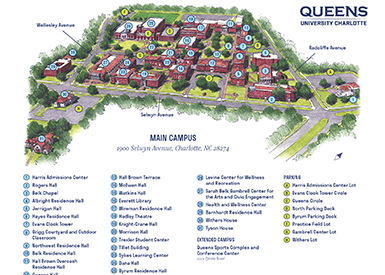
Life on the 165-year-old campus blends historic charm with modern amenities. The residential experience features apartment-style living in halls that offer skyline views of Charlotte. The Division of Student Life organizes a slate of activities and traditions it describes as dynamic, not stale, aimed at fostering personal growth and holistic well-being. This includes a range of student organizations and leadership development initiatives designed to build connections. The campus itself is noted for being surrounded by trees, creating a distinct, enclosed atmosphere just minutes from a major urban center.
Queens markets itself as a direct pipeline to employment, and the data largely supports that claim. The university reports that 97% of its graduates are employed or in graduate school, with 95% finding employment within six months of graduation. Furthermore, 88% of graduates felt their Queens experience prepared them for their career path. While early-career salary figures vary across sources, the long-term financial payoff appears solid, with a median earnings figure ten years after entry. The graduation rate, a key indicator of student success and institutional support, is a central metric for the university.
With a published annual tuition of $47,390, Queens is a significant financial investment. However, the university works to offset this cost through aggressive financial aid, claiming that 98% of its full-time, first-year undergraduates receive grant or scholarship aid. The —the average cost after aid—is the more relevant figure for families. Queens encourages all students to complete the FAFSA, which opens October 1 each year, and to wait for their official financial aid award before seeking alternative loans. The university provides a net price calculator to offer personalized estimates of first-year costs.
Queens University of Charlotte stands out for its unambiguous, almost transactional, value proposition: it exists to prepare students for specific careers in a specific city. The 100% internship guarantee isn't an aspirational goal; it's a graduation requirement, embedding professional experience directly into the curriculum. This focus makes it distinctly different from liberal arts colleges that prize abstract inquiry. Its identity is a hybrid—a traditional, tree-lined campus that psychologically feels separate, yet it operates as a feeder school for the adjacent urban economy. For a student certain they want to build a life and career in the Southeast, particularly in healthcare or business, Queens offers a streamlined, no-frills path with a strong track record of placing graduates into jobs quickly.
Queens University of Charlotte seal · sourceCampus Map & Parking - Queens University of Charlotte · sourceVisit Queens University of Charlotte · sourceQueens University of Charlotte - Profile, Rankings and Data | US News Best Colleges · source