Admit rate has ranged 41%–61% over the last 5 years — notably volatile. Source: IPEDS via Urban Institute.
Acceptance & SAT from Common Data Set / IPEDS; net price, earnings & graduation from the U.S. Dept. of Education College Scorecard. Figures lag ~1–2 years — verify with the school.
Rollins College is a small, sun-drenched liberal arts enclave in Winter Park, Florida, where the academic rigor of a top-tier private college meets the relaxed, resort-like atmosphere of a lakeside campus. It’s a place where business majors outnumber all others, student-athletes boast a near-perfect academic success rate, and the promise of a high-return education—backed by substantial financial aid—draws a selective, engaged student body. Think of it as a polished, professional launchpad with palm trees.
Admission requirements
Test-optional — scores considered if submitted
Required
High school transcript
Grade point average
Letters of recommendation
TOEFL (non-native English)
Considered (not required)
Class rank
Test scores (SAT/ACT)
College-prep program
Demonstrated competencies
Source: IPEDS Admissions survey (2022) via Urban Institute. Covers formal factors only — it does not reflect essays, extracurriculars, or other holistic criteria.
More details
Undergrad enrollment
2,631
In-state tuition
$60,580
Out-of-state tuition
$60,580
Campus Safety
92% feel extremely safe
Test-Flexible
56% applied test-optional (Class of 2028)
Campus Housing
58% of students live on campus
Graduation Rate
75%
Most Popular Majors
Business, Social Sciences, Communications
Demonstrated Interest
Not considered
Student Organizations
150+
Median Earnings (10yr)
$58,295
Average Annual Aid Package
Outcomes & value
Outcomes & value
Median earnings (10 yr)
$58,295
Value (earnings ÷ net price)
1.7×
Median debt at graduation
$25,500
Graduation rate
75%
First-year retention
85%
Reducing loan balance (3 yr)
56%
Pell (lower-income) share
23%
First-gen share (among federal-aid recipients)
24%
Top-earning majors
Median earnings by field of study (highest credential), ~2 years after completion.
International Business$43,798
Teacher Education and Professional Development, Specific Levels and Methods$43,638
Economics$42,044
Business/Commerce, General$41,565
Communication and Media Studies$36,368
International Relations and National Security Studies
Campus & location
Campus safety
On-campus violent crimes (2024)
12
Per 1,000 students
3.95
On-campus criminal offenses classed as violent (murder/non-negligent manslaughter, rape, robbery, aggravated assault) for the most recent reported year. Source: U.S. Dept. of Education Campus Safety and Security (Clery Act). Counts reflect what’s reported to the school, and urban campuses often report more partly due to non-student incidents nearby — read alongside campus size and setting, not as a standalone safety verdict.
Climate
Pleasant days / yr
131
Summer high
89°F
Winter low
55°F
Annual rain
70.7"
Natural-hazard risk
Relatively High
Pleasant days counts days per year with a mean temperature of 55–75°F, a high at or below 90°F, a low at or above 45°F, and little precipitation — a transparent comfort measure, not a weighting we invented. Computed from Open-Meteo ERA5 daily history (2019–2023). Natural-hazard risk is the county’s composite rating from the FEMA National Risk Index.
Deep dive — research, future-scholar output & economic mobility▾
Research output
Institutional h-index
133
Scholarly works
3,819
Institutional research volume and impact from OpenAlex. The h-index reflects large research universities and will be low for teaching-focused liberal-arts colleges — not a measure of undergraduate quality.
Economic mobility
Mobility rate
1.3%
Bottom → top quintile
23%
From bottom quintile
6%
Mobility rate = the share of students who both start in the bottom household-income quintile and reach the top quintile; bottom → top is that chance conditional on starting at the bottom. Source: Opportunity Insights Mobility Report Cards (Chetty, Friedman, Saez, Turner & Yagan). Reflects 1980–82 birth cohorts, so it’s directional, not current.
Quick answers
What is the acceptance rate at Rollins College?
Rollins College's acceptance rate is approximately 48% (Winter Park, FL), based on the most recent figures we compiled from public and primary sources.
What SAT score do you need for Rollins College?
Admitted students at Rollins College typically score 1160–1370 on the SAT (the middle-50% range). Scores outside this band are still admitted, especially with strong applications.
How much does Rollins College cost?
At Rollins College, the average net price (after aid) is about $34,732 per year. Actual cost varies with financial aid and residency.
How many undergraduates attend Rollins College?
Rollins College enrolls approximately 2,631 undergraduate students.
Where is Rollins College located?
Rollins College is located in Winter Park, FL.
Admissions
Rollins operates in a selective but accessible admissions zone, where nearly half of all applicants are offered a spot. The process is test-flexible, with 56% of the most recent incoming class applying without submitting SAT or ACT scores. For those who do submit, the academic profile is solid: the average SAT score for the Class of 2028 was 1260, with an average unweighted core GPA of 3.53. The college accepts the Common Application. Applying Early Decision can be a strategic move for committed students; one source indicates the ED is 41%, compared to an overall rate around 47%. However, Rollins does not consider demonstrated interest as a factor in admissions decisions, per guidelines, meaning campus visits and communications won't directly impact your application's evaluation. The rate—the percentage of admitted students who enroll—is a critical metric for understanding the college's appeal, though the exact figure from the sources is not explicitly stated in a single, clear statistic.
Earnings = median of students working ~10 years after entry; debt = median of graduates. Value divides 10-yr earnings by one year’s net price — read it as earnings per dollar of annual cost, not a full lifetime ROI; it favors lower-cost schools. Source: U.S. Dept. of Education College Scorecard. Figures lag ~2 years and reflect all students, not your intended major.
$33,459
Natural Resources Conservation and Research$30,771
Psychology, General$30,228
Source: U.S. Dept. of Education College Scorecard (field-of-study earnings). Figures cover graduates who received federal aid and lag ~2 years; not all programs report data.
Rollins is first and foremost a liberal arts college, but its curriculum has a distinctly practical tilt. The most popular majors cluster in Business, Management, Marketing, and Related Support Services, followed by the Social Sciences and Communications fields. This professional focus doesn't come at the expense of academic quality; the college has been ranked highly for academic excellence and value, landing a top spot among its peers based on measures like faculty quality. A standout feature is the exceptional performance of its student-athletes. As a top Division II school, Rollins boasts a remarkable 98% academic success rate for its athletes, a figure that far exceeds the national benchmark. The college promotes a 75% four-year graduation rate, indicating a structured path to degree completion.
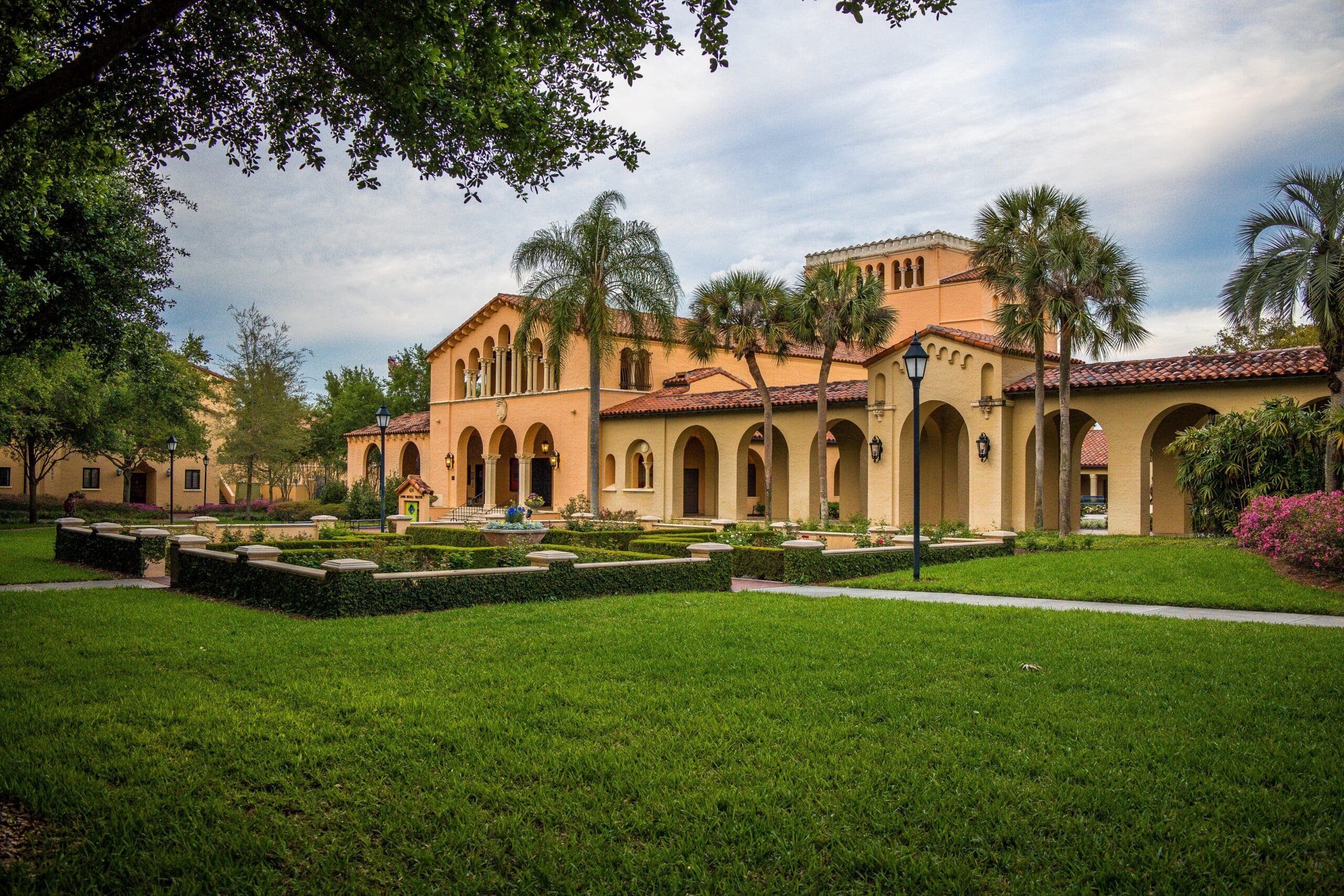
Life at Rollins is defined by an intimate, secure, and active campus culture nestled in the upscale suburb of Winter Park, just minutes from Orlando. The college fosters an open and inclusive environment with over 150 student clubs and organizations, including cultural groups like Spectrum. A strong majority of students (58%) live in college-owned housing, creating a residential community, while 42% live off-campus. Students report feeling extremely safe, with 92% saying they feel "extremely safe and secure on campus." The atmosphere is consistently described as inviting, from the lush, lakeside landscape and Spanish Mediterranean architecture to the overall vibe. This combination of a beautiful, contained campus with easy access to a major metropolitan area provides a unique blend of collegiate focus and urban opportunity.
Rollins promotes strong post-graduation outcomes, framing its education as a valuable investment. According to a recent First Destination report, the average annual salary for graduates was $55,000, with more than half earning $50,000 or more. A significant portion (30%) of graduates immediately continue their education. The college's overall graduation rate is a solid 75%, and it has been recognized nationally for the quality and affordability of its outcomes, with evaluations considering alumni salaries a decade after entry. These figures support the college's positioning as an institution that effectively prepares students for professional success or advanced study.
Rollins is a high-tuition private institution, but it aggressively uses financial aid to make attendance feasible for most students. A striking 94% of Rollins students receive some form of financial aid. The college makes over $102 million in annual aid available, offering need-based grants that range from $2,000 to $55,000 per year. The average financial aid package is substantial. While the college offers federal loans (both subsidized and unsubsidized) as part of aid packages, the sources do not indicate that Rollins has a universal "no-loan" policy that replaces all loans with grants for students meeting certain need criteria. Instead, they emphasize grants and scholarships as the primary tools for reducing cost. The —the average cost after grants and scholarships—is a critical figure for families to estimate.
Rollins carves out a distinctive niche by seamlessly blending several seemingly contradictory qualities. It's a serious liberal arts college with a pre-professional heartbeat, where business is the most popular pursuit but within a broader, interdisciplinary framework. It's a high-achieving athletic program (Division II) that doesn't compromise academics, evidenced by a near-perfect 98% academic success rate for its athletes—a point of immense pride and a rare differentiator. It's an intimate, beautiful campus that feels like a retreat, yet it's embedded in a dynamic metropolitan region, offering both tight-knit community and big-city internships and culture. Finally, it couples selective admissions with a high-percentage, high-dollar financial aid model, actively working to ensure its private education is accessible. This combination—polished, professional, sunny, and supportive—makes Rollins a unique and compelling option for students seeking a traditional collegiate experience with a clear eye on future returns.