Admit rate has ranged 72%–77% over the last 5 years, though the latest figure above (77%) falls outside that window. Source: IPEDS via Urban Institute.
Acceptance & SAT from Common Data Set / IPEDS; net price, earnings & graduation from the U.S. Dept. of Education College Scorecard. Figures lag ~1–2 years — verify with the school.
Saint Ambrose University is a Catholic liberal arts institution in Davenport, Iowa, that operates less like a selective ivory tower and more like a pragmatic, hands-on career launchpad. Its identity is defined by a high-acceptance, high-support admissions philosophy, a curriculum laser-focused on business and health professions, and a tight-knit, residential campus culture where nearly everyone plays a sport or joins a club. This is a place for students who want a direct, values-infused path from classroom to career, underscored by a notable return on investment.
Admission requirements
Test-optional — scores considered if submitted
Required
High school transcript
Grade point average
TOEFL (non-native English)
Considered (not required)
Class rank
Letters of recommendation
Test scores (SAT/ACT)
College-prep program
Demonstrated competencies
Source: IPEDS Admissions survey (2022) via Urban Institute. Covers formal factors only — it does not reflect essays, extracurriculars, or other holistic criteria.
More details
Undergrad enrollment
1,916
In-state tuition
$36,658
Out-of-state tuition
$36,658
Campus Housing
9 residence halls
Graduation Rate
61%
Most Popular Major
Business (26% of grads)
Student-Faculty Ratio
11:1
Early Decision Offered
No
Median Earnings (10yr)
$59,531
First-Year Retention Rate
76%
Outcomes & value
Outcomes & value
Median earnings (10 yr)
$59,531
Value (earnings ÷ net price)
2.4×
Median debt at graduation
$25,000
Graduation rate
61%
First-year retention
76%
Reducing loan balance (3 yr)
68%
Pell (lower-income) share
32%
First-gen share (among federal-aid recipients)
28%
Top-earning majors
Median earnings by field of study (highest credential), ~2 years after completion.
Industrial Engineering$63,005
Registered Nursing, Nursing Administration, Nursing Research and Clinical Nursing$59,377
Business Administration, Management and Operations$50,856
Accounting and Related Services$48,432
Finance and Financial Management Services$47,260
Multi/Interdisciplinary Studies, Other
Campus & location
Campus safety
On-campus violent crimes (2024)
4
Per 1,000 students
1.62
On-campus criminal offenses classed as violent (murder/non-negligent manslaughter, rape, robbery, aggravated assault) for the most recent reported year. Source: U.S. Dept. of Education Campus Safety and Security (Clery Act). Counts reflect what’s reported to the school, and urban campuses often report more partly due to non-student incidents nearby — read alongside campus size and setting, not as a standalone safety verdict.
Climate
Pleasant days / yr
86
Summer high
83°F
Winter low
20°F
Annual rain
36.9"
Annual snow
28.2"
Natural-hazard risk
Relatively Moderate
Pleasant days counts days per year with a mean temperature of 55–75°F, a high at or below 90°F, a low at or above 45°F, and little precipitation — a transparent comfort measure, not a weighting we invented. Computed from Open-Meteo ERA5 daily history (2019–2023). Natural-hazard risk is the county’s composite rating from the FEMA National Risk Index.
Deep dive — research, future-scholar output & economic mobility▾
Research output
Institutional h-index
77
Scholarly works
1,091
Institutional research volume and impact from OpenAlex. The h-index reflects large research universities and will be low for teaching-focused liberal-arts colleges — not a measure of undergraduate quality.
Economic mobility
Mobility rate
0.8%
Bottom → top quintile
26%
From bottom quintile
3%
Mobility rate = the share of students who both start in the bottom household-income quintile and reach the top quintile; bottom → top is that chance conditional on starting at the bottom. Source: Opportunity Insights Mobility Report Cards (Chetty, Friedman, Saez, Turner & Yagan). Reflects 1980–82 birth cohorts, so it’s directional, not current.
Quick answers
What is the acceptance rate at Saint Ambrose University?
Saint Ambrose University's acceptance rate is approximately 77% (Davenport, IA), based on the most recent figures we compiled from public and primary sources.
What SAT score do you need for Saint Ambrose University?
Admitted students at Saint Ambrose University typically score 930–1170 on the SAT (the middle-50% range). Scores outside this band are still admitted, especially with strong applications.
How much does Saint Ambrose University cost?
At Saint Ambrose University, the average net price (after aid) is about $24,691 per year. Actual cost varies with financial aid and residency.
How many undergraduates attend Saint Ambrose University?
Saint Ambrose University enrolls approximately 1,916 undergraduate students.
Where is Saint Ambrose University located?
Saint Ambrose University is located in Davenport, IA.
Admissions
Saint Ambrose practices a high-access admissions model, welcoming the vast majority of applicants who demonstrate basic college readiness. The process is straightforward and designed to be more of an open door than a guarded gate.
Selectivity & Profile: The university admits about three out of every four applicants, positioning it as "less selective." Admitted students typically present solid academic records, with GPAs often above 3.0 and standardized test scores in the middle ranges. For the SAT, the middle 50% of admitted students score between 930 and 1170; for the ACT, the range is 20 to 25.
Application Factors: While specific weightings from the aren't detailed in the provided snippets, the university's public-facing materials emphasize a . The admissions office can be reached directly at 563-333-6300 or via email at [email protected] for prospective student inquiries.
Policies: The university does not offer an Early Decision plan, making its rolling or regular decision process the standard route for all applicants. Demonstrated interest—such as campus visits or contact with admissions—is a factor whose importance level is defined within the Common Data Set's C7 grid, though the exact rating (e.g., "Considered" or "Important") is not specified in the provided sources.
Earnings = median of students working ~10 years after entry; debt = median of graduates. Value divides 10-yr earnings by one year’s net price — read it as earnings per dollar of annual cost, not a full lifetime ROI; it favors lower-cost schools. Source: U.S. Dept. of Education College Scorecard. Figures lag ~2 years and reflect all students, not your intended major.
$46,087
Management Sciences and Quantitative Methods$44,021
Marketing$39,729
Source: U.S. Dept. of Education College Scorecard (field-of-study earnings). Figures cover graduates who received federal aid and lag ~2 years; not all programs report data.
Academics at St. Ambrose are characterized by practical, career-oriented programs delivered in an intimate setting. The university offers over 100 majors, but the campus culture is overwhelmingly shaped by two dominant fields: business and health sciences.
Programs & Popular Majors: The curriculum is built around direct pathways to in-demand professions. Business, Management, Marketing, and Related Support Services is by far the most popular academic area, claimed by 26% of 2024 graduates. Health Professions and Related Programs follows as a strong second at 15%. Specific popular undergraduate majors include Nursing, Kinesiology and Exercise Science, Psychology, Marketing, and Management.
Educational Environment: With a student-to-faculty ratio of 11:1, classes are small and interaction with professors is the norm. The university frames its mission as developing "professional ability" within the context of a Catholic, values-based education, aiming to equip graduates with critical thinking skills and practical knowledge.
Recognition: This practical focus has earned the university external validation, including a recent placement on Money magazine's list of Best Colleges, which evaluates schools based on academics, cost, and outcomes.
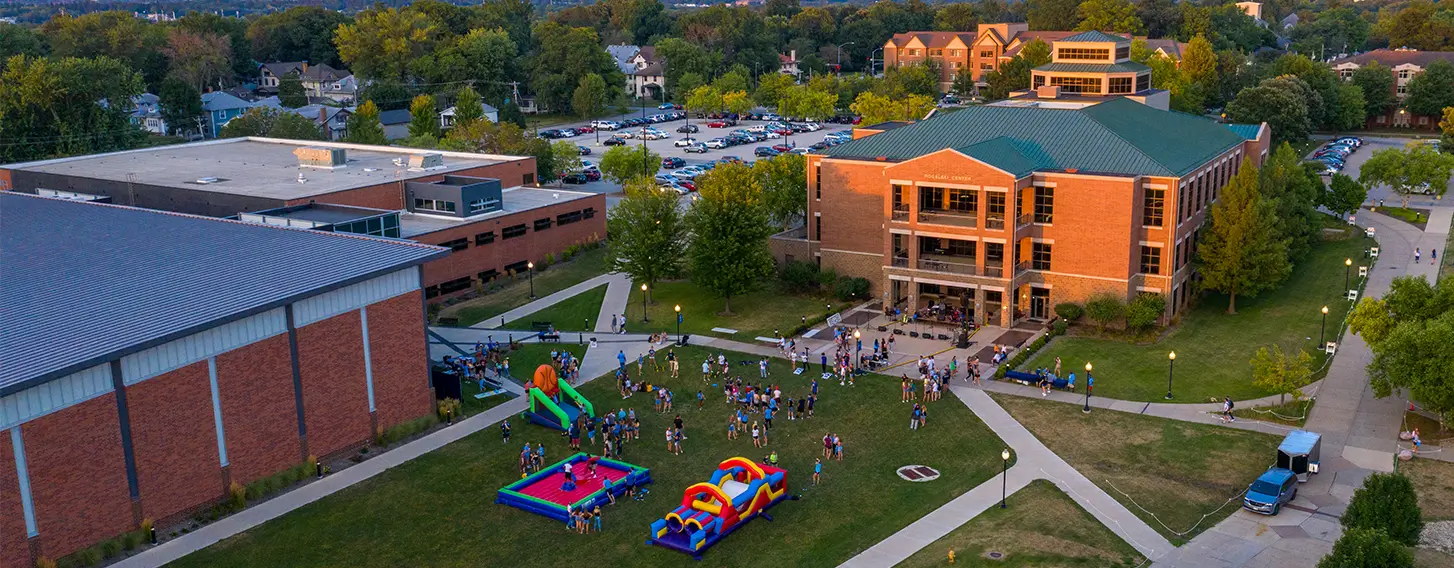
Life at St. Ambrose revolves around an active, residential campus in Davenport. The university promotes a "welcoming and walkable" environment where involvement—whether in athletics, clubs, or faith-based activities—is a central part of the experience.
Campus & Housing: The university strongly encourages living on campus to foster community and provide easy access to academic resources. It maintains nine residence halls offering a range of options from traditional dormitories to apartment-style living and townhouses.
Activities & Athletics: Student life is described as being about "academics–and so much more." The university fields 31 varsity sports programs, making athletics a major social and communal hub. Beyond sports, students have access to a variety of clubs, events, and faith and social justice opportunities. Socializing often happens through these organized channels, with off-campus students also connecting through work-study jobs and athletic involvement.
Community Vibe: The overall atmosphere is portrayed as supportive and engaged, designed to help students hone their skills and build networks within a close-knit setting.
St. Ambrose measures its success by graduation rates and the career readiness of its alumni. The outcomes data suggests a university that effectively supports the majority of its students to degree completion and positions them for solid earning potential.
Graduation & Retention: The university reports a six-year graduation rate around the mid-60s percentile, with specific sources citing figures of 63%, 64%, and 66%. The first-year student retention rate is reported as 76%, indicating that most who start at Ambrose are satisfied enough to return for a second year.
Post-Graduate Earnings: The median earnings for alumni ten years after starting at the university is a robust figure, reflecting the market value of its career-focused degrees in business and health. This strong outcome contributed to its recognition by Money magazine, which specifically includes "alumni outcomes—including salary data and career success" in its ranking methodology.
St. Ambrose is a private university with a sticker price that is offset for most students by significant institutional aid. The financial aid process is heavily emphasized, with tools and support designed to make the clear and accessible.
Net Price & Aid Prevalence: The average net price—the cost after grants and scholarships are applied—is a key figure for families. A very high percentage of full-time beginning undergraduates receive grant or scholarship aid, with one source stating 100% of such students receive this type of support.
Financial Aid Resources: The university provides a Net Price Calculator on its website to help families estimate their actual cost. It also details the various types of federal and state financial aid available and outlines its commitment to transparent financial aid policies in compliance with state and federal requirements.
Aid Policies: The provided sources do not specify whether St. Ambrose has a formal "no-loan" policy or a commitment to meet 100% of demonstrated financial need without loans. Families are directed to the university's financial aid office and net price calculator for personalized packaging details.
Saint Ambrose University carves out a distinct niche by unapologetically merging a Catholic, liberal arts ethos with the pragmatism of a career college. It doesn't try to be everything to everyone; instead, it excels at being a specific something for a specific someone.
Its standout identity is built on three pillars. First, its high-access, high-support model creates a pathway for a broad range of students to enter and succeed in higher education, backed by a solid retention rate. Second, its academic focus is remarkably concentrated; the campus culture is dominated by future business leaders and healthcare professionals, creating a cohesive, goal-oriented environment where networking and internships are part of the fabric. Finally, it delivers a notable return on investment, as evidenced by strong median earnings for graduates—a tangible result of its career-centric mission. This isn't a university of abstract theory; it's a launchpad for practical, values-driven careers, wrapped in the community of a residential campus where involvement is expected and support is personal.
Saint Ambrose University seal · sourceCampus Location | St. Ambrose University · sourceHistory of SAU | St. Ambrose University · sourceCampus Location | St. Ambrose University · source