Admit rate has ranged 84%–92% over the last 5 years — notably volatile, though the latest figure above (81%) falls outside that window. Source: IPEDS via Urban Institute.
Acceptance & SAT from Common Data Set / IPEDS; net price, earnings & graduation from the U.S. Dept. of Education College Scorecard. Figures lag ~1–2 years — verify with the school.
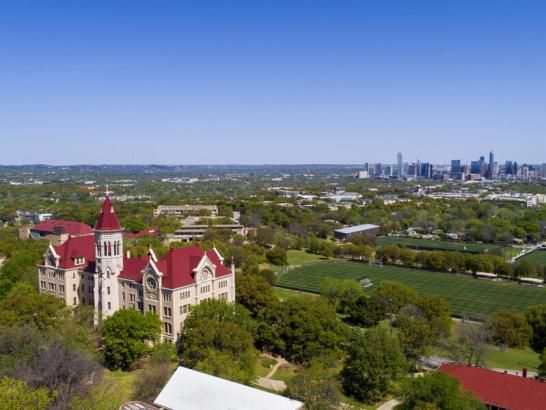
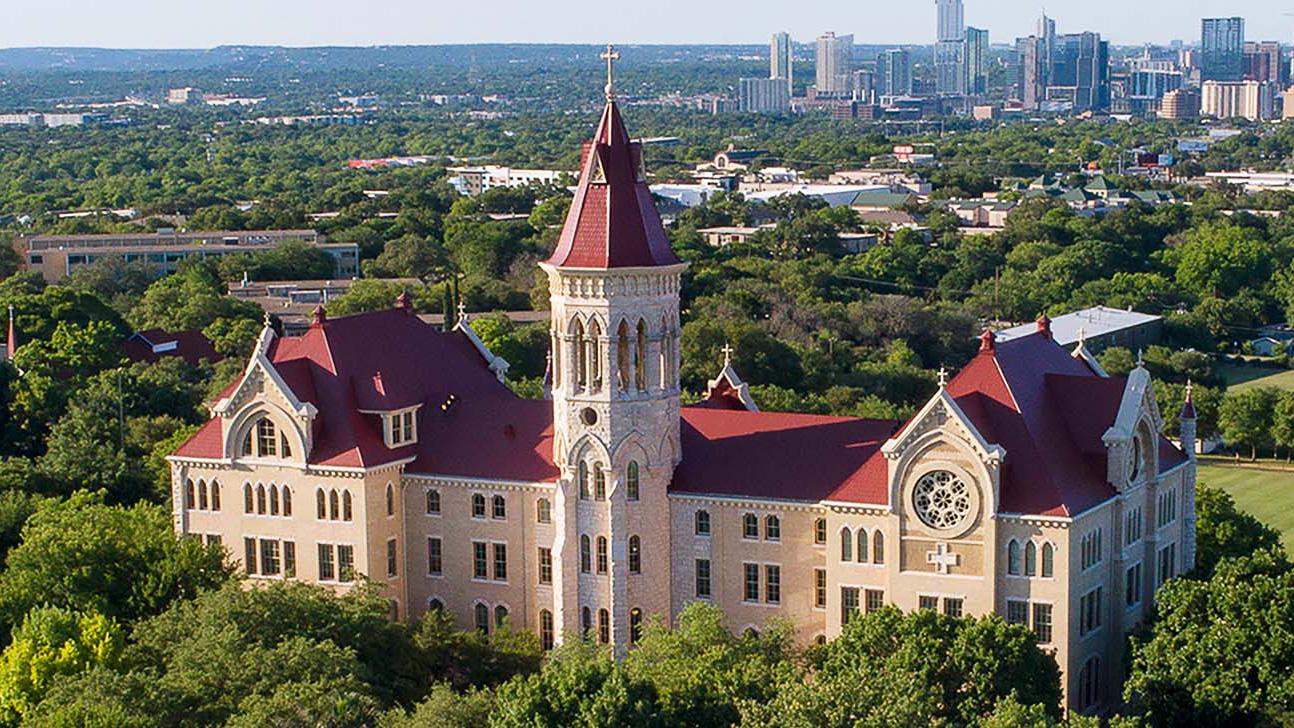
Saint Edward's University is a Holy Cross liberal arts college perched on a hilltop in Austin, offering a surprisingly intimate, small-class experience in the heart of a booming tech and cultural capital. With an 81% acceptance rate, it's an accessible gateway to a hands-on education where business and psychology dominate the majors, and the campus vibe is a unique blend of Catholic tradition and Austin's eclectic energy. The school's identity is defined by this contrast: a tight-knit, mission-driven community looking out over one of America's most dynamic cities.
Admission requirements
Test-optional — scores considered if submitted
Required
High school transcript
Grade point average
Letters of recommendation
TOEFL (non-native English)
Considered (not required)
Class rank
Test scores (SAT/ACT)
College-prep program
Demonstrated competencies
Source: IPEDS Admissions survey (2022) via Urban Institute. Covers formal factors only — it does not reflect essays, extracurriculars, or other holistic criteria.
More details
Undergrad enrollment
2,493
In-state tuition
$51,384
Out-of-state tuition
$51,384
Graduation Rate
63%
On-Campus Housing
51%
Most Popular Major
Business (22%)
Median Earnings (10yr)
$58,826
Student-to-Faculty Ratio
12:1
Outcomes & value
Outcomes & value
Median earnings (10 yr)
$58,826
Value (earnings ÷ net price)
2.3×
Median debt at graduation
$24,803
Graduation rate
63%
First-year retention
80%
Reducing loan balance (3 yr)
63%
Pell (lower-income) share
42%
First-gen share (among federal-aid recipients)
33%
Top-earning majors
Median earnings by field of study (highest credential), ~2 years after completion.
Accounting and Related Services$53,358
Multi/Interdisciplinary Studies, Other$50,856
Finance and Financial Management Services$50,856
Business Administration, Management and Operations$46,924
Teacher Education and Professional Development, Specific Subject Areas$46,087
Radio, Television, and Digital Communication
Campus & location
Campus safety
On-campus violent crimes (2024)
1
Per 1,000 students
0.33
On-campus criminal offenses classed as violent (murder/non-negligent manslaughter, rape, robbery, aggravated assault) for the most recent reported year. Source: U.S. Dept. of Education Campus Safety and Security (Clery Act). Counts reflect what’s reported to the school, and urban campuses often report more partly due to non-student incidents nearby — read alongside campus size and setting, not as a standalone safety verdict.
Climate
Pleasant days / yr
100
Summer high
95°F
Winter low
45°F
Annual rain
46.3"
Annual snow
1.5"
Natural-hazard risk
Relatively High
Pleasant days counts days per year with a mean temperature of 55–75°F, a high at or below 90°F, a low at or above 45°F, and little precipitation — a transparent comfort measure, not a weighting we invented. Computed from Open-Meteo ERA5 daily history (2019–2023). Natural-hazard risk is the county’s composite rating from the FEMA National Risk Index.
Deep dive — research, future-scholar output & economic mobility▾
Research output
Institutional h-index
88
Scholarly works
1,581
Institutional research volume and impact from OpenAlex. The h-index reflects large research universities and will be low for teaching-focused liberal-arts colleges — not a measure of undergraduate quality.
Quick answers
What is the acceptance rate at Saint Edward's University?
Saint Edward's University's acceptance rate is approximately 81% (Austin, TX), based on the most recent figures we compiled from public and primary sources.
What SAT score do you need for Saint Edward's University?
Admitted students at Saint Edward's University typically score 970–1240 on the SAT (the middle-50% range). Scores outside this band are still admitted, especially with strong applications.
How much does Saint Edward's University cost?
At Saint Edward's University, the average net price (after aid) is about $25,578 per year. Actual cost varies with financial aid and residency.
How many undergraduates attend Saint Edward's University?
Saint Edward's University enrolls approximately 2,493 undergraduate students.
Where is Saint Edward's University located?
Saint Edward's University is located in Austin, TX.
Admissions
Saint Edward's operates with an accessible admissions process, admitting a significant majority of its applicants. For the 2024-2025 academic year, the university received 5,830 applications and admitted 4,747, resulting in the canonical of 81%.
The middle 50% SAT range for admitted students is 970–1240, and the middle 50% ACT range is 21–27. Notably, the rate—the percentage of admitted students who choose to enroll—is relatively low at 9.54%, a trend that suggests admitted students often have multiple attractive options. The university accepts the Common Application and has a regular decision deadline of May 1. There is no mention of an Early Decision program or a binding early application option in the provided sources. The university's policy on 'demonstrated interest'—whether it tracks campus visits or engagement—is not explicitly stated in the available data; determining this would require consulting the C7 section of its , which is not provided here.
Earnings = median of students working ~10 years after entry; debt = median of graduates. Value divides 10-yr earnings by one year’s net price — read it as earnings per dollar of annual cost, not a full lifetime ROI; it favors lower-cost schools. Source: U.S. Dept. of Education College Scorecard. Figures lag ~2 years and reflect all students, not your intended major.
$41,193
Marketing$40,089
International Business$38,289
Source: U.S. Dept. of Education College Scorecard (field-of-study earnings). Figures cover graduates who received federal aid and lag ~2 years; not all programs report data.
Academics at St. Edward's are defined by close faculty interaction and a practical, hands-on approach within a liberal arts framework. The student-to-faculty ratio is an intimate 12:1, leading to small, discussion-based classes where, as one source notes, students can expect to write 'a lot of papers.' The university offers 65 majors.
The most popular fields of study are unmistakably clear. For the 2024 graduating class, Business, Management, Marketing, and Related Support Services accounted for 22% of degrees conferred. Psychology was the second most popular major at 13%, followed by Visual and Performing Arts at 11%. This aligns with student observations that psychology and business management are top choices. The university's criminal justice and design programs are also ranked favorably by external reviewers. The six-year graduation rate is reported by one source as 66%, though the canonical figure provided is 63%.
Life on the 'Hilltop' blends a traditional, residential campus experience with the relentless pulse of Austin just minutes away. About 51% of students live in college-owned, -operated, or -affiliated housing, creating a core residential community, while 49% live off-campus. The university fosters a vibrant campus life with over 100 student organizations, including cultural groups like LSLO (Latinx Student Leadership Organization), which is dedicated to 'uplifting culture and student involvement.'
As a Holy Cross institution, Catholic identity is present but not monolithic; approximately 50% of students identify as Catholic, while the other 50% represent 34 different faith traditions. This creates a spiritually inclusive environment. The campus itself is described as the 'center of campus life,' where students engage in wellness activities, faith-based programs, and the typical whirlwind of club meetings and social events. The proximity to Austin means students have immediate access to the city's legendary music, food, and tech scenes, making the St. Edward's experience a hybrid of cloistered college life and urban exploration.
Post-graduation outcomes for St. Edward's alumni show earnings that grow substantially over time. The canonical median earnings 10 years after entry is $58,826. Earlier in their careers, graduates report a median salary of approximately $37,814 one year after graduation, which increases to about $56,788 five years out.
The six-year graduation rate is cited as 64% in one source, though the canonical figure is 63%. This rate is noted as being a little lower than the national average. Specific major outcomes vary; for example, graduates in Accounting and Related Services have been reported with an average income around $48,585. The university's location in Austin, a major hub for technology and business, likely provides a strong regional career network for graduates.
The sticker price for St. Edward's is significant, with tuition and fees at $70,682 and room and board adding $14,358 for a total around $85,040. However, the university is aggressive with financial aid to bring down the for most families.
Seventy percent of students receive financial aid, with the average aid package totaling $45,652. This results in an average net price after aid of $25,578 (the canonical figure). The university offers need-based grants to U.S. citizens and legal residents who qualify via the FAFSA. It encourages all prospective students to use its online Net Price Calculator, promising an estimate of scholarships and grants within five minutes. The provided sources do not indicate that St. Edward's has a 'no-loan' policy or that it meets 100% of demonstrated financial need for all admitted students without using loans.
Saint Edward's University stands out for its potent and unique synthesis of contrasting elements. It is a Holy Cross liberal arts college with a social justice mission, planted firmly in the secular, entrepreneurial heart of Austin. This isn't a sheltered enclave; it's a hilltop perch overlooking one of America's most dynamic cities, and that geography defines the experience. Students get the close-knit community, small classes (12:1 ratio), and personal attention of a classic liberal arts college, but their internships, cultural diet, and career networks are fed by Austin's booming tech, music, and startup scenes.
The academic profile is pragmatic and popular, dominated by business and psychology, reflecting a student body focused on applied, marketable skills. Demographically, the campus is a fascinating blend—about half Catholic and half from a wide spectrum of other faiths—which creates a more inclusive and diverse spiritual environment than the 'Catholic school' label might imply. With a high but a low , St. Edward's often serves as a compelling option for students who want the vibe of a small college without sacrificing access to a major metropolitan playground. It’s for the student who wants to discuss ethics in a seminar room one hour and be at a tech meetup or a legendary music venue the next.
Saint Edward's University seal · source4 Ways to See Our Campus · sourceThe College Tour: St. Edward's · sourceSt. Edward's University (@stedwardsuniversity) • Facebook · source