Loading…
← All schools
Salish Kootenai College
Pablo, MTpublicwww.skc.edu/
Avg net price
$7,945
Earnings (10 yr)
$32,725
Graduation rate
28%
Acceptance & SAT from Common Data Set / IPEDS; net price, earnings & graduation from the U.S. Dept. of Education College Scorecard. Figures lag ~1–2 years — verify with the school.
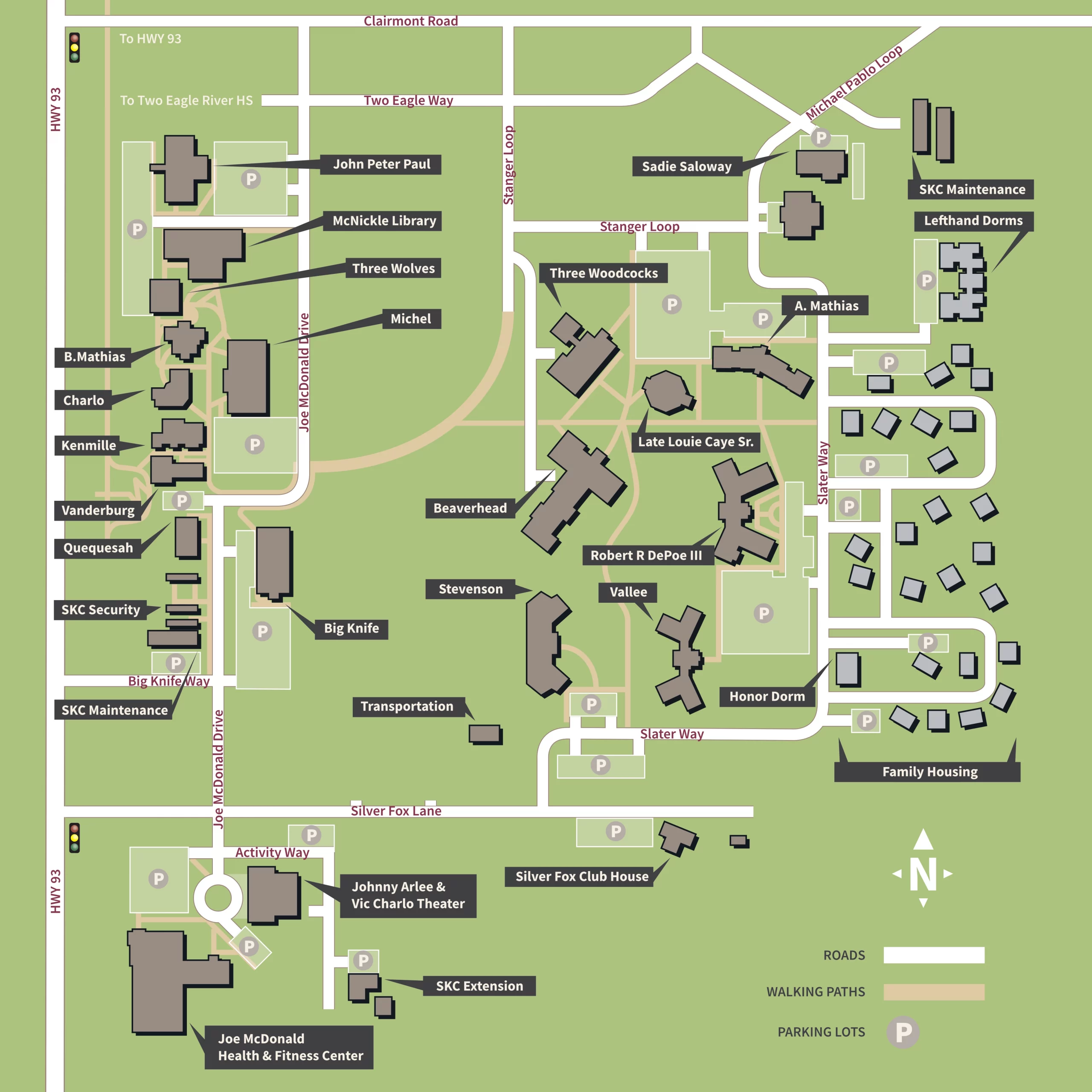
Salish Kootenai College is not just a college; it's a cultural anchor and a vital engine of opportunity on the Flathead Indian Reservation in Pablo, Montana. As a tribal college, its mission is inseparable from its identity, blending rigorous academic programs in high-demand fields with a profound commitment to perpetuating the living cultures of the Séliš, Ql̓ispé, and Ksanka peoples. The campus is intentionally family-friendly and community-centered, creating a supportive environment where education is a pathway to both personal success and tribal sovereignty.
More details
- Undergrad enrollment
- 580
- In-state tuition
- $4,311
- Out-of-state tuition
- $11,583
- Campus Vibe
- Family-friendly, culturally centered
- Graduation Rate
- 28%
- Notable Programs
- Nursing, Native American Studies, Environmental Science
- Median Earnings (10yr)
- $32,725
Outcomes & value
Outcomes & value
- Median earnings (10 yr)
- $32,725
- Value (earnings ÷ net price)
- 4.1×
- Median debt at graduation
- $12,923
- Graduation rate
- 28%
- First-year retention
- 82%
- Reducing loan balance (3 yr)
- 37%
- Pell (lower-income) share
- 58%
- First-gen share (among federal-aid recipients)
- 45%
Campus & location
Campus safety
- On-campus violent crimes (2024)
- 0
- Per 1,000 students
- 0.00
On-campus criminal offenses classed as violent (murder/non-negligent manslaughter, rape, robbery, aggravated assault) for the most recent reported year. Source: U.S. Dept. of Education Campus Safety and Security (Clery Act). Counts reflect what’s reported to the school, and urban campuses often report more partly due to non-student incidents nearby — read alongside campus size and setting, not as a standalone safety verdict.
Climate
- Pleasant days / yr
- 91
- Summer high
- 79°F
- Winter low
- 23°F
- Annual rain
- 17.1"
- Annual snow
- 51"
- Natural-hazard risk
- Relatively Low
Pleasant days counts days per year with a mean temperature of 55–75°F, a high at or below 90°F, a low at or above 45°F, and little precipitation — a transparent comfort measure, not a weighting we invented. Computed from Open-Meteo ERA5 daily history (2019–2023). Natural-hazard risk is the county’s composite rating from the FEMA National Risk Index.
Deep dive — research, future-scholar output & economic mobility
Research output
- Institutional h-index
- 50
- Scholarly works
- 239
Institutional research volume and impact from OpenAlex. The h-index reflects large research universities and will be low for teaching-focused liberal-arts colleges — not a measure of undergraduate quality.
Quick answers
- How much does Salish Kootenai College cost?
- At Salish Kootenai College, the average net price (after aid) is about $7,945 per year. Actual cost varies with financial aid and residency.
- How many undergraduates attend Salish Kootenai College?
- Salish Kootenai College enrolls approximately 580 undergraduate students.
- Where is Salish Kootenai College located?
- Salish Kootenai College is located in Pablo, MT.
Admissions
Salish Kootenai College operates with an open admissions policy, prioritizing access and serving its community. The process is straightforward and designed to be a gateway rather than a barrier. The criterion for admission is any one of the following: having earned a diploma from an accredited high school or having earned a High School Equivalency Credential. Prospective students fill out and submit the SKC Admission Application Form and will receive an email from SKC Admissions with important next steps. Multiple sources characterize the institution as having "open admissions," and external sites report an of 100%, with 1,072 applicants accepted from 1,072 who applied, resulting in an enrolled class of 636. Standardized test scores (SAT/ACT) are not a focal point of the admissions process, and sources indicate that score ranges are not reported or are not applicable. The college does not appear to have an Early Decision program in the traditional, binding sense; however, it does offer Early College Pathways for high school students to take college courses while completing their high school curriculum.
Compare Salish Kootenai College
vs University of Alaska Southeastvs University of Science and Arts of Oklahomavs University of Arkansas at Pine Bluffvs Northwestern Oklahoma State University
See colleges similar to Salish Kootenai College →Sources
- Common Data Set: Home
- Undergraduates: From Application to the First Day of Class
- Common Data Set Repository
- CDS-2024-2025-TEMPLATE.pdf
- Admissions Requirements - Salish Kootenai College
- Office of Institutional Research & Analytics
- Salish Kootenai College
- Salish Kootenai College - Tuition and Acceptance Rate
- Salish Kootenai College (SKC) Requirements
- Salish Kootenai College Admissions: Costs & More