Admit rate has ranged 42%–52% over the last 5 years — notably volatile, though the latest figure above (55%) falls outside that window. Source: IPEDS via Urban Institute.
Acceptance & SAT from Common Data Set / IPEDS; net price, earnings & graduation from the U.S. Dept. of Education College Scorecard. Figures lag ~1–2 years — verify with the school.
The San Francisco Conservatory of Music isn't just a school; it's a professional launchpad embedded in one of America's most vibrant cultural cities. With an acceptance rate that is surprisingly accessible for a top-tier conservatory, SFCM operates on a simple, high-stakes premise: your talent at the audition is the primary currency, not your SAT score. The result is an intensely focused, entrepreneurial environment where nearly every student receives significant merit aid to pursue a singular, all-consuming passion, graduating into the precarious but deeply rewarding world of professional music.
Admission requirements
Test-optional — scores considered if submitted
Required
High school transcript
Grade point average
Letters of recommendation
Demonstrated competencies
TOEFL (non-native English)
Considered (not required)
Test scores (SAT/ACT)
Source: IPEDS Admissions survey (2022) via Urban Institute. Covers formal factors only — it does not reflect essays, extracurriculars, or other holistic criteria.
More details
Undergrad enrollment
226
In-state tuition
$56,150
Out-of-state tuition
$56,150
Location
San Francisco, CA (Civic Center)
Graduation Rate
74%
First-Year Retention
93%
Merit Aid Recipients
99% of students
Demonstrated Interest
Not considered
Outcomes & value
Outcomes & value
Median debt at graduation
$27,000
Graduation rate
74%
First-year retention
93%
Reducing loan balance (3 yr)
59%
Pell (lower-income) share
17%
Endowment / student
$148,820
Earnings = median of students working ~10 years after entry; debt = median of graduates. Value divides 10-yr earnings by one year’s net price — read it as earnings per dollar of annual cost, not a full lifetime ROI; it favors lower-cost schools. Source: U.S. Dept. of Education College Scorecard. Figures lag ~2 years and reflect all students, not your intended major.
Financial health
3.0 / 3.0Meets the federal financial-responsibility standard
U.S. Dept. of Education Financial Responsibility Composite Score (FY2022-23). Scale −1.0 to 3.0; ≥1.5 meets the standard. Reported for private nonprofit & for-profit institutions only — public universities are state-backed and not scored, so this is a stability signal, not a ranking.
Top-earning majors
Median earnings by field of study (highest credential), ~2 years after completion.
Music$15,922
Source: U.S. Dept. of Education College Scorecard (field-of-study earnings). Figures cover graduates who received federal aid and lag ~2 years; not all programs report data.
Campus & location
Campus safety
On-campus violent crimes (2024)
0
Per 1,000 students
0.00
On-campus criminal offenses classed as violent (murder/non-negligent manslaughter, rape, robbery, aggravated assault) for the most recent reported year. Source: U.S. Dept. of Education Campus Safety and Security (Clery Act). Counts reflect what’s reported to the school, and urban campuses often report more partly due to non-student incidents nearby — read alongside campus size and setting, not as a standalone safety verdict.
Climate
Pleasant days / yr
198
Summer high
66°F
Winter low
46°F
Annual rain
23.6"
Natural-hazard risk
Very High
Pleasant days counts days per year with a mean temperature of 55–75°F, a high at or below 90°F, a low at or above 45°F, and little precipitation — a transparent comfort measure, not a weighting we invented. Computed from Open-Meteo ERA5 daily history (2019–2023). Natural-hazard risk is the county’s composite rating from the FEMA National Risk Index.
Deep dive — research, future-scholar output & economic mobility▾
Research output
Institutional h-index
11
Scholarly works
61
Institutional research volume and impact from OpenAlex. The h-index reflects large research universities and will be low for teaching-focused liberal-arts colleges — not a measure of undergraduate quality.
Quick answers
What is the acceptance rate at San Francisco Conservatory of Music?
San Francisco Conservatory of Music's acceptance rate is approximately 55% (San Francisco, CA), based on the most recent figures we compiled from public and primary sources.
How much does San Francisco Conservatory of Music cost?
At San Francisco Conservatory of Music, the average net price (after aid) is about $42,607 per year. Actual cost varies with financial aid and residency.
How many undergraduates attend San Francisco Conservatory of Music?
San Francisco Conservatory of Music enrolls approximately 226 undergraduate students.
Where is San Francisco Conservatory of Music located?
San Francisco Conservatory of Music is located in San Francisco, CA.
Admissions
Forget the common at liberal arts colleges; admission to SFCM hinges almost entirely on a musician's artistic promise. The school is notably less selective than elite national conservatories like Curtis (with its ~3% ), positioning itself as a more accessible gateway to high-level training. The process is straightforward but demanding: a live or recorded audition is paramount. Standardized test scores are explicitly not considered for admission, a policy that underscores the conservatory's focus on artistic merit over academic metrics. While the overall applicant pool is modest compared to large universities, the 55% acceptance rate reflects a gate kept by faculty in the audition room, not by an admissions committee weighing GPAs. The school does not appear to factor demonstrated interest into its decisions, aligning with a meritocratic, talent-first ethos. The admitted class is small, creating an intimate, studio-based environment from day one.
Primary Criteria: The audition is the definitive factor. Academic records are reviewed but are secondary to artistic evaluation.
Test-Optional Reality: SAT and ACT scores are not considered in the admissions process.
Selectivity Context: With a 55% acceptance rate, SFCM is considered "less selective" than many peer institutions, though this belies the rigorous standard of the audition.
SFCM's curriculum is a deep, immersive dive into music, built around the Bachelor of Music degree—described by the school as "one of the most robust and rewarding tracks of musical study available in the United States." The program is unapologetically specialized. The most popular majors are performance-focused: Musical Instruments, Voice and Opera, and Music Theory and Composition dominate. A notable and growing presence is the Music Technology program, reflecting a modern, entrepreneurial edge. The pedagogy is built on a "connected learning" approach, designed to break down barriers between academic study and performance, theory and practice. At the graduate level, SFCM offers a dynamic, two-year Master's program recognized for its professional development focus. The academic culture is that of a conservatory: demanding, practice-room-centric, and geared toward producing "entrepreneurial, culturally informed, and articulate" artists. Students live and breathe their instrument or craft, with academic coursework supporting the central mission of artistic excellence.
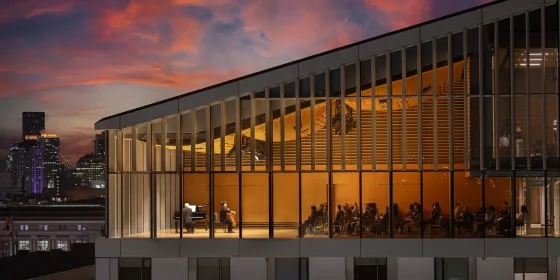
Life at SFCM is a hybrid of cloistered artistic intensity and urban exploration. The campus itself, centered at 50 Oak Street in the vibrant Civic Center area, is a hub of constant musical activity. The school emphasizes that living on campus in the Bowes Center has a "clear and profound impact on student persistence and engagement," fostering a tight-knit community of musicians. This community is the core of the social scene—collaborating in ensembles, practicing in shared spaces, and attending each other's recitals. Yet, the conservatory's walls are porous. The school actively leverages its San Francisco location, facilitating student interactions with touring artists and industry experts through workshops and side-by-side performance opportunities. Students are encouraged to engage with the city's immense cultural richness, from the Symphony and Opera across the street to the eclectic neighborhoods. Dining services, health and wellness resources, and transportation guidance are provided to help students navigate life in a major city while managing the rigorous demands of conservatory training. The overall vibe is professional and focused, with the city serving as an extended classroom and source of inspiration.
A conservatory education is a bet on a non-linear career path, and SFCM's outcomes reflect both the challenges and successes of that wager. The six-year graduation rate is a solid 74%, indicating strong student persistence through a demanding program. Where the data gets interesting is in post-graduation earnings. The median salary for graduates six years out is reported at $23,988—a figure that starkly illustrates the freelance, gig-based reality of many early-career musicians, where income can be sporadic and supplemented by teaching or other work. However, other sources suggest a higher median earnings figure of $50,407 four years after graduation, though still noted as below the national median. The school frames its outcomes around empowerment and unique career goals, leading to "high employment" and a "strong work-life balance" among alumni. The true outcome metric for a school like SFCM is less about a standardized salary and more about professional placement: are graduates playing in orchestras, recording studios, opera companies, or building sustainable careers as soloists and composers? The school's focus on entrepreneurial and culturally informed graduates suggests a preparation for the portfolio careers that define the modern music industry.
With a published tuition and fees of $56,150, SFCM is an expensive proposition. However, the conservatory deploys merit-based scholarships aggressively to offset this cost. The school states that 99% of students are awarded merit-based scholarships, with an average award covering 60% of tuition. This translates to significant discounts for nearly all admitted students. Furthermore, 100% of students receive some form of grant aid, with average grant awards around $19,350. The result is an average of $42,607. The financial aid office emphasizes that all students are awarded scholarship assistance and encourages families to file the FAFSA to access federal aid, including Direct Unsubsidized Loans (which are not need-based). The school provides a Net Price Calculator for personalized estimates. It's important to note that while scholarship support is nearly universal and substantial, SFCM is not listed among colleges that meet full demonstrated need with a no-loan policy; loans remain a component of many financial aid packages for families who need them to bridge the gap.
SFCM carves out a distinctive niche by marrying the intense, traditional focus of a conservatory with the innovative, entrepreneurial spirit of San Francisco. It stands out for its accessibility—a 55% is a world away from the sub-10% rates of its most elite competitors, offering a realistic pathway for serious musicians. It stands out for its meritocracy—where the audition is king, and test scores are irrelevant. It stands out for its generosity—awarding substantial merit scholarships to 99% of its students, making high-level training financially plausible. And crucially, it stands out for its location. The school doesn't just exist in San Francisco; it is integrated into its cultural fabric, turning the city's symphony halls, opera houses, tech studios, and eclectic arts scene into a living curriculum. This creates a graduate who is not only a skilled performer but also, as the school intends, culturally informed and entrepreneurial—equipped to build a career in the 21st-century music landscape.
San Francisco Conservatory of Music seal · sourceSan Francisco Conservatory of Music · sourceConnect & Visit | SFCM · sourceLife on Campus | SFCM · source
_-1.jpg?width=1600)