Loading…
← All schools
Santa Ana College
Santa Ana, CApublicwww.sac.edu/
Avg net price
$3,133
Earnings (10 yr)
$43,552
Graduation rate
31%
Acceptance & SAT from Common Data Set / IPEDS; net price, earnings & graduation from the U.S. Dept. of Education College Scorecard. Figures lag ~1–2 years — verify with the school.
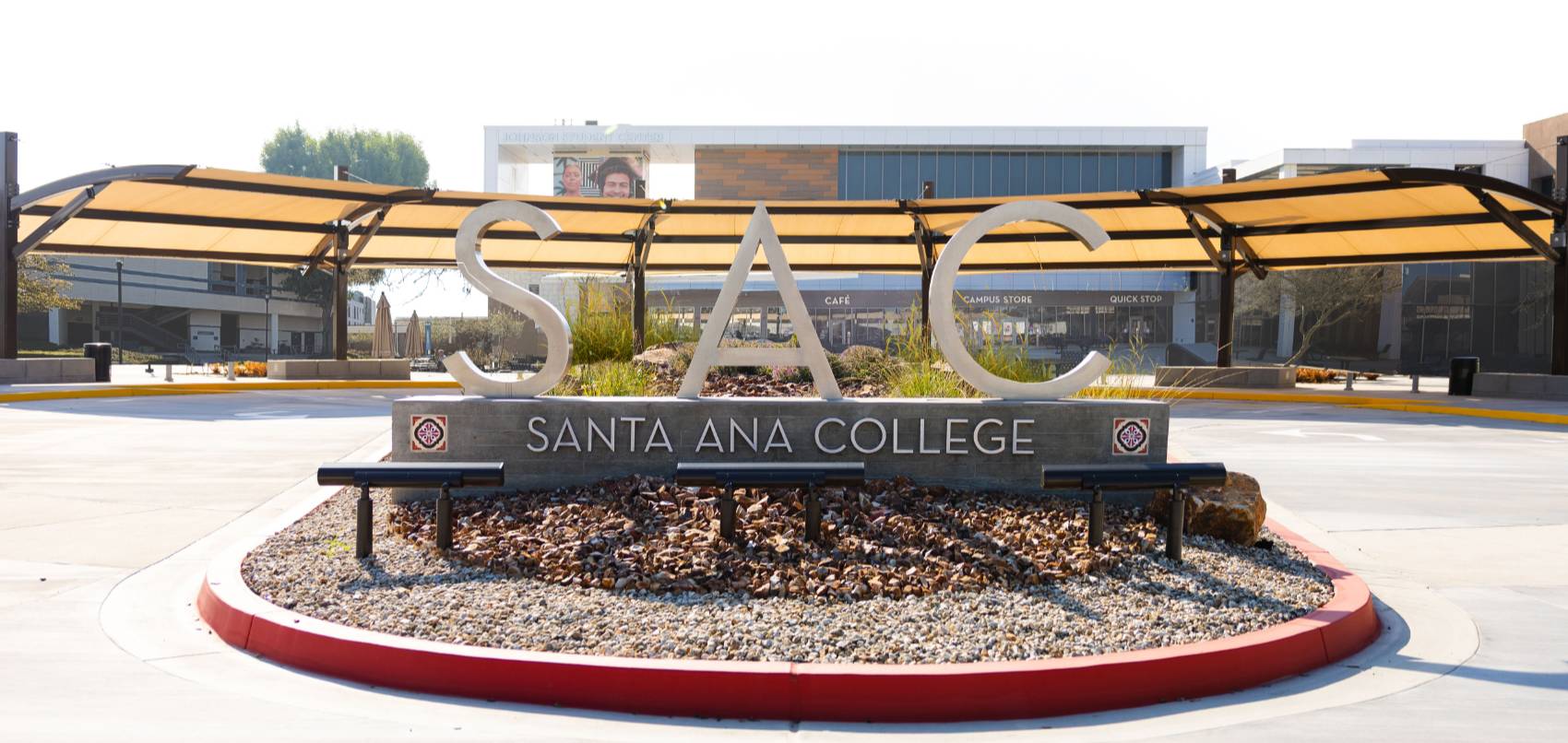
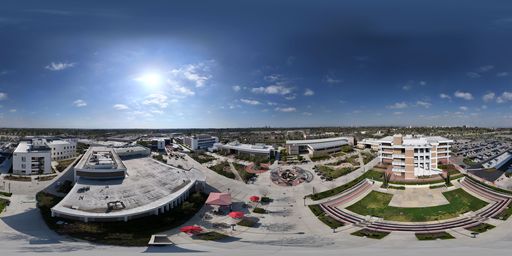
Santa Ana College is a sprawling, open-access community college in Orange County that operates less like a selective institution and more like a public utility for education and workforce training. Its identity is forged in its deep community roots, a vast catalog of over 250 programs, and a student body that is predominantly working-class and first-generation. This is a place of pragmatic ambition, where the goal isn't prestige but access: to an associate degree, a new career, a bachelor's degree via transfer, or simply the next step up.
More details
- Undergrad enrollment
- 22,485
- In-state tuition
- $1,180
- Out-of-state tuition
- $10,756
- Popular Majors
- Liberal Arts, Criminal Science, Fire Protection
- Graduation Rate
- 31%
- Student-Faculty Ratio
- 32:1
- Median Earnings (10yr)
- $43,552
- Bachelor's Degrees Offered
- Occupational Studies, Paralegal Studies, Automotive Technology
- First-Year Students Receiving Grant Aid
- 89%
Outcomes & value
Outcomes & value
- Median earnings (10 yr)
- $43,552
- Value (earnings ÷ net price)
- 13.9×
- Median debt at graduation
- $6,871
- Graduation rate
- 31%
- Reducing loan balance (3 yr)
- 46%
- Pell (lower-income) share
- 16%
- First-gen share (among federal-aid recipients)
- 70%
Earnings = median of students working ~10 years after entry; debt = median of graduates. Value divides 10-yr earnings by one year’s net price — read it as earnings per dollar of annual cost, not a full lifetime ROI; it favors lower-cost schools. Source: U.S. Dept. of Education College Scorecard. Figures lag ~2 years and reflect all students, not your intended major.
Campus & location
Campus safety
- On-campus violent crimes (2024)
- 0
On-campus criminal offenses classed as violent (murder/non-negligent manslaughter, rape, robbery, aggravated assault) for the most recent reported year. Source: U.S. Dept. of Education Campus Safety and Security (Clery Act). Counts reflect what’s reported to the school, and urban campuses often report more partly due to non-student incidents nearby — read alongside campus size and setting, not as a standalone safety verdict.
Climate
- Pleasant days / yr
- 263
- Summer high
- 83°F
- Winter low
- 48°F
- Annual rain
- 15"
- Natural-hazard risk
- Very High
Pleasant days counts days per year with a mean temperature of 55–75°F, a high at or below 90°F, a low at or above 45°F, and little precipitation — a transparent comfort measure, not a weighting we invented. Computed from Open-Meteo ERA5 daily history (2019–2023). Natural-hazard risk is the county’s composite rating from the FEMA National Risk Index.
Deep dive — research, future-scholar output & economic mobility
Research output
- Institutional h-index
- 50
- Scholarly works
- 583
Institutional research volume and impact from OpenAlex. The h-index reflects large research universities and will be low for teaching-focused liberal-arts colleges — not a measure of undergraduate quality.
Quick answers
- How much does Santa Ana College cost?
- At Santa Ana College, the average net price (after aid) is about $3,133 per year. Actual cost varies with financial aid and residency.
- How many undergraduates attend Santa Ana College?
- Santa Ana College enrolls approximately 22,485 undergraduate students.
- Where is Santa Ana College located?
- Santa Ana College is located in Santa Ana, CA.
Admissions
Santa Ana College practices open admissions, a policy that defines its mission. The is universally reported as 100%, meaning any applicant with a high school diploma or equivalent is admitted. This reflects its role as a public community college dedicated to access rather than selectivity. The process is administrative, not evaluative: the Admissions and Records Office focuses on supporting students through enrollment steps rather than judging applications. There is no mention of Early Decision, Early Action, or any form of early admission program in the provided sources, nor is demonstrated interest a factor—this is an institution where enrollment is the primary demonstration of interest. The admissions landscape is about navigating paperwork and deadlines, not competing for a spot.
Academics
The academic engine of SAC is its enormous and practical program array, designed for direct workforce entry or transfer. The college offers over 250 degrees and certificates across a wide spectrum. Its most popular majors, by graduation numbers, are Liberal Arts and Humanities (a classic transfer pathway), followed immediately by career-focused fields like Police and Criminal Science, and Fire Protection and Prevention. The scale is significant: the student-to-faculty ratio is 32:1, indicating large lecture halls are common, though this is typical for introductory courses at community colleges. A notable and recent evolution is SAC's entry into baccalaureate education; it now offers three Bachelor of Science degrees: in Occupational Studies, Paralegal Studies, and Automotive Technology. This allows students to pursue a four-year degree in high-demand technical fields without leaving the community college environment. The academic model is flexible and modular, built around the needs of students who are often balancing work, family, and school.
Compare Santa Ana College
vs University of North Georgiavs North Carolina A & T State Universityvs California State Polytechnic University-Pomonavs Eastern Kentucky University
See colleges similar to Santa Ana College →Sources
- Common Data Set: Home
- Admissions and Records - Santa Ana College
- The Common Data Set: What It Is & How to Use It In College ...
- Common Data Set | Pomona College in Claremont, California
- [PDF] CDS-2024-2025-TEMPLATE.pdf - Common Data Set
- Santa Ana College
- Santa Ana College
- Santa Ana College - Tuition and Acceptance Rate
- Santa Ana College Acceptance Rate
- Santa Ana College Admissions - BigFuture
- Santa Ana College - Profile, Rankings and Data