Loading…
← All schools
Schoolcraft Community College District
Livonia, MIpublicschoolcraft.edu
Avg net price
$2,260
Earnings (10 yr)
$42,722
Graduation rate
18%
Acceptance & SAT from Common Data Set / IPEDS; net price, earnings & graduation from the U.S. Dept. of Education College Scorecard. Figures lag ~1–2 years — verify with the school.
Schoolcraft Community College District is a public, open-door institution in Livonia, Michigan, built for practical, career-focused education. It operates with a distinctly no-frills, accessible ethos, welcoming over 8,500 predominantly part-time students into a sprawling catalog of over 130 programs, with particular renown in culinary arts and public safety. This is a college where the mission is clear: provide a low-cost, high-flexibility pathway to a certificate, an associate degree, or a transfer ticket, without the barriers of traditional admissions.
More details
- Undergrad enrollment
- 7,511
- In-state tuition
- $4,736
- Out-of-state tuition
- $8,142
- Loan Policy
- Does not certify PLUS or private loans
- Application Fee
- $0
- Graduation Rate
- 18%
- Part-Time Students
- 64.1%
- Demonstrated Interest
- Not considered (Open Admission)
- Student-Faculty Ratio
- 21:1
- Median Earnings (10yr)
- $42,722
Outcomes & value
Outcomes & value
- Median earnings (10 yr)
- $42,722
- Value (earnings ÷ net price)
- 18.9×
- Median debt at graduation
- $10,500
- Graduation rate
- 18%
- Reducing loan balance (3 yr)
- 30%
- Pell (lower-income) share
- 28%
- First-gen share (among federal-aid recipients)
- 43%
Earnings = median of students working ~10 years after entry; debt = median of graduates. Value divides 10-yr earnings by one year’s net price — read it as earnings per dollar of annual cost, not a full lifetime ROI; it favors lower-cost schools. Source: U.S. Dept. of Education College Scorecard. Figures lag ~2 years and reflect all students, not your intended major.
Campus & location
Campus safety
- On-campus violent crimes (2024)
- 0
On-campus criminal offenses classed as violent (murder/non-negligent manslaughter, rape, robbery, aggravated assault) for the most recent reported year. Source: U.S. Dept. of Education Campus Safety and Security (Clery Act). Counts reflect what’s reported to the school, and urban campuses often report more partly due to non-student incidents nearby — read alongside campus size and setting, not as a standalone safety verdict.
Climate
- Pleasant days / yr
- 90
- Summer high
- 81°F
- Winter low
- 23°F
- Annual rain
- 37.9"
- Annual snow
- 30.5"
- Natural-hazard risk
- Relatively High
Pleasant days counts days per year with a mean temperature of 55–75°F, a high at or below 90°F, a low at or above 45°F, and little precipitation — a transparent comfort measure, not a weighting we invented. Computed from Open-Meteo ERA5 daily history (2019–2023). Natural-hazard risk is the county’s composite rating from the FEMA National Risk Index.
Quick answers
- How much does Schoolcraft Community College District cost?
- At Schoolcraft Community College District, the average net price (after aid) is about $2,260 per year. Actual cost varies with financial aid and residency.
- How many undergraduates attend Schoolcraft Community College District?
- Schoolcraft Community College District enrolls approximately 7,511 undergraduate students.
- Where is Schoolcraft Community College District located?
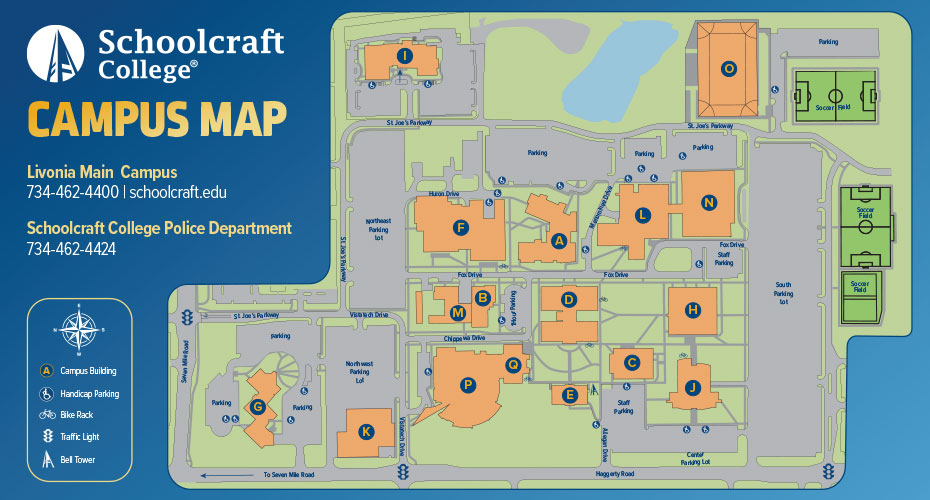
- Schoolcraft Community College District is located in Livonia, MI.
Admissions
Schoolcraft College's defining characteristic is its open-door admissions policy. There is no application fee, and the college is open to all applicants who are high school graduates or hold a GED. This policy results in a reported of 100%. The process is designed for maximum accessibility, with no mention of standardized test scores (SAT/ACT) as a requirement for general admission. As a community college, it does not employ selective admissions practices like Early Decision or Early Action, and demonstrated interest is not a factor in its open-enrollment model. The student body reflects this accessibility: total undergraduate enrollment was 7,596 in Fall 2023, with a significant majority (64.1%) attending part-time.
Compare Schoolcraft Community College District
vs Purdue University Northwestvs Indiana University-Northwestvs University of Akron Main Campusvs Southeast Missouri State University
See colleges similar to Schoolcraft Community College District →Sources
- [PDF] Comprehensive Quality Review - Schoolcraft College
- Schoolcraft Community College District - IPEDS
- Schoolcraft Community College District | Data USA
- [PDF] Common Data Set 2021-2022 - Colorado Department of Education
- Common Data Set: Home
- Student Outcomes - Schoolcraft College
- Schoolcraft Community College District - Sallie
- Schoolcraft College - Niche
- Admissions – Schoolcraft College – We help prospective students ...
- Schoolcraft College - Tuition and Acceptance Rate - Peterson's