Admit rate has ranged 74%–79% over the last 5 years. Source: IPEDS via Urban Institute.
Acceptance & SAT from Common Data Set / IPEDS; net price, earnings & graduation from the U.S. Dept. of Education College Scorecard. Figures lag ~1–2 years — verify with the school.
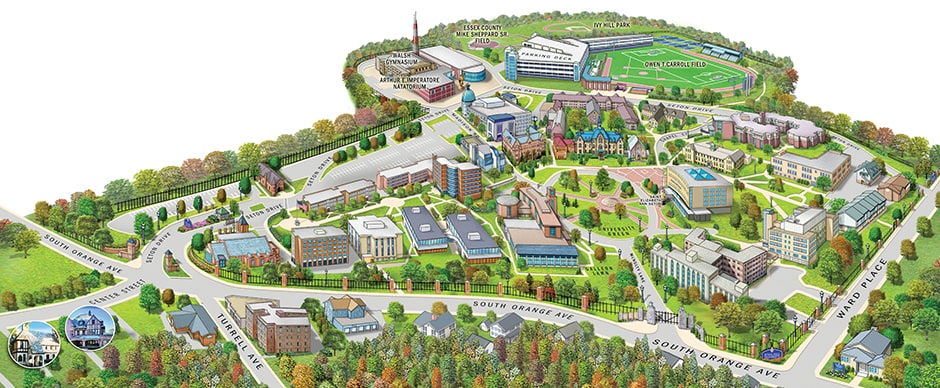
Seton Hall University is a private Catholic university in South Orange, New Jersey, that has become increasingly selective while maintaining a practical, career-focused identity. Its 58-acre campus, just 14 miles from Manhattan, offers a classic collegiate feel with a distinctly metropolitan edge, anchored by powerhouse programs in business, diplomacy, and health sciences. This is a place where tradition meets professional ambition, producing graduates with notably strong employment outcomes.
Admission requirements
Test-optional — scores considered if submitted
Required
High school transcript
Grade point average
Letters of recommendation
College-prep program
TOEFL (non-native English)
Considered (not required)
Class rank
Test scores (SAT/ACT)
Source: IPEDS Admissions survey (2022) via Urban Institute. Covers formal factors only — it does not reflect essays, extracurriculars, or other holistic criteria.
More details
Undergrad enrollment
6,036
In-state tuition
$53,170
Out-of-state tuition
$53,170
No-Loan Policy
Not Stated in Sources
Graduation Rate
69%
Meets Full Need
Not Stated in Sources
ED Share of Class
Not Stated in Sources
First-Year Retention
Not Stated in Sources
Demonstrated Interest
Considered
Median Earnings (10yr)
$70,196
Outcomes & value
Outcomes & value
Median earnings (10 yr)
$70,196
Value (earnings ÷ net price)
2.2×
Median debt at graduation
$22,750
Graduation rate
69%
First-year retention
81%
Reducing loan balance (3 yr)
70%
Pell (lower-income) share
32%
First-gen share (among federal-aid recipients)
28%
Financial health
3.0 / 3.0Meets the federal financial-responsibility standard
U.S. Dept. of Education Financial Responsibility Composite Score (FY2022-23). Scale −1.0 to 3.0; ≥1.5 meets the standard. Reported for private nonprofit & for-profit institutions only — public universities are state-backed and not scored, so this is a stability signal, not a ranking.
Top-earning majors
Median earnings by field of study (highest credential), ~2 years after completion.
Registered Nursing, Nursing Administration, Nursing Research and Clinical Nursing$74,576
Accounting and Related Services$64,791
Management Information Systems and Services$63,005
Business/Managerial Economics$55,914
Finance and Financial Management Services$55,693
Human Resources Management and Services
Campus & location
Campus safety
On-campus violent crimes (2024)
6
Per 1,000 students
0.63
On-campus criminal offenses classed as violent (murder/non-negligent manslaughter, rape, robbery, aggravated assault) for the most recent reported year. Source: U.S. Dept. of Education Campus Safety and Security (Clery Act). Counts reflect what’s reported to the school, and urban campuses often report more partly due to non-student incidents nearby — read alongside campus size and setting, not as a standalone safety verdict.
Climate
Pleasant days / yr
87
Summer high
84°F
Winter low
28°F
Annual rain
53.6"
Annual snow
20.5"
Natural-hazard risk
Relatively High
Pleasant days counts days per year with a mean temperature of 55–75°F, a high at or below 90°F, a low at or above 45°F, and little precipitation — a transparent comfort measure, not a weighting we invented. Computed from Open-Meteo ERA5 daily history (2019–2023). Natural-hazard risk is the county’s composite rating from the FEMA National Risk Index.
Deep dive — research, future-scholar output & economic mobility▾
Research output
Institutional h-index
171
Scholarly works
10,587
Institutional research volume and impact from OpenAlex. The h-index reflects large research universities and will be low for teaching-focused liberal-arts colleges — not a measure of undergraduate quality.
Economic mobility
Mobility rate
3.2%
Bottom → top quintile
42%
From bottom quintile
8%
Mobility rate = the share of students who both start in the bottom household-income quintile and reach the top quintile; bottom → top is that chance conditional on starting at the bottom. Source: Opportunity Insights Mobility Report Cards (Chetty, Friedman, Saez, Turner & Yagan). Reflects 1980–82 birth cohorts, so it’s directional, not current.
Quick answers
What is the acceptance rate at Seton Hall University?
Seton Hall University's acceptance rate is approximately 73% (South Orange, NJ), based on the most recent figures we compiled from public and primary sources.
What SAT score do you need for Seton Hall University?
Admitted students at Seton Hall University typically score 1220–1390 on the SAT (the middle-50% range). Scores outside this band are still admitted, especially with strong applications.
How much does Seton Hall University cost?
At Seton Hall University, the average net price (after aid) is about $31,446 per year. Actual cost varies with financial aid and residency.
How many undergraduates attend Seton Hall University?
Seton Hall University enrolls approximately 6,036 undergraduate students.
Where is Seton Hall University located?
Seton Hall University is located in South Orange, NJ.
Admissions
Seton Hall's admissions process is moderately selective and notably holistic, where demonstrated interest is an explicit factor alongside academic performance. The university accepts the Common Application and maintains a policy. For the admitted class, the average high school GPA is a 3.68 (B+), and the middle 50% SAT range is 1240–1380 (or 26–30 on the ACT). The university's own counselor handbook lists an average SAT of 1328 and an of 69%, while other sources, including U.S. News, peg the rate at 73%. Notably, the admission rate has dropped by nearly 10 percentage points in recent years, from 79% in 2023 to 69% in 2025, indicating a trend toward greater selectivity. The university's FAQ page confirms that while academic performance is primary, demonstrated interest is considered in the process—a fact corroborated by external guides that list Seton Hall among colleges that track this metric. rates—the percentage of admitted students who enroll—have historically hovered around 8-9%.
Earnings = median of students working ~10 years after entry; debt = median of graduates. Value divides 10-yr earnings by one year’s net price — read it as earnings per dollar of annual cost, not a full lifetime ROI; it favors lower-cost schools. Source: U.S. Dept. of Education College Scorecard. Figures lag ~2 years and reflect all students, not your intended major.
$48,198
Economics$44,971
Marketing$43,319
Source: U.S. Dept. of Education College Scorecard (field-of-study earnings). Figures cover graduates who received federal aid and lag ~2 years; not all programs report data.
Seton Hall offers over 90 undergraduate majors and programs across its core colleges: Arts and Sciences; Business; Diplomacy and International Relations; Health and Medical Sciences; and Human Development, Culture, and Media. The curriculum is described as rigorous, with programs highly ranked by The Princeton Review, U.S. News, and Bloomberg Businessweek. Popular majors include Psychology, Humanities/Humanistic Studies, International Relations and Affairs, and Criminal Justice/Safety Studies. The university emphasizes practical, career-oriented education, facilitated by dual-degree arrangements and graduate admissions criteria that allow students to articulate degrees across fields. This structure supports a direct pipeline from undergraduate study to professional advancement, particularly in its signature schools of Business and Diplomacy.
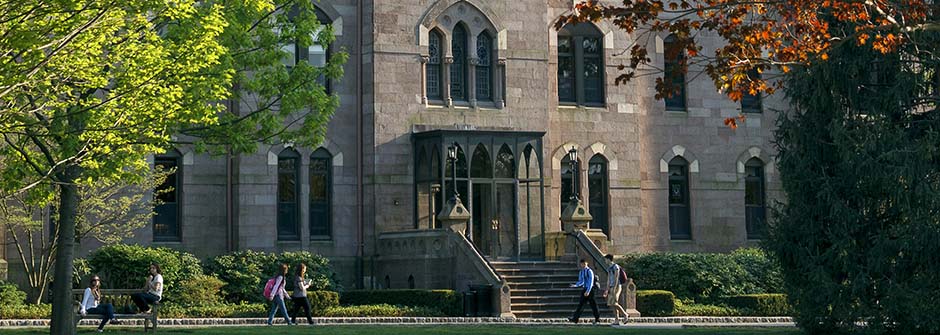
Life on Seton Hall's 58-acre main campus is described as active and bustling, with events and activities scheduled seven days a week. The student body is geographically diverse, hailing from all 50 states and over 50 countries, creating what the university calls a 'kaleidoscope of experiences and perspectives.' About half of the undergraduate population lives on campus, fostering a close-knit community. The campus provides a wealth of employment, recreation, social, cultural, and learning activities. Its location in South Orange, New Jersey—a suburb just 14 miles from New York City—is a defining feature, offering easy access to the internships and cultural capital of Manhattan while maintaining a traditional collegiate environment. Student perspectives note that while the surrounding area can be 'sketchy,' the university does a good job of creating a safe, healthy environment for learning and spiritual growth.
Seton Hall graduates enter the workforce with a significant advantage, as evidenced by strong post-graduation metrics. The university reports an overall employment rate of 96.6% and a graduate school of 98.3% for its graduating seniors, leading to a 97.4% overall success rate. Its four-year graduation rate is 24 points higher than the last reported national average, with 11% of students graduating in less than four years. Other sources cite an overall graduation rate of 71%, placing it in the top 25% nationally. This focus on timely completion and career readiness translates into solid financial outcomes for alumni.
Seton Hall is a private institution with a published tuition and fee cost of $55,040. However, the university emphasizes affordability through institutional aid, stating that on average, students receive grants and scholarships from Seton Hall totaling nearly $25,000 per year. External sources report an average grant award of $20,519 and an average aid package of $29,861. The university states that every student who submits a complete FAFSA is considered for its institutional need-based grant programs. It's important to note that while the university meets demonstrated financial need for some loan programs, its aid materials discuss Unsubsidized Loans for which no remaining need is demonstrated, indicating it does not have a universal 'no-loan' policy for all students. Renewable merit scholarships are also available, ranging from $2,000 to $8,000 per year.
Seton Hall carves out a distinctive niche as a mid-sized Catholic university that successfully bridges a traditional campus experience with direct access to the professional epicenter of New York City. Its identity is less about ivory-tower abstraction and more about pragmatic preparation, a focus reflected in its standout schools of Business and Diplomacy and International Relations. The university has managed to increase its selectivity significantly in recent years while maintaining a community described as 'close-knit.' The data tells a compelling story of return on investment: students graduate at rates well above the national average and immediately step into strong career outcomes, with nearly 97% employed or in graduate school within months of receiving their diploma. For students seeking a classic college atmosphere without sacrificing proximity to world-class internships and networks, Seton Hall offers a potent combination of community, location, and results-oriented education.
Seton Hall University seal · sourceVisiting Seton Hall · sourceVisiting Seton Hall · sourceSeton Hall University - Profile, Rankings and Data | US News Best Colleges · source