Admit rate has ranged 74%–80% over the last 5 years. Source: IPEDS via Urban Institute.
Acceptance & SAT from Common Data Set / IPEDS; net price, earnings & graduation from the U.S. Dept. of Education College Scorecard. Figures lag ~1–2 years — verify with the school.
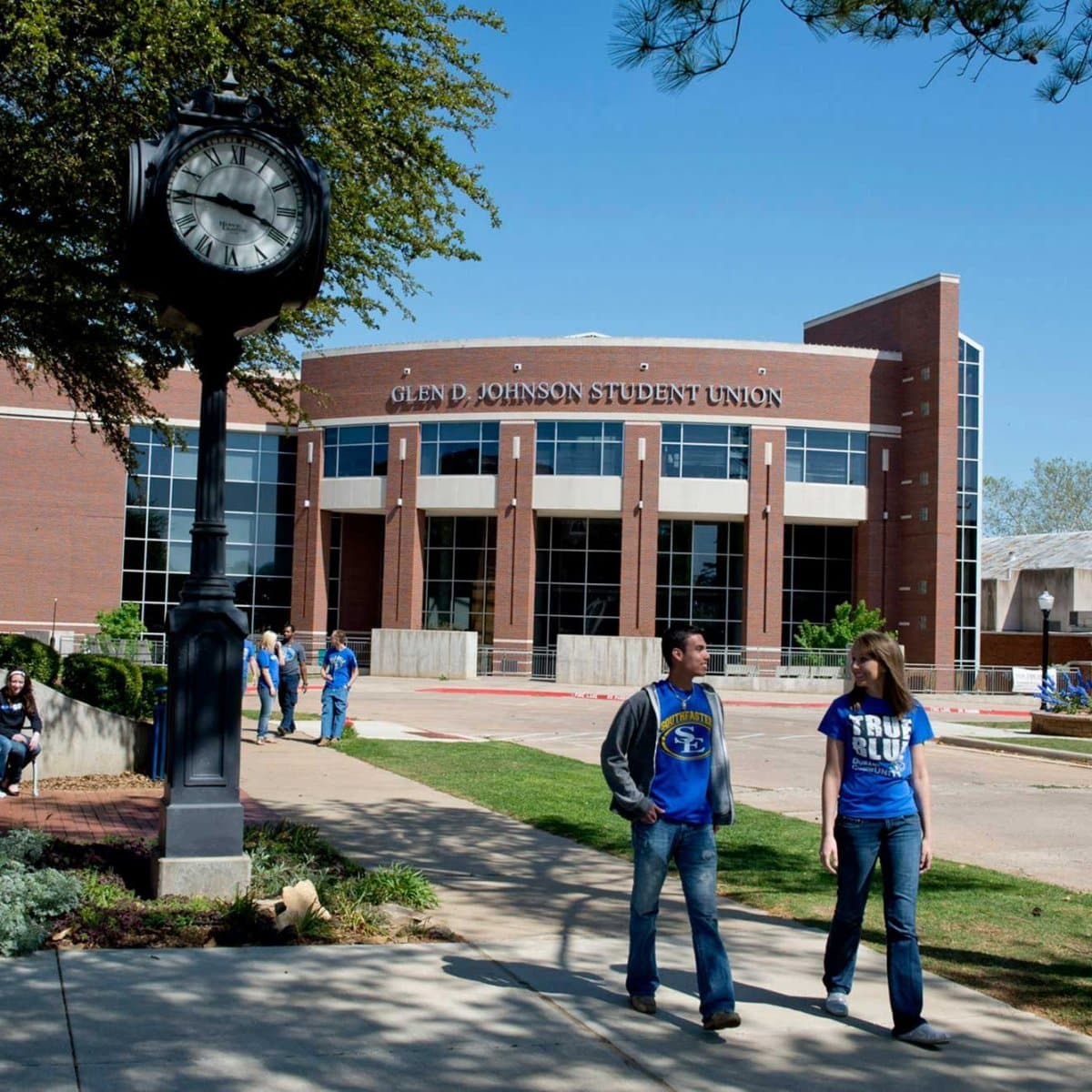
Southeastern Oklahoma State University is a regional public university in Durant that serves as an accessible, practical launchpad for students from southeastern Oklahoma and beyond. It operates with a straightforward, test-optional admissions philosophy and leans heavily into career-focused programs like Aviation Management and Occupational Safety, alongside a robust suite of online degrees. The campus vibe is small and close-knit, with Greek life and student events providing a traditional college experience, though its graduation rates and post-college earnings reflect the challenges typical of a regional institution serving a high proportion of Pell Grant recipients.
Admission requirements
Test scores required
Required
High school transcript
Grade point average
Class rank
Test scores (SAT/ACT)
TOEFL (non-native English)
Source: IPEDS Admissions survey (2022) via Urban Institute. Covers formal factors only — it does not reflect essays, extracurriculars, or other holistic criteria.
More details
Undergrad enrollment
3,018
In-state tuition
$7,530
Out-of-state tuition
$16,740
Greek Life
5 organizations (2 sororities, 3 fraternities)
Popular Majors
Liberal Arts, Occupational Safety, Business
Graduation Rate
32%
Median Earnings (10yr)
$45,079
Students Receiving Grant/Scholarship Aid
96%
Outcomes & value
Outcomes & value
Median earnings (10 yr)
$45,079
Value (earnings ÷ net price)
5.6×
Median debt at graduation
$17,000
Graduation rate
32%
First-year retention
63%
Reducing loan balance (3 yr)
50%
Pell (lower-income) share
42%
First-gen share (among federal-aid recipients)
44%
Top-earning majors
Median earnings by field of study (highest credential), ~2 years after completion.
Quality Control and Safety Technologies/Technicians$46,087
Management Sciences and Quantitative Methods$46,087
Teacher Education and Professional Development, Specific Subject Areas$37,208
Teacher Education and Professional Development, Specific Levels and Methods$32,569
Psychology, General$32,391
Criminal Justice and Corrections
Campus & location
Campus safety
On-campus violent crimes (2024)
1
Per 1,000 students
0.18
On-campus criminal offenses classed as violent (murder/non-negligent manslaughter, rape, robbery, aggravated assault) for the most recent reported year. Source: U.S. Dept. of Education Campus Safety and Security (Clery Act). Counts reflect what’s reported to the school, and urban campuses often report more partly due to non-student incidents nearby — read alongside campus size and setting, not as a standalone safety verdict.
Climate
Pleasant days / yr
93
Summer high
92°F
Winter low
38°F
Annual rain
46.6"
Annual snow
2.6"
Natural-hazard risk
Relatively Low
Pleasant days counts days per year with a mean temperature of 55–75°F, a high at or below 90°F, a low at or above 45°F, and little precipitation — a transparent comfort measure, not a weighting we invented. Computed from Open-Meteo ERA5 daily history (2019–2023). Natural-hazard risk is the county’s composite rating from the FEMA National Risk Index.
Deep dive — research, future-scholar output & economic mobility▾
Research output
Institutional h-index
57
Scholarly works
1,152
Institutional research volume and impact from OpenAlex. The h-index reflects large research universities and will be low for teaching-focused liberal-arts colleges — not a measure of undergraduate quality.
Economic mobility
Mobility rate
3.2%
Bottom → top quintile
18%
From bottom quintile
18%
Mobility rate = the share of students who both start in the bottom household-income quintile and reach the top quintile; bottom → top is that chance conditional on starting at the bottom. Source: Opportunity Insights Mobility Report Cards (Chetty, Friedman, Saez, Turner & Yagan). Reflects 1980–82 birth cohorts, so it’s directional, not current.
Quick answers
What is the acceptance rate at Southeastern Oklahoma State University?
Southeastern Oklahoma State University's acceptance rate is approximately 76% (Durant, OK), based on the most recent figures we compiled from public and primary sources.
What SAT score do you need for Southeastern Oklahoma State University?
Admitted students at Southeastern Oklahoma State University typically score 980–1186 on the SAT (the middle-50% range). Scores outside this band are still admitted, especially with strong applications.
How much does Southeastern Oklahoma State University cost?
At Southeastern Oklahoma State University, the average net price (after aid) is about $8,039 per year. Actual cost varies with financial aid and residency.
How many undergraduates attend Southeastern Oklahoma State University?
Southeastern Oklahoma State University enrolls approximately 3,018 undergraduate students.
Where is Southeastern Oklahoma State University located?
Southeastern Oklahoma State University is located in Durant, OK.
Admissions
Southeastern Oklahoma State University maintains an accessible, moderately selective admissions process designed to serve the region. With an of 76%, the university admits a significant majority of its applicants. The middle 50% SAT range for admitted students is 980–1186, and the ACT range is 18–24. The university outlines clear, attainable criteria for automatic admission: a high school GPA of 2.7 or higher combined with ranking in the upper 50% of one's class, OR an ACT composite score of 20 (or SAT equivalent). Notably, submitting standardized test scores is optional. The admissions office does not appear to offer an Early Decision program, focusing instead on a standard rolling or regular decision cycle. While the is a standard resource for understanding admissions factors, the specific Southeastern CDS document detailing the relative importance of factors like 'level of applicant's interest' was not available among the provided sources to confirm whether demonstrated interest is considered.
Earnings = median of students working ~10 years after entry; debt = median of graduates. Value divides 10-yr earnings by one year’s net price — read it as earnings per dollar of annual cost, not a full lifetime ROI; it favors lower-cost schools. Source: U.S. Dept. of Education College Scorecard. Figures lag ~2 years and reflect all students, not your intended major.
$28,598
Human Development, Family Studies, and Related Services$23,649
Liberal Arts and Sciences, General Studies and Humanities$22,329
Source: U.S. Dept. of Education College Scorecard (field-of-study earnings). Figures cover graduates who received federal aid and lag ~2 years; not all programs report data.
Southeastern's academic identity is defined by practicality and regional workforce needs. The university offers over 55 undergraduate degree plans and options, with a distinct emphasis on career-oriented and professional fields. Its most popular majors, according to Niche, are Liberal Arts and Humanities, Occupational Safety and Health Technician, and Business. The university promotes an 'array of unique programs,' notably highlighting Aviation Management and Occupational Safety. Beyond traditional on-campus offerings, Southeastern has developed a substantial online presence, providing fully online undergraduate majors in fields like Accounting, Computer Information Systems, Criminal Justice, and Early Intervention & Childhood Development. This dual delivery model—combining a physical campus in Durant with a growing online catalog—allows it to serve both traditional students and working adults across the region. The academic environment is described as one that 'provides an environment of academic excellence that enables students to reach their highest potential,' though specific data on class sizes or faculty-student ratios were not detailed in the provided sources.
Life at Southeastern revolves around a 'small, close-knit community' atmosphere on its Durant campus. The Office of Student Life positions itself as the 'gateway to your life on campus,' promoting involvement through student events, organizations, and campus culture. Greek life is a visible component of social life, with five national Greek organizations currently on campus: two sororities and three fraternities. The university actively fosters this community through events like welcome-back gatherings, as seen on its official Facebook page. While specific details on housing or dining are limited in the sources, the overall portrait is of a traditional, residential college experience where forming new friendships and participating in campus activities are central pillars. The campus culture appears to be actively nurtured by the administration, aiming to create a sense of belonging that extends beyond the classroom.
Outcomes data for Southeastern graduates presents a mixed picture, reflective of its mission and student population. The six-year graduation rate is 32%. Post-graduation earnings are modest; the median earnings 10 years after entry are $45,079. Earlier-career earnings are lower, with one source noting graduates earn 'about $34,000 in their early career,' which it describes as '$7,000 worse than might be expected' based on a comparison model. Another source reports median earnings one year after graduation at $36,427. The College Scorecard shows a 40% graduation rate, but the canonical figure of 32% overrides this. These metrics, combined with U.S. News ranking outcomes at 29 out of 100, underscore the challenges faced by many regional public universities in supporting students through to degree completion and into higher-earning career pathways.
Southeastern's most compelling financial attribute is its low . The average net price after aid is $8,039, which is significantly below the national midpoint for four-year colleges. A large majority of students receive grant aid, with one source indicating 96% of full-time beginning undergraduates receive grant or scholarship aid. The university encourages all students to use its Net Price Calculator to get an individualized estimate, defined as the minus estimated grant and scholarship aid. Financial aid support comes through federal programs like Pell Grants and SEOG, state programs like the Oklahoma Tuition Aid Grant, and a substantial number of institutional scholarships—the university boasts 229 endowed scholarships. Notably, a social media post from the university claims that 'Over 65% of first-time, full-time students in our state system graduate without federal loans!' suggesting a focus on grant-based aid. The university also states it does not use a preferred lender list for loans, adhering to a code of conduct.
Southeastern Oklahoma State University stands out for its unwavering commitment to serving as an accessible, low-cost educational engine for its region. It doesn't chase prestige or high rankings; instead, it focuses on providing clear pathways to a degree, particularly in high-demand, practical fields like Aviation Management and Occupational Safety and Health. Its , criteria-based admissions remove barriers to entry, while its extensive online program portfolio extends its reach to non-traditional students. The combination of a very low —far below the national average—and a reported high percentage of students graduating without federal debt makes it a financially sensible choice for cost-conscious families in Oklahoma and neighboring states. While graduation rates and earnings outcomes indicate room for improvement in student support and post-graduate success, the university's value proposition is clear: a straightforward, affordable, and community-focused college experience designed to launch students into the workforce with manageable debt.
Southeastern Oklahoma State University seal · sourceParent FAQ | Southeastern Oklahoma State University · sourceAbout Southeastern | Southeastern Oklahoma State University · sourceFacilities - English, Humanities, & Languages · source