Admit rate has ranged 43%–74% over the last 5 years — notably volatile. Source: IPEDS via Urban Institute.
Acceptance & SAT from Common Data Set / IPEDS; net price, earnings & graduation from the U.S. Dept. of Education College Scorecard. Figures lag ~1–2 years — verify with the school.
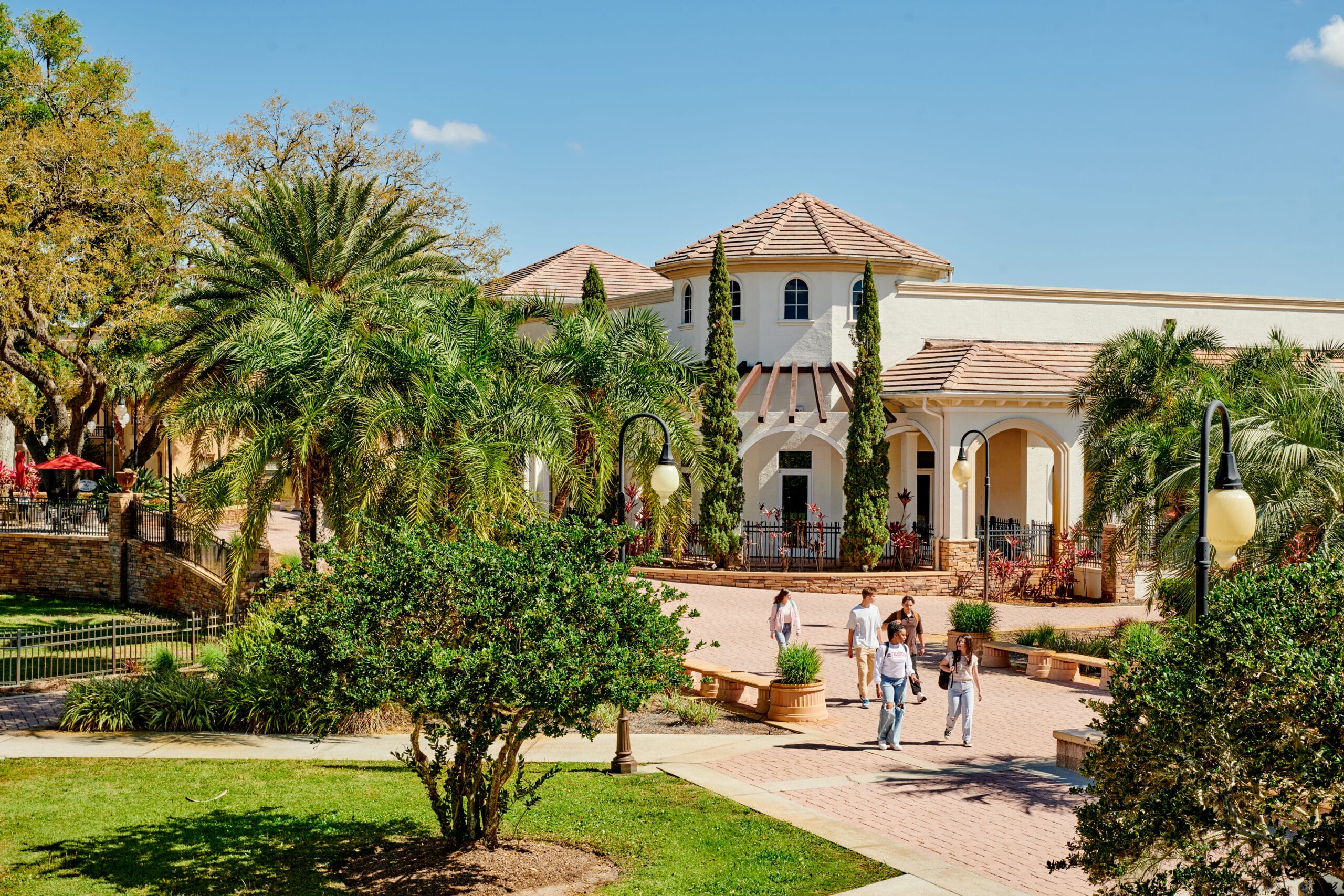
Southeastern University in Lakeland, Florida, is a private Christian institution where faith and academics are woven together into a 'resort-style' campus experience. It offers a broad, career-focused curriculum with over 120 degree programs, anchored by its most popular majors in theology and business. The university's admissions process is moderately selective, but its graduation and post-graduate earnings figures suggest a challenging path for many students to translate their education into strong financial outcomes.
Admission requirements
Test-optional — scores considered if submitted
Required
High school transcript
Grade point average
Letters of recommendation
TOEFL (non-native English)
Considered (not required)
Class rank
Test scores (SAT/ACT)
College-prep program
Demonstrated competencies
Source: IPEDS Admissions survey (2022) via Urban Institute. Covers formal factors only — it does not reflect essays, extracurriculars, or other holistic criteria.
More details
Undergrad enrollment
4,813
In-state tuition
$32,950
Out-of-state tuition
$32,950
Popular Majors
Theology & Religious Vocations; Business
Graduation Rate
43%
Early Decision Plan
Not reported
Application Deadline
May 1
Median Earnings (10yr)
$46,744
Financial Aid Recipients
71.53%
Student-to-Faculty Ratio
27:1
Outcomes & value
Outcomes & value
Median earnings (10 yr)
$46,744
Value (earnings ÷ net price)
1.5×
Median debt at graduation
$21,500
Graduation rate
43%
First-year retention
70%
Reducing loan balance (3 yr)
55%
Pell (lower-income) share
22%
First-gen share (among federal-aid recipients)
35%
Financial health
2.1 / 3.0Meets the federal financial-responsibility standard
U.S. Dept. of Education Financial Responsibility Composite Score (FY2022-23). Scale −1.0 to 3.0; ≥1.5 meets the standard. Reported for private nonprofit & for-profit institutions only — public universities are state-backed and not scored, so this is a stability signal, not a ranking.
Top-earning majors
Median earnings by field of study (highest credential), ~2 years after completion.
Business/Commerce, General$40,485
Teacher Education and Professional Development, Specific Levels and Methods$37,208
Human Services, General$37,208
Theology and Religious Vocations, Other$32,925
Business Administration, Management and Operations$30,119
Source: U.S. Dept. of Education College Scorecard (field-of-study earnings). Figures cover graduates who received federal aid and lag ~2 years; not all programs report data.
Compare on earnings:
Campus & location
Campus safety
On-campus violent crimes (2024)
2
Per 1,000 students
0.33
On-campus criminal offenses classed as violent (murder/non-negligent manslaughter, rape, robbery, aggravated assault) for the most recent reported year. Source: U.S. Dept. of Education Campus Safety and Security (Clery Act). Counts reflect what’s reported to the school, and urban campuses often report more partly due to non-student incidents nearby — read alongside campus size and setting, not as a standalone safety verdict.
Climate
Pleasant days / yr
126
Summer high
89°F
Winter low
55°F
Annual rain
58.3"
Natural-hazard risk
Relatively High
Pleasant days counts days per year with a mean temperature of 55–75°F, a high at or below 90°F, a low at or above 45°F, and little precipitation — a transparent comfort measure, not a weighting we invented. Computed from Open-Meteo ERA5 daily history (2019–2023). Natural-hazard risk is the county’s composite rating from the FEMA National Risk Index.
Deep dive — research, future-scholar output & economic mobility▾
Research output
Institutional h-index
128
Scholarly works
2,494
Institutional research volume and impact from OpenAlex. The h-index reflects large research universities and will be low for teaching-focused liberal-arts colleges — not a measure of undergraduate quality.
Economic mobility
Mobility rate
1.6%
Bottom → top quintile
14%
From bottom quintile
12%
Mobility rate = the share of students who both start in the bottom household-income quintile and reach the top quintile; bottom → top is that chance conditional on starting at the bottom. Source: Opportunity Insights Mobility Report Cards (Chetty, Friedman, Saez, Turner & Yagan). Reflects 1980–82 birth cohorts, so it’s directional, not current.
Quick answers
What is the acceptance rate at Southeastern University?
Southeastern University's acceptance rate is approximately 53% (Lakeland, FL), based on the most recent figures we compiled from public and primary sources.
How much does Southeastern University cost?
At Southeastern University, the average net price (after aid) is about $31,942 per year. Actual cost varies with financial aid and residency.
How many undergraduates attend Southeastern University?
Southeastern University enrolls approximately 4,813 undergraduate students.
Where is Southeastern University located?
Southeastern University is located in Lakeland, FL.
Admissions
Southeastern University operates with a moderately selective admissions process, though reported vary significantly across sources from 61.65% to 74%. The university's own is the definitive source for its admissions criteria and statistics. The application deadline is May 1. While specific SAT and ACT ranges are not detailed in the provided sources, the university does consider a student's academic GPA, rigor of secondary school record, and class rank as part of its evaluation. Notably, the Common Data Set is used to indicate how heavily a school weighs factors like 'demonstrated interest,' though the specific ranking for Southeastern is not provided in these snippets. The university does not appear to have an Early Decision plan, as one source explicitly states 'early decision plan Not reported.'
Earnings = median of students working ~10 years after entry; debt = median of graduates. Value divides 10-yr earnings by one year’s net price — read it as earnings per dollar of annual cost, not a full lifetime ROI; it favors lower-cost schools. Source: U.S. Dept. of Education College Scorecard. Figures lag ~2 years and reflect all students, not your intended major.
Southeastern University bills its academic experience as 'transformative' and 'beyond traditional learning,' offering more than 120 degree programs across associate, bachelor's, master's, and doctoral levels. The curriculum is career-oriented, with notable '4+1' accelerated master's programs in fields like Kinesiology, Exceptional Student Education, Social Work, and Business. Theology and Religious Vocations, along with Business, Management, Marketing, and related support services, stand out as the most popular majors, reflecting the institution's Christian identity and practical focus. The student-to-faculty ratio is reported as 27:1, which suggests larger class sizes. The university's retention rate and specific teaching methodologies are not detailed in the provided sources.
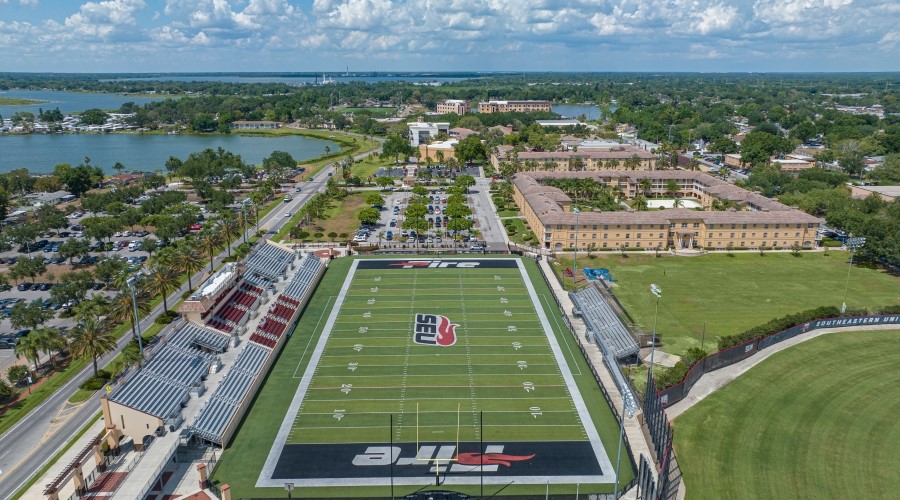
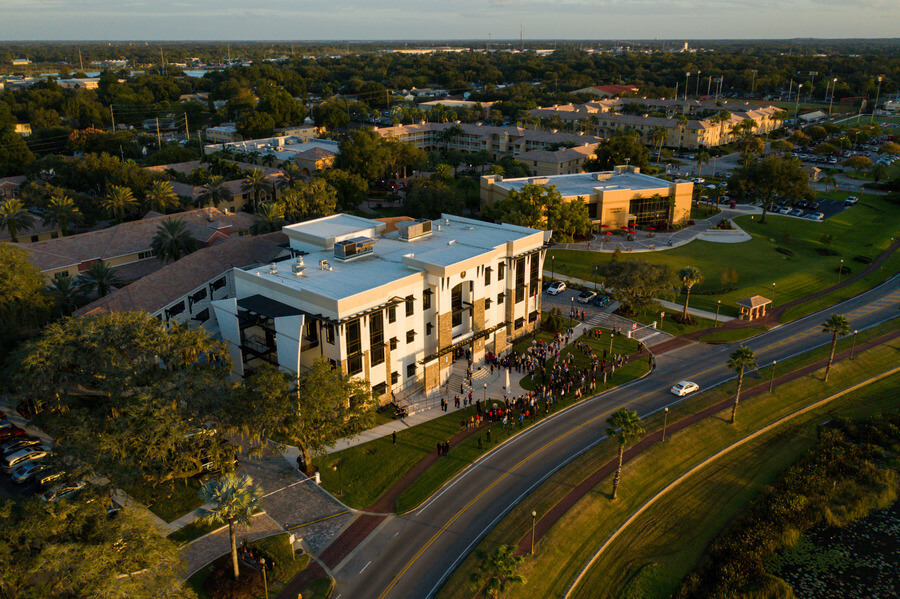
Life at Southeastern University is promoted as an immersive experience centered on community, faith, and campus engagement. The university describes its campus as 'resort-style,' featuring modern residence halls and ample amenities. Student life is framed as being 'more than time spent in the classroom,' with a strong emphasis on making 'meaningful connections' through events, activities, and a shared campus culture. While specific clubs, Greek life, or athletic offerings aren't enumerated in these sources, the university highlights 'powerful worship' and 'real community' as defining characteristics. Campus services, including telecounseling, are available to support students.
Post-graduation outcomes at Southeastern University present a mixed picture. The university sets a minimum performance benchmark of a 75% combined employment or continuing education rate for its graduates. One source reports that 79.8% of alumni are employed within three years of leaving. However, early-career earnings are reported to be about $31,000 on average, which one analysis notes is "about $10,000 worse than might be expected given the mix of majors at the school." Other sources cite median earnings four years after graduation at $50,572 and five years after at $43,308 per year. The university itself uses two primary data sources to collect post-graduation data, indicating an institutional focus on tracking these metrics.
The cost of attending Southeastern University is significant, with a published tuition and fees figure of $33,740 and additional expenses of $7,800. However, financial aid plays a major role for most students: 71.53% of students receive financial aid, with an average aid package of $21,116. This brings the average after scholarships and grants to $27,935 according to one source, though another lists a net price of $46,900. The university provides online cost calculators and financial aid guides to help families estimate their bottom-line cost, noting that students are not required to accept federal loans even if they qualify for them. There is no indication in the provided sources that Southeastern University meets full demonstrated financial need or has a no-loan policy for low-income students.
Southeastern University carves out its niche by unapologetically merging evangelical Christian faith with a broad, career-focused academic portfolio. It's not a small Bible college; it's a university with over 120 programs, including doctorates, built around a 'resort-style' campus designed for an immersive student experience. The emphasis is on practical preparation—evident in its popular business and theology majors and its accelerated '4+1' master's pathways—within a community explicitly centered on worship and connection. This combination of scale, vocational focus, and pronounced religious identity makes it a distinct option in the Florida higher education landscape, particularly for students seeking a faith-based environment with a wide array of professional degree options.
Southeastern University seal · sourceSoutheastern University · sourceA Record-Breaking Year in University Enrollment - Southeastern University · sourceRecord-Breaking Enrollment & 2025 National Rankings - Southeastern University · source