Loading…
← All schools
Southern California Health Institute
North Hollywood, CAprivate forprofitwww.sochi.edu/
Avg net price
$29,326
Earnings (10 yr)
$34,558
Acceptance & SAT from Common Data Set / IPEDS; net price, earnings & graduation from the U.S. Dept. of Education College Scorecard. Figures lag ~1–2 years — verify with the school.
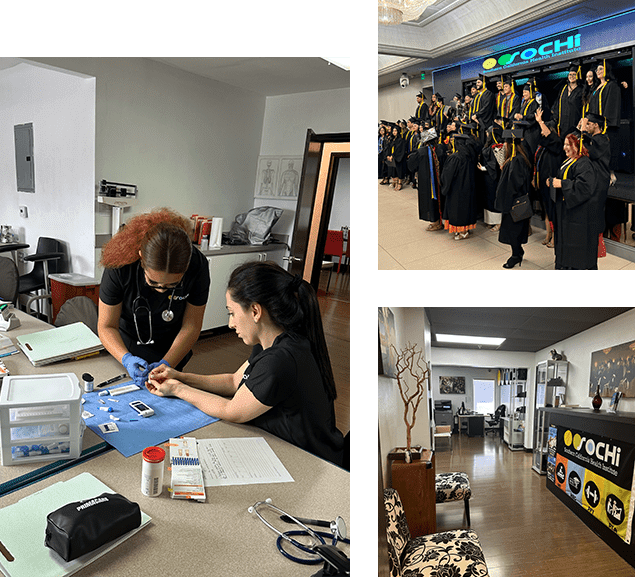
Southern California Health Institute (SOCHi) is a hyper-practical, career-focused trade school in North Hollywood that operates more like a boot camp for allied health than a traditional college. With an open admissions policy and a 100% acceptance rate, it serves a diverse, non-traditional student body seeking fast-track training for roles like Physical Therapy Aide, Personal Fitness Trainer, and Sports Rehab professional. Its identity is defined by flexible, extended hours, a singular focus on employable skills, and a straightforward path into the Southern California healthcare workforce.
More details
- Undergrad enrollment
- 156
- Campus Hours
- 8:00 AM - 10:00 PM (Mon-Fri)
- Student Body
- Commuter, Non-traditional
- Program Examples
- Physical Therapy Aide/Sports Rehab, Personal Fitness Trainer
- Median Earnings (10yr)
- $34,558
Outcomes & value
Outcomes & value
- Median earnings (10 yr)
- $34,558
- Value (earnings ÷ net price)
- 1.2×
- Median debt at graduation
- $9,500
- Reducing loan balance (3 yr)
- 48%
- Pell (lower-income) share
- 84%
- First-gen share (among federal-aid recipients)
- 50%
Earnings = median of students working ~10 years after entry; debt = median of graduates. Value divides 10-yr earnings by one year’s net price — read it as earnings per dollar of annual cost, not a full lifetime ROI; it favors lower-cost schools. Source: U.S. Dept. of Education College Scorecard. Figures lag ~2 years and reflect all students, not your intended major.
Campus & location
Campus safety
- On-campus violent crimes (2024)
- 0
On-campus criminal offenses classed as violent (murder/non-negligent manslaughter, rape, robbery, aggravated assault) for the most recent reported year. Source: U.S. Dept. of Education Campus Safety and Security (Clery Act). Counts reflect what’s reported to the school, and urban campuses often report more partly due to non-student incidents nearby — read alongside campus size and setting, not as a standalone safety verdict.
Climate
- Pleasant days / yr
- 205
- Summer high
- 87°F
- Winter low
- 45°F
- Annual rain
- 20.3"
- Natural-hazard risk
- Very High
Pleasant days counts days per year with a mean temperature of 55–75°F, a high at or below 90°F, a low at or above 45°F, and little precipitation — a transparent comfort measure, not a weighting we invented. Computed from Open-Meteo ERA5 daily history (2019–2023). Natural-hazard risk is the county’s composite rating from the FEMA National Risk Index.
Quick answers
- How much does Southern California Health Institute cost?
- At Southern California Health Institute, the average net price (after aid) is about $29,326 per year. Actual cost varies with financial aid and residency.
- How many undergraduates attend Southern California Health Institute?
- Southern California Health Institute enrolls approximately 156 undergraduate students.
- Where is Southern California Health Institute located?
- Southern California Health Institute is located in North Hollywood, CA.
Admissions
SOCHi maintains an open admission policy, meaning it accepts virtually all applicants who have completed a secondary school education or hold a GED. Multiple sources confirm its is 100%. This reflects its mission as a career-focused trade school designed to provide accessible entry into healthcare fields rather than engage in selective screening. The admissions process is straightforward, centered on exploring program requirements and taking the first step toward a healthcare career. There is no indication that the institute considers standardized test scores like the SAT or ACT in its admissions decisions, nor is there evidence of an Early Decision or Early Action program; its admissions operate on a rolling, non-competitive basis year-round.
- Acceptance Rate: 100% (open admission).
- Policy: Open admission for secondary school graduates or GED holders.
- Focus: The process is geared toward program exploration and career preparation.
Academics
Academics at SOCHi are exclusively vocational and laser-focused on preparing students for immediate employment in specific allied health roles. The institute does not offer traditional liberal arts degrees or a broad curriculum. Instead, training is concentrated in short-term, career-oriented programs. According to its state regulatory filings, instructional programs include and . The institute describes its environment as one of 'scholastic learning' aimed at producing 'empathetic and compassionate allied health workers.' The educational model is built around practical, hands-on skills needed to pass certification exams and succeed in entry-level healthcare positions. Class schedules are built for working adults, with availability noted from 8:00 AM to 10:00 PM.
Compare Southern California Health Institute
vs United States Coast Guard Academyvs Northwest Nazarene Universityvs Dean Collegevs Arizona Christian University
See colleges similar to Southern California Health Institute →Sources
- Common Data Set 2024-2025 - Office of Institutional Research
- Common Data Set 2021-2022 - Institutional Research Office
- Common Data Set
- Common Data Set: Home
- How To Use a Common Data Set
- The Common Data Set: What It Is & How to Use It In ...
- Southern California Health Institute
- Southern California Health Institute Statistics
- Southern California Health Institute | College Matchup
- Southern California University of Health Sciences Acceptance Rate
- Student Distribution Details for Southern California Health Institute