Loading…
← All schools
Southwestern College
Chula Vista, CApublicswccd.edu
Avg net price
$12,671
Earnings (10 yr)
$40,060
Acceptance & SAT from Common Data Set / IPEDS; net price, earnings & graduation from the U.S. Dept. of Education College Scorecard. Figures lag ~1–2 years — verify with the school.
Southwestern College in Chula Vista, California, operates as a sprawling, open-access community college district with a distinctly practical, career-oriented mission. It’s a place where the barriers to entry are intentionally low—open to any high school graduate or adult who can benefit from instruction—and the academic focus is squarely on workforce preparation, transfer pathways, and certificates. With five physical locations and a heavy emphasis on applied fields like business, health sciences, and technology, it functions less as a traditional residential college and more as a vital public engine for social mobility in San Diego’s South Bay.
More details
- Undergrad enrollment
- 18,614
- In-state tuition
- $1,344
- Out-of-state tuition
- $10,640
- Graduation Rate
- 30%
- Student-Faculty Ratio
- 25:1
- Course Completion Rate
- 84-87%
- Median Earnings (10yr)
- $40,060
- Students Receiving Grant Aid
- 86%
Outcomes & value
Outcomes & value
- Median earnings (10 yr)
- $40,060
- Value (earnings ÷ net price)
- 3.2×
- Median debt at graduation
- $4,500
- Reducing loan balance (3 yr)
- 38%
- Pell (lower-income) share
- 36%
- First-gen share (among federal-aid recipients)
- 57%
Earnings = median of students working ~10 years after entry; debt = median of graduates. Value divides 10-yr earnings by one year’s net price — read it as earnings per dollar of annual cost, not a full lifetime ROI; it favors lower-cost schools. Source: U.S. Dept. of Education College Scorecard. Figures lag ~2 years and reflect all students, not your intended major.
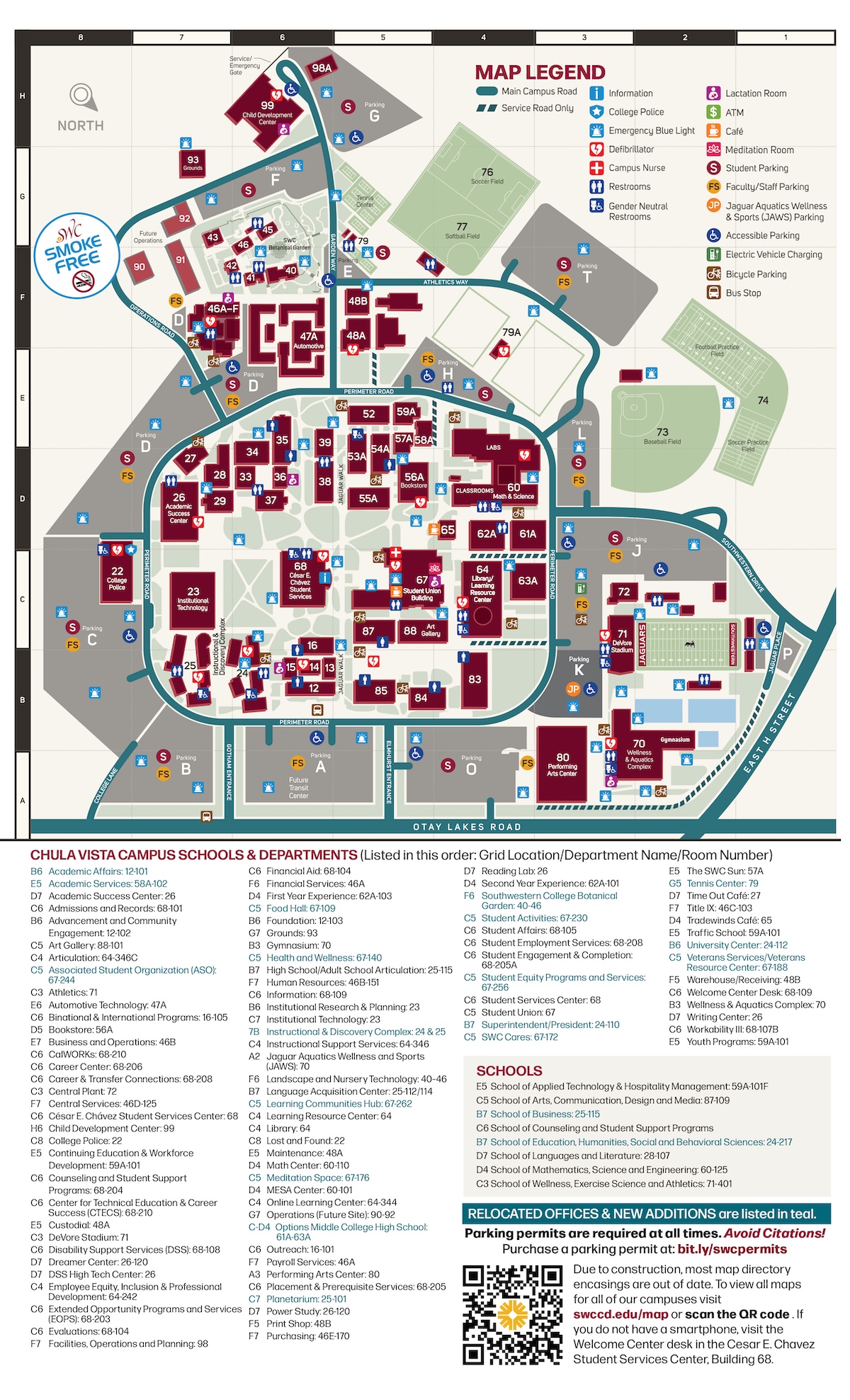
Campus & location
Campus safety
- On-campus violent crimes (2024)
- 1
On-campus criminal offenses classed as violent (murder/non-negligent manslaughter, rape, robbery, aggravated assault) for the most recent reported year. Source: U.S. Dept. of Education Campus Safety and Security (Clery Act). Counts reflect what’s reported to the school, and urban campuses often report more partly due to non-student incidents nearby — read alongside campus size and setting, not as a standalone safety verdict.
Climate
- Pleasant days / yr
- 255
- Summer high
- 79°F
- Winter low
- 47°F
- Annual rain
- 18.6"
- Natural-hazard risk
- Very High
Pleasant days counts days per year with a mean temperature of 55–75°F, a high at or below 90°F, a low at or above 45°F, and little precipitation — a transparent comfort measure, not a weighting we invented. Computed from Open-Meteo ERA5 daily history (2019–2023). Natural-hazard risk is the county’s composite rating from the FEMA National Risk Index.
Quick answers
- How much does Southwestern College cost?
- At Southwestern College, the average net price (after aid) is about $12,671 per year. Actual cost varies with financial aid and residency.
- How many undergraduates attend Southwestern College?
- Southwestern College enrolls approximately 18,614 undergraduate students.
- Where is Southwestern College located?
- Southwestern College is located in Chula Vista, CA.
Admissions
Admission to Southwestern College is defined by its open-access mission. The college states that enrollment is "open to anyone who has graduated from a US high school or has equivalency, or is 18 years of age or older" and can benefit from instruction. This policy is reiterated across official sources, framing it as an institution designed for broad public access rather than selective screening. There is no mention of a standardized test requirement for admission; the process appears to be centered on eligibility (high school graduation, GED, or age) rather than competitive review. While external sources like U.S. News report an of 74%, this figure is somewhat misleading in the context of an open-enrollment institution—the primary 'admissions' hurdle is simply meeting the basic eligibility criteria, not gaining selection from a competitive applicant pool. The college's planning and counseling offices provide support for enrollment, but the gatekeeping is minimal by design.
Academics
The academic profile is that of a comprehensive community college, organized into broad 'Fields of Study' designed for direct career entry or transfer to a four-year institution. The college catalog and website list these fields as: Applied Technology & Hospitality Management; Arts, Communication, Design & Media; Business; and Education, Humanities, Social & Behavioral Sciences. Within these umbrellas, students pursue Associate degrees and certificates. According to Niche and U.S. News data, the most popular majors are Liberal Arts and Humanities (a common transfer-oriented path), Business Administration and Management, Psychology, and Health Service Preparatory Studies. The student-faculty ratio is reported as 25:1. The curriculum is structured for practical outcomes, with academic maps guiding students to completion. Course completion rates are notably high, consistently reported between 84% and 87%, with course success rates (presumably earning a C or better) ranging from 68% to 72%, suggesting a supportive environment for progressing through coursework once enrolled.
Compare Southwestern College
vs United States Air Force Academyvs San Diego State Universityvs California State University-Long Beachvs UC Santa Cruz
See colleges similar to Southwestern College →Sources
- A0. Respondent Information (not for publication) A0A. Comments About ...
- Fact Book 2023-2024
- A. General Information
- Step 1: Apply for Admission to Southwestern College
- Institutional Plans, Reports & Surveys
- Frequently Asked Questions
- Southwestern College Admissions
- Southwestern College Acceptance Rate - Admissions Chances & Data
- Southwestern College SAT Scores and GPA