Loading…
← All schools
State Technical College of Missouri
Linn, MOpublicstatetechmo.edu
Avg net price
$15,190
Earnings (10 yr)
$55,901
Acceptance & SAT from Common Data Set / IPEDS; net price, earnings & graduation from the U.S. Dept. of Education College Scorecard. Figures lag ~1–2 years — verify with the school.
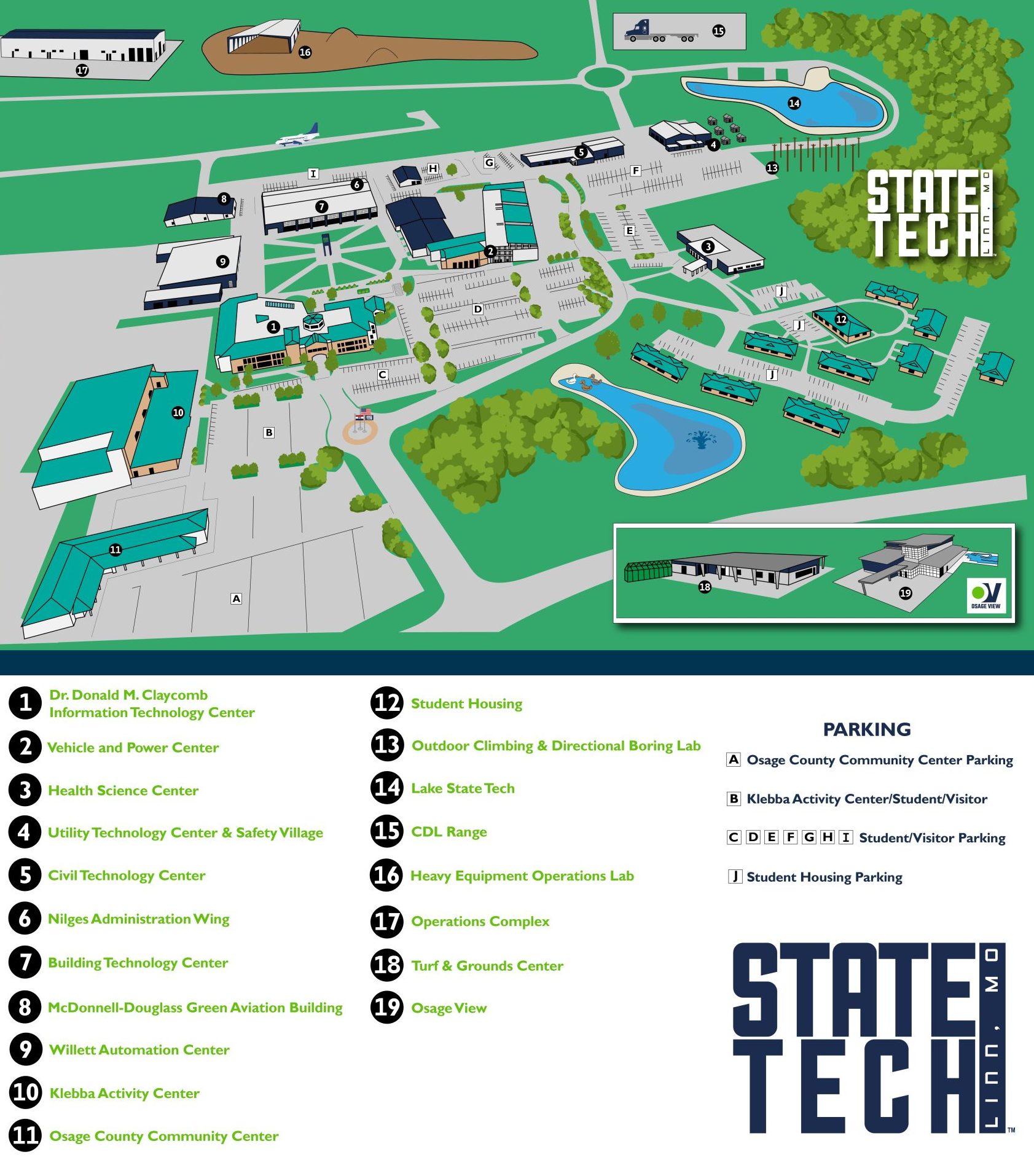
State Technical College of Missouri is a singular institution that operates less like a traditional college and more like a direct pipeline to the skilled trades. With a sprawling 850-acre campus in Linn, it has built a national reputation not on selectivity, but on an almost industrial-grade focus on outcomes: a near-perfect job placement rate and a graduation rate that it claims is the highest in the country for two-year colleges. This is a place where the application is a formality, but the real test is in the labs and workshops, preparing for a career that starts on day one after graduation.
More details
- Undergrad enrollment
- 2,123
- In-state tuition
- $8,160
- Out-of-state tuition
- $14,610
- Campus Size
- 850+ acres
- Program Areas
- 30+ degree/certificate fields
- Graduation Rate
- 84-85%
- Job Placement Rate
- 99%
- Student Population
- ~2,200
- Median Earnings (10yr)
- $55,901
Outcomes & value
Outcomes & value
- Median earnings (10 yr)
- $55,901
- Value (earnings ÷ net price)
- 3.7×
- Median debt at graduation
- $10,986
- Reducing loan balance (3 yr)
- 72%
- Pell (lower-income) share
- 33%
- First-gen share (among federal-aid recipients)
- 41%
Earnings = median of students working ~10 years after entry; debt = median of graduates. Value divides 10-yr earnings by one year’s net price — read it as earnings per dollar of annual cost, not a full lifetime ROI; it favors lower-cost schools. Source: U.S. Dept. of Education College Scorecard. Figures lag ~2 years and reflect all students, not your intended major.
Campus & location
Campus safety
- On-campus violent crimes (2024)
- 0
On-campus criminal offenses classed as violent (murder/non-negligent manslaughter, rape, robbery, aggravated assault) for the most recent reported year. Source: U.S. Dept. of Education Campus Safety and Security (Clery Act). Counts reflect what’s reported to the school, and urban campuses often report more partly due to non-student incidents nearby — read alongside campus size and setting, not as a standalone safety verdict.
Climate
- Pleasant days / yr
- 84
- Summer high
- 87°F
- Winter low
- 28°F
- Annual rain
- 45.8"
- Annual snow
- 16.6"
- Natural-hazard risk
- Very Low
Pleasant days counts days per year with a mean temperature of 55–75°F, a high at or below 90°F, a low at or above 45°F, and little precipitation — a transparent comfort measure, not a weighting we invented. Computed from Open-Meteo ERA5 daily history (2019–2023). Natural-hazard risk is the county’s composite rating from the FEMA National Risk Index.
Deep dive — research, future-scholar output & economic mobility
Research output
- Institutional h-index
- 5
- Scholarly works
- 11
Institutional research volume and impact from OpenAlex. The h-index reflects large research universities and will be low for teaching-focused liberal-arts colleges — not a measure of undergraduate quality.
Quick answers
- How much does State Technical College of Missouri cost?
- At State Technical College of Missouri, the average net price (after aid) is about $15,190 per year. Actual cost varies with financial aid and residency.
- How many undergraduates attend State Technical College of Missouri?
- State Technical College of Missouri enrolls approximately 2,123 undergraduate students.
- Where is State Technical College of Missouri located?
- State Technical College of Missouri is located in Linn, MO.
Admissions
State Tech's admissions philosophy is defined by accessibility, not exclusivity. The institution operates with what is effectively an open admission policy for most students, accepting virtually all applicants. Multiple sources, including Peterson's and Niche, report a 100% . This aligns with the 's description of an 'open admission policy' for most students, with selective admission potentially applying only to out-of-state students or specific programs. The college is in a period of significant growth, welcoming a record-breaking 2,200 students to campus recently, an 8% increase from the previous year, marking the sixth straight year of record enrollment. The process is straightforward: the college states it accepts SAT scores (results cannot be older than five years) and notes a recommended GPA of 3.0 for consideration. There is no indication in the provided sources of an Early Decision program or that demonstrated interest is a considered factor in admissions decisions; the focus is on meeting baseline requirements for entry into its career-focused programs.
Key Admissions Notes:
- Policy: Open admission for most in-state students.
- Acceptance Rate: Reported as 100% by multiple sources.
- Testing: SAT scores accepted (not older than 5 years).
- Recommended GPA: 3.0.
Compare State Technical College of Missouri
vs Governors State Universityvs Minot State Universityvs Bemidji State Universityvs Southwest Minnesota State University
See colleges similar to State Technical College of Missouri →Sources
- Common Data Set 2024-2025
- Common Data Set
- Common Data Set
- Common Data Set: Home
- 6th Straight Year of Record Breaking Enrollment - State Tech
- State Technical College of Missouri - DFR Report PDF
- State Technical College of Missouri
- State Technical College of Missouri
- State Technical College of Missouri - The Employers' Choice
- Contact Admissions -
- State Technical College Of Missouri Acceptance Rate, SAT ...