Admit rate has ranged 58%–75% over the last 5 years — notably volatile, though the latest figure above (78%) falls outside that window. Source: IPEDS via Urban Institute.
Acceptance & SAT from Common Data Set / IPEDS; net price, earnings & graduation from the U.S. Dept. of Education College Scorecard. Figures lag ~1–2 years — verify with the school.
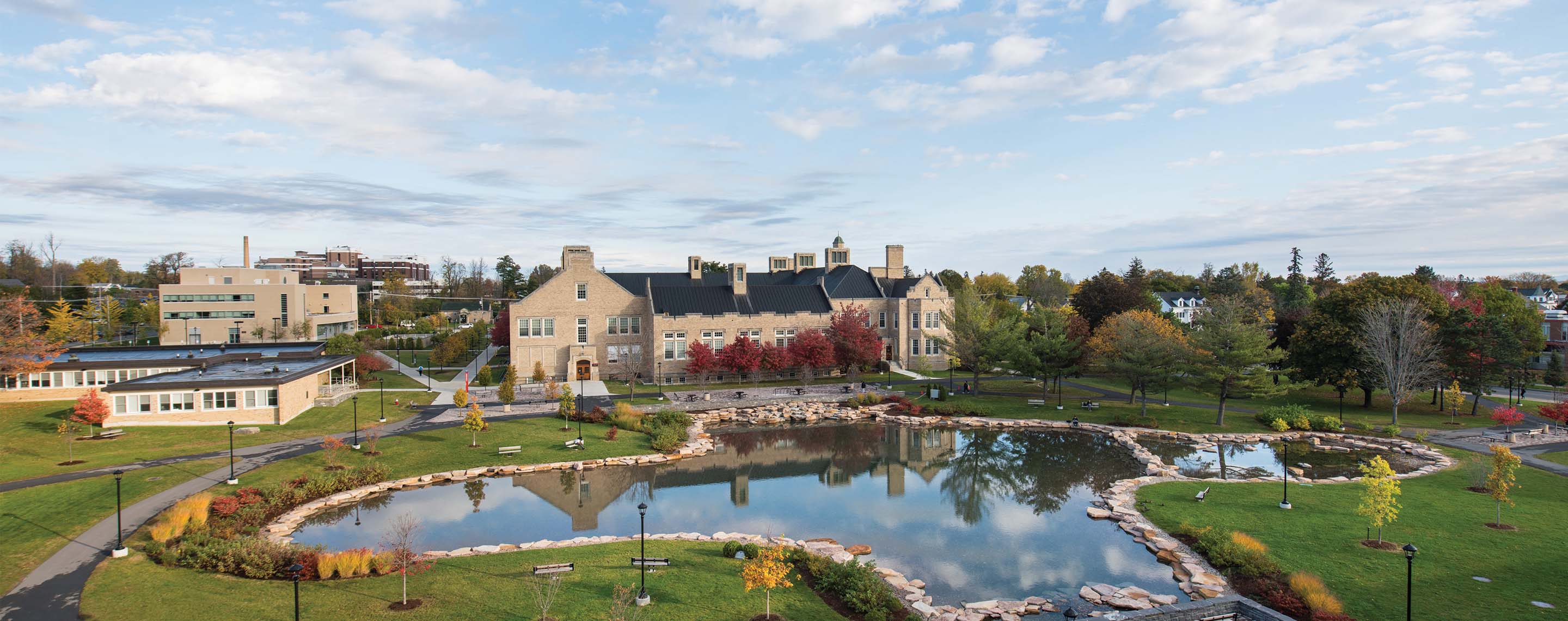
SUNY Plattsburgh is a public liberal arts college on the shores of Lake Champlain, a place where the outdoorsy, small-town vibe meets a surprisingly international student body. It's a school for practical learners, offering over 70 majors with a focus on experiential education, and where the sticker price for out-of-state students is tempered by a high rate of financial aid. This is not a cutthroat academic pressure cooker, but a community where 60% of students come from outside the region, creating a mix of downstate New Yorkers, international students, and locals all navigating the brisk North Country climate together.
Admission requirements
Test-optional — scores considered if submitted
Required
High school transcript
Grade point average
Letters of recommendation
College-prep program
TOEFL (non-native English)
Considered (not required)
Class rank
Test scores (SAT/ACT)
Source: IPEDS Admissions survey (2022) via Urban Institute. Covers formal factors only — it does not reflect essays, extracurriculars, or other holistic criteria.
More details
Undergrad enrollment
3,769
In-state tuition
$9,035
Out-of-state tuition
$18,945
Graduation Rate
59%
On-Campus Housing
42%
Student Population
~5,000
Countries Represented
70+
Median Earnings (10yr)
$56,403
Out-of-Region Students
60%
Total Academic Programs
70+
Students Receiving Grant/Scholarship Aid
81%
Institutional Scholarships/Grants Awarded
Outcomes & value
Outcomes & value
Median earnings (10 yr)
$56,403
Value (earnings ÷ net price)
3.3×
Median debt at graduation
$21,196
Graduation rate
59%
First-year retention
73%
Reducing loan balance (3 yr)
63%
Pell (lower-income) share
41%
First-gen share (among federal-aid recipients)
31%
Top-earning majors
Median earnings by field of study (highest credential), ~2 years after completion.
Registered Nursing, Nursing Administration, Nursing Research and Clinical Nursing$71,095
Clinical/Medical Laboratory Science/Research and Allied Professions$64,493
Business, Management, Marketing, and Related Support Services, Other$59,350
Management Information Systems and Services$55,512
Finance and Financial Management Services$50,856
Campus & location
Campus safety
On-campus violent crimes (2024)
3
Per 1,000 students
0.67
On-campus criminal offenses classed as violent (murder/non-negligent manslaughter, rape, robbery, aggravated assault) for the most recent reported year. Source: U.S. Dept. of Education Campus Safety and Security (Clery Act). Counts reflect what’s reported to the school, and urban campuses often report more partly due to non-student incidents nearby — read alongside campus size and setting, not as a standalone safety verdict.
Climate
Pleasant days / yr
91
Summer high
78°F
Winter low
16°F
Annual rain
42.1"
Annual snow
48.4"
Natural-hazard risk
Relatively Low
Pleasant days counts days per year with a mean temperature of 55–75°F, a high at or below 90°F, a low at or above 45°F, and little precipitation — a transparent comfort measure, not a weighting we invented. Computed from Open-Meteo ERA5 daily history (2019–2023). Natural-hazard risk is the county’s composite rating from the FEMA National Risk Index.
Quick answers
What is the acceptance rate at State University of New York at Plattsburgh?
State University of New York at Plattsburgh's acceptance rate is approximately 78% (Plattsburgh, NY), based on the most recent figures we compiled from public and primary sources.
What SAT score do you need for State University of New York at Plattsburgh?
Admitted students at State University of New York at Plattsburgh typically score 1080–1250 on the SAT (the middle-50% range). Scores outside this band are still admitted, especially with strong applications.
How much does State University of New York at Plattsburgh cost?
At State University of New York at Plattsburgh, the average net price (after aid) is about $17,156 per year. Actual cost varies with financial aid and residency.
How many undergraduates attend State University of New York at Plattsburgh?
State University of New York at Plattsburgh enrolls approximately 3,769 undergraduate students.
Where is State University of New York at Plattsburgh located?
State University of New York at Plattsburgh is located in Plattsburgh, NY.
Admissions
SUNY Plattsburgh's admissions process is characterized by its accessibility and rolling notification. The school admits a significant majority of its applicants, with an of 78%. The enrolling first-year class for Fall 2025 was 833 students. Admissions are , and the middle 50% SAT range for admitted students is 1080–1250. The average GPA of admitted students is reported as 3.09. Acceptance packets are mailed on a rolling basis beginning in November and continue until admissions closes, typically in mid-summer. While the is referenced as a key source for admissions factors, the provided sources do not specify whether SUNY Plattsburgh considers demonstrated interest in its evaluation process.
Earnings = median of students working ~10 years after entry; debt = median of graduates. Value divides 10-yr earnings by one year’s net price — read it as earnings per dollar of annual cost, not a full lifetime ROI; it favors lower-cost schools. Source: U.S. Dept. of Education College Scorecard. Figures lag ~2 years and reflect all students, not your intended major.
Marketing
$42,363
International Business$41,565
Computer and Information Sciences, General$41,342
Source: U.S. Dept. of Education College Scorecard (field-of-study earnings). Figures cover graduates who received federal aid and lag ~2 years; not all programs report data.
Plattsburgh defines itself as a liberal arts college offering more than 70 academic programs across humanities, science, business, education, and other fields. The curriculum is built around a promise of leading professors, experiential learning opportunities, and alumni networking. The School of Arts and Sciences provides a core liberal arts education aimed at developing critical thinkers. Popular majors include Accounting, Business, and Psychology. The university highlights specific programs like a combined bachelor's and master's in Accounting and Data Analytics that can be completed in five years to meet growing demand. Students often praise the smaller class sizes. The academic profile shows notable concentrations in Biological and Biomedical Sciences (6%), Public Administration and Social Service Professions (6%), History (4%), and Homeland Security, Law Enforcement, and Firefighting (4%).
Life at Plattsburgh, branded as #PlattsLife, is pitched as an adventure of new friends and experiences. The campus draws a geographically diverse mix, with 60% of students coming from outside the region, fostering a varied cultural environment. With a total enrollment around 5,000, it maintains a mid-sized feel. In terms of housing, 42% of students live in college-owned, -operated, or -affiliated housing, while 58% live off-campus. Student life is active, with more than 70 clubs and organizations catering to diverse interests, including Greek life and cultural groups like the Black Student Union. The university emphasizes its international character, with more than 70 countries represented in the student body, and cultural-themed clubs provide opportunities for cross-cultural engagement. SUNY Plattsburgh also fields NCAA Division III athletic teams.
Graduation outcomes at SUNY Plattsburgh show a four-year graduation rate of 59%. The average time to graduate is 4.5 years. In terms of earnings, the median salary for alumni 10 years after entry is $56,403. Earlier post-graduation earnings are reported as $37,823 one year after graduation and $55,178 five years after graduation. The university is actively working to improve student success metrics; it received over $900,000 from New York State's $75 million Transformation Fund in Spring 2024, an initiative launched to increase graduation rates and reduce equity gaps. Other data points show a 150% normal time completion rate of 64.66% and a 50.52% graduation rate for a standard timeframe, though the specific degree level for that metric is not detailed in the provided snippet.
SUNY Plattsburgh's average after aid is $17,156. The university awards a significant $4.8 million in institutional scholarships and grants annually. A high percentage of students receive financial aid, with 81% of full-time beginning undergraduates receiving grant or scholarship aid. The average total aid awarded is $12,733. For New York State residents, tuition and fees are $9,035, while out-of-state tuition and fees are $18,945. The university provides a Net Price Calculator for families to estimate their financial aid package and directs students to complete the FAFSA and the NYS Payment Application, including applying for the Excelsior Scholarship. The provided sources do not indicate that SUNY Plattsburgh has a "no-loan" policy or that it meets 100% of demonstrated financial need solely with grants.
SUNY Plattsburgh carves out a distinct niche as a public liberal arts college with a genuinely global feel in a remote, scenic setting. Its defining characteristic is the blend of a small, teaching-focused academic environment—with over 70 programs and praised smaller classes—within the affordable SUNY system. The student body composition is unique: a majority come from outside the North Country region, creating a campus culture that is neither purely commuter nor purely residential, but a mix of New Yorkers seeking a traditional college experience at a public price and a sizable international community. This is not a school for students seeking a bustling urban campus, but for those who value outdoor access, a tight-knit community, and practical, hands-on academic programs like its accelerated 5-year accounting/data analytics degree. It’s a place where the value proposition is clear: a low-stakes admissions process opens the door to a solid education with strong financial aid support, set against the backdrop of Lake Champlain.
State University of New York at Plattsburgh seal · sourceState University of New York, Plattsburgh · sourceSUNY--Plattsburgh - Profile, Rankings and Data | US News Best Colleges · sourceApply to SUNY Plattsburgh · source