Admit rate has ranged 72%–79% over the last 5 years, though the latest figure above (81%) falls outside that window. Source: IPEDS via Urban Institute.
Acceptance & SAT from Common Data Set / IPEDS; net price, earnings & graduation from the U.S. Dept. of Education College Scorecard. Figures lag ~1–2 years — verify with the school.
Susquehanna University is a future-focused liberal arts college in Pennsylvania's Susquehanna River Valley that delivers a surprisingly high-return education. It combines a traditional, residential campus experience—where nearly 90% of students live on campus—with distinctive, career-oriented programs in creative writing, music education, and the sciences. The university's character is defined by its high-touch, accessible faculty and a culture that actively encourages student voice and civic engagement, producing graduates whose lifetime earnings rank in the top 12% nationally.
Admission requirements
Test-optional — scores considered if submitted
Required
High school transcript
Grade point average
Letters of recommendation
College-prep program
TOEFL (non-native English)
Considered (not required)
Class rank
Test scores (SAT/ACT)
Demonstrated competencies
Source: IPEDS Admissions survey (2022) via Urban Institute. Covers formal factors only — it does not reflect essays, extracurriculars, or other holistic criteria.
More details
Undergrad enrollment
2,163
In-state tuition
$59,850
Out-of-state tuition
$59,850
Campus Housing
89% of students live on campus
Graduation Rate
82%
Meets Full Need
Aid packages include loans
First-Year Retention
See Common Data Set
Demonstrated Interest
See Common Data Set C7
Student Organizations
150+
Median Earnings (10yr)
$61,723
Outcomes & value
Outcomes & value
Median earnings (10 yr)
$61,723
Value (earnings ÷ net price)
2.1×
Median debt at graduation
$27,000
Graduation rate
82%
First-year retention
86%
Reducing loan balance (3 yr)
82%
Pell (lower-income) share
25%
First-gen share (among federal-aid recipients)
22%
Financial health
2.3 / 3.0Meets the federal financial-responsibility standard
U.S. Dept. of Education Financial Responsibility Composite Score (FY2022-23). Scale −1.0 to 3.0; ≥1.5 meets the standard. Reported for private nonprofit & for-profit institutions only — public universities are state-backed and not scored, so this is a stability signal, not a ranking.
Top-earning majors
Median earnings by field of study (highest credential), ~2 years after completion.
Accounting and Related Services$58,221
International Business$54,661
Finance and Financial Management Services$47,846
Marketing$46,478
Business/Corporate Communications$44,170
Teacher Education and Professional Development, Specific Subject Areas
Campus & location
Campus safety
On-campus violent crimes (2024)
4
Per 1,000 students
1.84
On-campus criminal offenses classed as violent (murder/non-negligent manslaughter, rape, robbery, aggravated assault) for the most recent reported year. Source: U.S. Dept. of Education Campus Safety and Security (Clery Act). Counts reflect what’s reported to the school, and urban campuses often report more partly due to non-student incidents nearby — read alongside campus size and setting, not as a standalone safety verdict.
Climate
Pleasant days / yr
90
Summer high
84°F
Winter low
26°F
Annual rain
44.2"
Annual snow
25"
Natural-hazard risk
Relatively Low
Pleasant days counts days per year with a mean temperature of 55–75°F, a high at or below 90°F, a low at or above 45°F, and little precipitation — a transparent comfort measure, not a weighting we invented. Computed from Open-Meteo ERA5 daily history (2019–2023). Natural-hazard risk is the county’s composite rating from the FEMA National Risk Index.
Deep dive — research, future-scholar output & economic mobility▾
Research output
Institutional h-index
95
Scholarly works
1,944
Institutional research volume and impact from OpenAlex. The h-index reflects large research universities and will be low for teaching-focused liberal-arts colleges — not a measure of undergraduate quality.
Economic mobility
Mobility rate
0.7%
Bottom → top quintile
22%
From bottom quintile
3%
Mobility rate = the share of students who both start in the bottom household-income quintile and reach the top quintile; bottom → top is that chance conditional on starting at the bottom. Source: Opportunity Insights Mobility Report Cards (Chetty, Friedman, Saez, Turner & Yagan). Reflects 1980–82 birth cohorts, so it’s directional, not current.
Quick answers
What is the acceptance rate at Susquehanna University?
Susquehanna University's acceptance rate is approximately 81% (Selinsgrove, PA), based on the most recent figures we compiled from public and primary sources.
What SAT score do you need for Susquehanna University?
Admitted students at Susquehanna University typically score 1100–1300 on the SAT (the middle-50% range). Scores outside this band are still admitted, especially with strong applications.
How much does Susquehanna University cost?
At Susquehanna University, the average net price (after aid) is about $28,819 per year. Actual cost varies with financial aid and residency.
How many undergraduates attend Susquehanna University?
Susquehanna University enrolls approximately 2,163 undergraduate students.
Where is Susquehanna University located?
Susquehanna University is located in Selinsgrove, PA.
Admissions
Susquehanna's admissions process is accessible, with a high that reflects its mission to provide a rigorous liberal arts education to a broad range of students. The university offers an Early Decision program with a December 1 deadline, which provides applicants with an earlier notification date. While the overall pool is less selective, applying Early Decision can be a strategic advantage. The admissions office can be contacted directly at [email protected] or 800-326-9672, and the hotline is 866-943-5787.
Application Volume & Yield: The university typically receives several thousand applications each cycle. The rate—the percentage of admitted students who choose to enroll—has historically been modest, averaging around 14% over recent years.
Academic Profile of Admitted Students: Admitted students typically present strong academic credentials. The middle 50% of admitted students who submit test scores have SAT scores between 1100 and 1300, or ACT scores between 21 and 29. A significant portion of the admitted class earns high school GPAs of 3.5 or above.
Test-Optional Practice: A notable portion of the admitted student body—over half in recent cycles—gains admission without submitting standardized test scores, indicating the university's process.
The Common Data Set: The university participates in the Common Data Set (CDS) initiative, a collaborative effort to standardize data reporting. This document, which details factors considered in admission, is a key resource for prospective families. Section C7 of the CDS outlines how the university weights various application factors, including the level of importance placed on demonstrated interest.
Earnings = median of students working ~10 years after entry; debt = median of graduates. Value divides 10-yr earnings by one year’s net price — read it as earnings per dollar of annual cost, not a full lifetime ROI; it favors lower-cost schools. Source: U.S. Dept. of Education College Scorecard. Figures lag ~2 years and reflect all students, not your intended major.
$43,426
Communication and Media Studies$39,927
Design and Applied Arts$39,369
Source: U.S. Dept. of Education College Scorecard (field-of-study earnings). Figures cover graduates who received federal aid and lag ~2 years; not all programs report data.
Susquehanna's academic identity is built on a "future-ready" liberal arts foundation, emphasizing critical thinking and practical application across more than 100 majors and minors. The Princeton Review has specifically highlighted several programs as standouts, including a "top-notch" creative writing program, an "outstanding" music education program, and "strong" science departments. This blend of traditional arts and robust STEM offerings defines the curriculum.
School of Natural & Social Sciences: This school embodies the hands-on, research-driven approach. Students work alongside faculty on projects ranging from neuroscience research and criminal justice reform proposals to modeling climate change impacts.
Popular Majors: Psychology and Visual and Performing Arts are among the most popular fields of study, each comprising about 6% of graduates. Social Sciences, Physical Sciences, and Computer and Information Sciences are also significant.
Faculty & Support: The academic experience is characterized by small class sizes and accessible, caring professors. Resources like the Career Development Center are integrated to support students from exploration to post-graduate outcomes. The university's self-described mission is to prepare students for "a life of achievement, leadership and service with first-class academics and dedicated faculty."
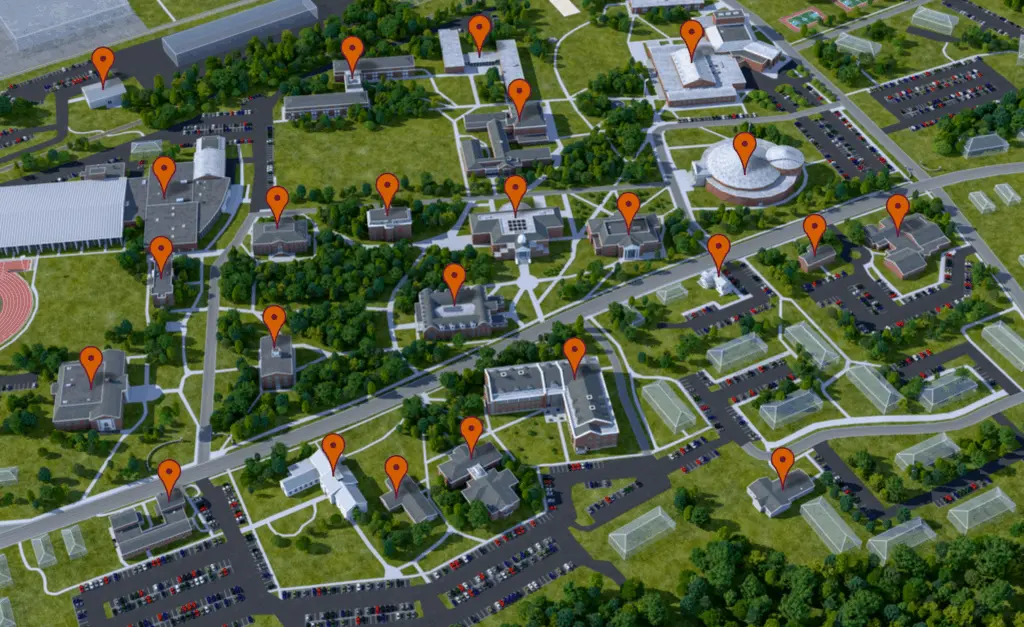
Life at Susquehanna is overwhelmingly residential and intentionally engaged. A full 89% of students live in college-owned, -operated, or -affiliated housing, creating a cohesive, on-campus community. The university actively cultivates a culture where every student is encouraged to feel "seen, heard and empowered."
Clubs & Organizations: With more than 150 active clubs and organizations, students have ample opportunities for involvement, leadership, and fun outside the classroom.
Civic Engagement: The university has gained national recognition for fostering a campus culture that encourages student civic participation and making one's "voice heard at the ballot box."
Cultural Programming: The campus calendar features events celebrating diverse communities, such as Hispanic Heritage Month, alongside a wide array of other activities that contribute to a vibrant social and intellectual environment.
Susquehanna's core value proposition is a strong return on investment, a point underscored by its recent ascent in national rankings like Forbes, which heavily weights alumni salary, student debt, and graduation rates. The university proudly notes that its graduates' lifetime earnings place it in the top 12% of all U.S. universities for career-long return.
Graduation Success: The university's graduation rate significantly outpaces the national average. This success in shepherding students to degree completion is a key component of its positive outcomes profile.
Post-Graduate Earnings: While earnings grow over time, the financial payoff for a Susquehanna degree is clear in longitudinal data. The university's focus on this metric has been central to its recent recognition and rankings improvements.
Affording Susquehanna is a primary concern for families, and the university provides several tools and aid options. The Calculator is the recommended first step for estimating a family's actual cost after scholarships and grants. A large majority of students—over 76%—receive financial aid, with the average aid package being substantial.
Financial Aid Philosophy: Aid is awarded based on a combination of merit (for incoming students) and/or demonstrated financial need as calculated by the FAFSA. Need-based grants, including federal Pell Grants, are a form of gift aid that does not require repayment.
Merit Scholarships: The university offers merit scholarships to qualified students, including admitted international students. It is important to note that the university states no "full cost" financial aid awards are available for international students.
Policy Context: While some elite institutions advertise "no-loan" policies where 100% of need is met with grants, Susquehanna's aid packages are typically a mix of grants, scholarships, work-study, and loans based on the calculated need. Families should use the official Net Price Calculator and consult with the financial aid office for a personalized assessment.
Susquehanna University carves out a distinctive niche by marrying the intimate, formative experience of a traditional residential liberal arts college with a relentlessly practical focus on postgraduate outcomes. It’s not a cloistered ivory tower; it’s a launchpad. This is most evident in its nationally recognized creative writing and music education programs, which blend artistic rigor with professional preparation, and in its science departments where undergraduate research is the norm, not the exception.
The campus culture is its other secret weapon. With nearly nine out of ten students living on campus, it fosters a tight-knit community where engagement is expected—whether in one of 150 clubs, in the voting booth (a point of national pride for the university), or in dialogue with accessible faculty. The result is a graduate who is not only broadly educated but also confident and civically minded. Ultimately, Susquehanna’s compelling argument is quantitative: it delivers a high-touch, classic liberal arts experience that consistently translates into a financial payoff, placing its graduates' lifetime earnings in the top echelon of American universities. It’s a bet on the enduring value of a well-rounded education, with the data to back it up.
Susquehanna University seal · sourceAbout - Susquehanna University · sourceBuildings & Spaces - Susquehanna University · sourceCampus Transformations - Susquehanna University · source