Admit rate has ranged 59%–61% over the last 5 years, though the latest figure above (69%) falls outside that window. Source: IPEDS via Urban Institute.
Acceptance & SAT from Common Data Set / IPEDS; net price, earnings & graduation from the U.S. Dept. of Education College Scorecard. Figures lag ~1–2 years — verify with the school.
Tennessee Wesleyan University is a small, private liberal arts college in Athens, Tennessee, that operates with a distinctly practical, career-focused ethos. It's a place where a 13:1 student-faculty ratio and a sprawling list of 80+ majors—led by nursing, business, and education—aim to translate directly into post-graduation employment. The vibe is supportive, residential, and community-oriented, with a significant portion of students living off-campus but still engaging in over 25 student organizations and Greek life.
Admission requirements
Test-optional — scores considered if submitted
Required
High school transcript
Grade point average
TOEFL (non-native English)
Considered (not required)
Class rank
Letters of recommendation
Test scores (SAT/ACT)
College-prep program
Source: IPEDS Admissions survey (2022) via Urban Institute. Covers formal factors only — it does not reflect essays, extracurriculars, or other holistic criteria.
More details
Undergrad enrollment
846
In-state tuition
$30,814
Out-of-state tuition
$30,814
Popular Majors
Nursing, Business, Dental Hygiene
Graduation Rate
48%
On-Campus Housing
37% of students
Student-Faculty Ratio
13:1
Median Earnings (10yr)
$45,989
Classes Under 20 Students
70.2%
Students Receiving Merit Aid
100%
Outcomes & value
Outcomes & value
Median earnings (10 yr)
$45,989
Value (earnings ÷ net price)
3.1×
Median debt at graduation
$20,000
Graduation rate
48%
First-year retention
72%
Reducing loan balance (3 yr)
62%
Pell (lower-income) share
39%
First-gen share (among federal-aid recipients)
41%
Top-earning majors
Median earnings by field of study (highest credential), ~2 years after completion.
Registered Nursing, Nursing Administration, Nursing Research and Clinical Nursing$50,401
Business Administration, Management and Operations$39,009
Accounting and Related Services$38,289
Teacher Education and Professional Development, Specific Levels and Methods$37,208
Multi/Interdisciplinary Studies, Other$36,560
Security Science and Technology
Campus & location
Campus safety
On-campus violent crimes (2024)
0
Per 1,000 students
0.00
On-campus criminal offenses classed as violent (murder/non-negligent manslaughter, rape, robbery, aggravated assault) for the most recent reported year. Source: U.S. Dept. of Education Campus Safety and Security (Clery Act). Counts reflect what’s reported to the school, and urban campuses often report more partly due to non-student incidents nearby — read alongside campus size and setting, not as a standalone safety verdict.
Climate
Pleasant days / yr
94
Summer high
87°F
Winter low
36°F
Annual rain
57.9"
Annual snow
4.2"
Natural-hazard risk
Relatively Low
Pleasant days counts days per year with a mean temperature of 55–75°F, a high at or below 90°F, a low at or above 45°F, and little precipitation — a transparent comfort measure, not a weighting we invented. Computed from Open-Meteo ERA5 daily history (2019–2023). Natural-hazard risk is the county’s composite rating from the FEMA National Risk Index.
Quick answers
What is the acceptance rate at Tennessee Wesleyan University?
Tennessee Wesleyan University's acceptance rate is approximately 69% (Athens, TN), based on the most recent figures we compiled from public and primary sources.
How much does Tennessee Wesleyan University cost?
At Tennessee Wesleyan University, the average net price (after aid) is about $14,836 per year. Actual cost varies with financial aid and residency.
How many undergraduates attend Tennessee Wesleyan University?
Tennessee Wesleyan University enrolls approximately 846 undergraduate students.
Where is Tennessee Wesleyan University located?
Tennessee Wesleyan University is located in Athens, TN.
Admissions
Tennessee Wesleyan's admissions process is best described as accessible and holistic, with a focus on bringing in students who are prepared to succeed in its career-oriented programs. The university reports an of 69%. Admitted students typically present academic profiles in the middle ranges: the middle 50% of admitted students who submitted test scores have an SAT range between 1010 and 1140, or an ACT range between 19 and 23. A significant portion of admitted freshmen have strong high school GPAs, with 42% reporting a GPA of 3.75 or higher and another 19% between 3.50 and 3.74. The process is counselor-driven, with the admissions office promising to walk each applicant through the steps. While the university does not appear to have a binding Early Decision plan, it does give "special consideration" to students with demonstrated talents or abilities in areas of interest to the institution, such as sports, the arts, or languages.
Academics at TWU are defined by close faculty interaction and a pragmatic curriculum designed for marketability. The student-faculty ratio is 13:1, and over 70% of classes have fewer than 20 students, fostering a personalized learning environment. The university boasts a broad portfolio of over 80 majors and minors, with a clear tilt toward pre-professional and career-ready fields. The most popular majors are Nursing, Business, Dental Hygiene, Marketing, and Kinesiology and Exercise Science. Programs in Biology, Special Education, and Sports Management are also notable. This focus is underscored by a reported 7% student employment rate for those working on campus. The academic structure supports this hands-on approach, aiming to equip graduates with the specific skills sought by employers in the region and beyond.
Earnings = median of students working ~10 years after entry; debt = median of graduates. Value divides 10-yr earnings by one year’s net price — read it as earnings per dollar of annual cost, not a full lifetime ROI; it favors lower-cost schools. Source: U.S. Dept. of Education College Scorecard. Figures lag ~2 years and reflect all students, not your intended major.
$30,409
Human Services, General$28,598
Sports, Kinesiology, and Physical Education/Fitness$25,194
Source: U.S. Dept. of Education College Scorecard (field-of-study earnings). Figures cover graduates who received federal aid and lag ~2 years; not all programs report data.
Life at Tennessee Wesleyan balances a tight-knit, supportive campus community with the independence of a significant commuter population. Only 37% of students live in college-owned, -operated, or -affiliated housing, meaning nearly two-thirds live off-campus. For those who do reside on campus or are heavily involved, the university fosters connection through more than 25 student organizations, Greek life, and several weekly worship opportunities. The campus environment is described as "filled with support - academically and socially," designed to celebrate with students and lift them up during struggles. Athletics also play a role in campus life. The overall feel is one of a small community where it's easy to get involved and find your niche, whether through clubs, faith-based activities, or campus events.
Tennessee Wesleyan's outcomes reflect its mission as a career-launching institution, with metrics showing solid returns for many graduates. The university's graduation rate is 48%. For those who complete their degrees, the earning potential is promising: median earnings for recent graduates one year out are reported at $41,284, rising to $51,701 five years after graduation. Another source reports median earnings of $53,707 four years after graduation. These outcomes contributed to the university being named a "Best College" by Money Magazine, earning a 3.5 out of 5-star rating for providing a quality education at an affordable price that leads to graduation rates at or above the national median. The data paints a picture of a school that, for its graduates, facilitates a tangible financial uplift relative to a high school diploma.
TWU positions itself as an affordable private college option, heavily leveraging institutional aid to reduce the for families. The average net price after aid and scholarships is $14,836. This net cost is achieved through robust financial aid packages; the university states that 100% of its students receive a merit scholarship based on academic or athletic achievements, and the average financial aid package is $19,709. The institution provides tools like a True Cost Calculator and Net Price Calculator to help families estimate their actual out-of-pocket expense, which is often significantly lower than the sticker tuition. This approach to aid is a cornerstone of the university's accessibility, making a private, career-focused education a financially viable possibility for a broad range of students.
Tennessee Wesleyan University stands out for its unapologetic fusion of the small liberal arts college experience with a vocational, results-oriented mission. It doesn't try to be an ivory tower; instead, it's a launchpad. The expansive catalog of 80+ majors is overwhelmingly practical, dominated by fields like nursing, business, and education that have clear pathways to employment. This focus is validated by the strong median earnings of its graduates, which show a steady climb in the years after graduation. Furthermore, it delivers this career-focused education within an intimate, supportive setting characterized by a 13:1 student-faculty ratio and small classes. Crucially, it makes this private education accessible through a universal policy, bringing the down to a competitive level. For students in the region seeking a personalized education that directly connects to a profession, TWU offers a compelling and distinct alternative to larger public universities.
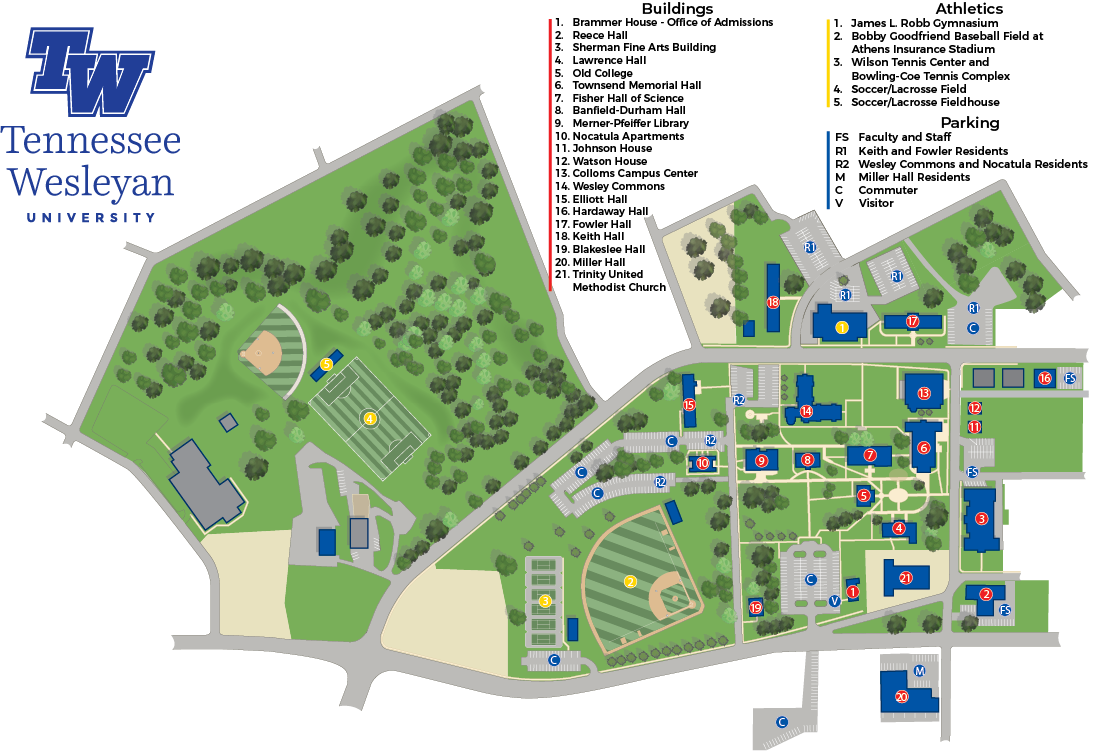
Tennessee Wesleyan University seal · sourceCampus Map | Tennessee Wesleyan University · sourceVirtual Tour | Tennessee Wesleyan University · sourceTWUAthens_042820-91 (1) | Tennessee Wesleyan University · source