Admit rate has ranged 80%–96% over the last 5 years — notably volatile, though the latest figure above (64%) falls outside that window. Source: IPEDS via Urban Institute.
Acceptance & SAT from Common Data Set / IPEDS; net price, earnings & graduation from the U.S. Dept. of Education College Scorecard. Figures lag ~1–2 years — verify with the school.
Texas A&M University-Texarkana operates as a pragmatic, regional outpost of the Aggie network, built on a promise of accessibility and direct career pathways rather than prestige. Its identity is defined by flexibility—with a significant online presence—and a tight-knit, commuter-leaning campus culture that serves a diverse student body from the Ark-La-Tex region. While graduation rates signal the challenges of its mission, the university leans heavily into its role as an attainable engine for local workforce development.
Admission requirements
Test-optional — scores considered if submitted
Required
High school transcript
Grade point average
Class rank
TOEFL (non-native English)
Considered (not required)
Test scores (SAT/ACT)
Source: IPEDS Admissions survey (2022) via Urban Institute. Covers formal factors only — it does not reflect essays, extracurriculars, or other holistic criteria.
More details
Undergrad enrollment
1,982
In-state tuition
$8,349
Out-of-state tuition
$45,080
Campus Vibe
Community-focused, commuter-friendly
Common Majors
Interdisciplinary Studies, Parks & Recreation
Graduation Rate
30%
Student-Faculty Ratio
13:1
Median Earnings (10yr)
$45,515
Financial Aid Recipients
92% of first-year students
Outcomes & value
Outcomes & value
Median earnings (10 yr)
$45,515
Value (earnings ÷ net price)
3.5×
Median debt at graduation
$18,953
Graduation rate
30%
First-year retention
64%
Reducing loan balance (3 yr)
52%
Pell (lower-income) share
53%
First-gen share (among federal-aid recipients)
48%
Top-earning majors
Median earnings by field of study (highest credential), ~2 years after completion.
Liberal Arts and Sciences, General Studies and Humanities$33,993
Multi/Interdisciplinary Studies, Other$33,162
Criminal Justice and Corrections$32,569
Business Administration, Management and Operations$32,569
Biology, General$29,685
Psychology, General
Campus & location
Campus safety
On-campus violent crimes (2024)
2
Per 1,000 students
0.83
On-campus criminal offenses classed as violent (murder/non-negligent manslaughter, rape, robbery, aggravated assault) for the most recent reported year. Source: U.S. Dept. of Education Campus Safety and Security (Clery Act). Counts reflect what’s reported to the school, and urban campuses often report more partly due to non-student incidents nearby — read alongside campus size and setting, not as a standalone safety verdict.
Climate
Pleasant days / yr
87
Summer high
93°F
Winter low
40°F
Annual rain
53.7"
Annual snow
2.2"
Natural-hazard risk
Relatively Low
Pleasant days counts days per year with a mean temperature of 55–75°F, a high at or below 90°F, a low at or above 45°F, and little precipitation — a transparent comfort measure, not a weighting we invented. Computed from Open-Meteo ERA5 daily history (2019–2023). Natural-hazard risk is the county’s composite rating from the FEMA National Risk Index.
Deep dive — research, future-scholar output & economic mobility▾
Research output
Institutional h-index
49
Scholarly works
756
Institutional research volume and impact from OpenAlex. The h-index reflects large research universities and will be low for teaching-focused liberal-arts colleges — not a measure of undergraduate quality.
Quick answers
What is the acceptance rate at Texas A&M University-Texarkana?
Texas A&M University-Texarkana's acceptance rate is approximately 64% (Texarkana, TX), based on the most recent figures we compiled from public and primary sources.
How much does Texas A&M University-Texarkana cost?
At Texas A&M University-Texarkana, the average net price (after aid) is about $12,997 per year. Actual cost varies with financial aid and residency.
How many undergraduates attend Texas A&M University-Texarkana?
Texas A&M University-Texarkana enrolls approximately 1,982 undergraduate students.
Where is Texas A&M University-Texarkana located?
Texas A&M University-Texarkana is located in Texarkana, TX.
Admissions
Admissions at Texas A&M-Texarkana are decidedly non-selective, positioning the university as an open door for students from the region. The process emphasizes minimum eligibility criteria over . The university's own published standards for freshman admission are straightforward: a student must meet one of three benchmarks—a top 30% high school class rank, a minimum 2.75 GPA on a 4.0 scale, or a minimum test score of 1060 on the post-March 2016 SAT, 980 on the pre-March 2016 SAT, or 21 on the ACT. External sources report a wide range of admitted student test scores, with SAT ranges typically cited between 870–1110 and ACT ranges between 16–23. The university does not offer an early decision plan, and while the provided sources do not explicitly state a policy on demonstrated interest, general guidance indicates such a factor would be found in the CDS C7 section. The admissions office contact is listed as [email protected].
Earnings = median of students working ~10 years after entry; debt = median of graduates. Value divides 10-yr earnings by one year’s net price — read it as earnings per dollar of annual cost, not a full lifetime ROI; it favors lower-cost schools. Source: U.S. Dept. of Education College Scorecard. Figures lag ~2 years and reflect all students, not your intended major.
$25,967
Source: U.S. Dept. of Education College Scorecard (field-of-study earnings). Figures cover graduates who received federal aid and lag ~2 years; not all programs report data.
The academic profile of Texas A&M-Texarkana is defined by practicality, flexibility, and a focus on regional workforce needs. The university markets itself as "FLEXIBLE. Meeting you where you are – on-campus and online," "REPUTABLE. Degrees that lead directly to high paying jobs in our region," and "ATTAINABLE." It offers a range of undergraduate and graduate degree programs. The student-to-faculty ratio is reported as 13:1. According to an analysis of conferred degrees, the most specialized majors are Interdisciplinary Studies (45 degrees awarded) and Parks, Recreation, & Leisure (23 degrees). Specific programs, like the Chemistry degree, are described as preparing students for careers as chemists, physical scientists, or technicians in research, quality control, or production. Student feedback highlights the quality of teachers, staff, and mentors. The 4-year graduation rate is noted as 17%.
Campus culture is described as one of community, a spirit students are told they will feel upon stepping on campus. The student body demographics as of Fall 2023 were approximately 49% White and 19% Hispanic. Life outside the classroom revolves around more than 30 student organizations, which include Greek life with sororities like Phi Beta and Alpha Sigma Alpha. The university provides standard student support services, including a Veterans Services Center, and promotes intramural sports and on-campus activities and events. A study abroad program is also offered for students seeking international experience. The library is noted as a vast and well-stocked resource. For those living on campus, the community aspect is particularly emphasized.
Outcomes data paints a mixed picture, reflective of the university's mission-serving, open-access student body. The median earnings for graduates ten years after entry is $45,515. The six-year graduation rate is reported at 27% in one source and 31% in another, which places it in the bottom 10% nationally. Another source cites a 49% graduation rate. The "value score" of the institution has been rated as 27 out of 100, considered below-average relative to its cost, with graduates earning about 15% below the national average. The median debt at graduation is reported as $19,000. An analysis of outcomes weightings in rankings shows that 57% of a ranking score is based on outcomes, with average six-year graduation rate accounting for 21% of that.
Texas A&M-Texarkana positions itself as an affordable option, with a significant majority of students receiving financial aid. The average annual after aid is $12,997. A substantial 92% of full-time beginning undergraduates receive grant or scholarship aid. The average total aid awarded is $10,736 per year, which breaks down into average federal grant aid of $6,307, state grant aid of $7,035, and institutional grant aid of $4,000. Financial aid is awarded based on full-time enrollment for undergraduates and is distributed on a first-come, first-served basis. The university has initiatives like the "Eagle Promise," designed to fill the tuition gap for qualifying students by fully covering the balance for 12 credit hours per semester. Another program, the "TAMUT Commitment," is aimed at providing continued financial assistance to graduates of the local Texarkana College. To be eligible for need-based grants, students must demonstrate exceptional financial need as determined by the FAFSA or TASFA.
Texas A&M-Texarkana stands out not for elite selectivity or national rankings, but for its unwavering commitment to being a pragmatic, accessible educational provider for the Ark-La-Tex region. Its singular focus is on "attainable" degrees that lead "directly to high paying jobs in our region." This mission manifests in its highly flexible academic model, which equally promotes on-campus and online learning to meet students where they are. It carves a distinct niche through hyper-local initiatives like the Eagle Promise tuition coverage program and the TAMUT Commitment for community college graduates, demonstrating a deep institutional investment in the economic mobility of its immediate community. While graduation rates reflect the challenges inherent in this open-access model, the university's value proposition is clear: it is a no-frills, high-touch (with a 13:1 student-faculty ratio) conduit to the workforce and a vital piece of the broader Texas A&M system's service mandate, offering the Aggie brand and network to a student population it is uniquely designed to serve.
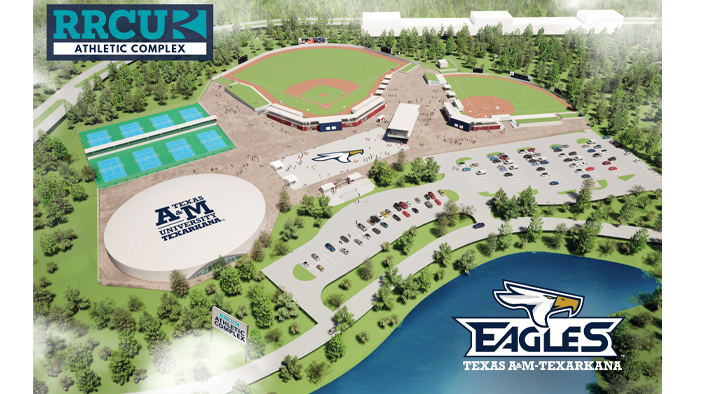
Texas A&M University-Texarkana seal · sourceTexas A&M University-Texarkana (@TAMUT.edu) • Facebook · sourceTexas A&M Texarkana | A&M-Texarkana Uses Substantial Online Offerings and Partnerships to Attract Students from Across the United States · sourceTexas A&M Texarkana | A&M-Texarkana to Hold Groundbreaking Celebration For New RRCU Athletic Complex · source
.jpg?width=1600)