Loading…
← All schools.gif)
Tillamook Bay Community College
Tillamook, ORpublictillamookbaycc.edu/
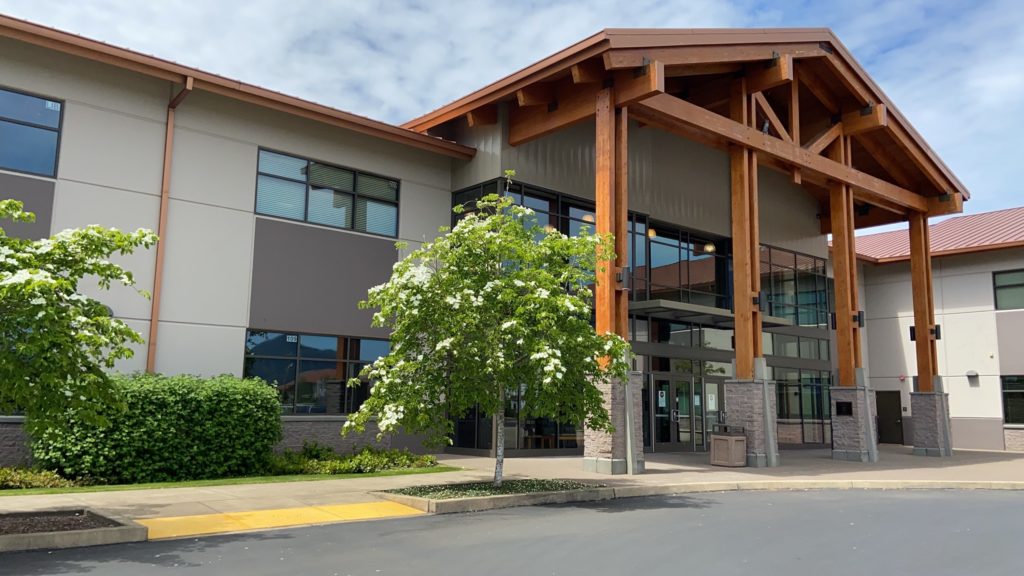
Tillamook Bay Community College is a small, open-door institution on Oregon’s rugged coast that defines itself by accessibility and practical training, not selectivity. With an open admissions policy and a focus on workforce readiness, TBCC serves a local population of about 600 students with a mix of transfer-oriented associate degrees and career-focused certificates in fields like agriculture and transportation. It’s a place where education is treated as a public utility—low-cost, low-barrier, and tightly woven into the economic fabric of Tillamook County.
More details
- Undergrad enrollment
- 294
- In-state tuition
- $4,896
- Out-of-state tuition
- $5,616
- Graduation Rate
- 20%
- Notable Programs
- Liberal Arts & Humanities, Transportation, Agricultural Technology
- Standardized Tests
- Not required
- Demonstrated Interest
- Not considered
- Student-Faculty Ratio
- 9:1
- Annual Scholarship Funds
- Over $150,000
- Application Deadlines (2026-27)
- Summer: June 14, Fall: Sept 13, Winter: Dec 27, Spring: Mar 14
Outcomes & value
Outcomes & value
- Reducing loan balance (3 yr)
- 25%
- Pell (lower-income) share
- 25%
- First-gen share (among federal-aid recipients)
- 49%
Earnings = median of students working ~10 years after entry; debt = median of graduates. Value divides 10-yr earnings by one year’s net price — read it as earnings per dollar of annual cost, not a full lifetime ROI; it favors lower-cost schools. Source: U.S. Dept. of Education College Scorecard. Figures lag ~2 years and reflect all students, not your intended major.
Campus & location
Campus safety
- On-campus violent crimes (2024)
- 0
On-campus criminal offenses classed as violent (murder/non-negligent manslaughter, rape, robbery, aggravated assault) for the most recent reported year. Source: U.S. Dept. of Education Campus Safety and Security (Clery Act). Counts reflect what’s reported to the school, and urban campuses often report more partly due to non-student incidents nearby — read alongside campus size and setting, not as a standalone safety verdict.
Climate
- Pleasant days / yr
- 115
- Summer high
- 67°F
- Winter low
- 39°F
- Annual rain
- 61.4"
- Annual snow
- 19.4"
- Natural-hazard risk
- Relatively Moderate
Pleasant days counts days per year with a mean temperature of 55–75°F, a high at or below 90°F, a low at or above 45°F, and little precipitation — a transparent comfort measure, not a weighting we invented. Computed from Open-Meteo ERA5 daily history (2019–2023). Natural-hazard risk is the county’s composite rating from the FEMA National Risk Index.
Deep dive — research, future-scholar output & economic mobility
Research output
- Institutional h-index
- 12
- Scholarly works
- 56
Institutional research volume and impact from OpenAlex. The h-index reflects large research universities and will be low for teaching-focused liberal-arts colleges — not a measure of undergraduate quality.
Quick answers
- How much does Tillamook Bay Community College cost?
- At Tillamook Bay Community College, the average net price (after aid) is about $5,405 per year. Actual cost varies with financial aid and residency.
- How many undergraduates attend Tillamook Bay Community College?
- Tillamook Bay Community College enrolls approximately 294 undergraduate students.
- Where is Tillamook Bay Community College located?
- Tillamook Bay Community College is located in Tillamook, OR.
Admissions
Admissions at Tillamook Bay Community College are defined by an open admission policy, meaning virtually all applicants with a high school diploma or GED are admitted. The school explicitly states it has this policy, and multiple sources report an of 100% as a result. This stands in stark contrast to some external sites that incorrectly list a competitive acceptance rate around 42%; the authoritative sources confirm open admissions. The process is designed for accessibility: standardized test scores (SAT/ACT) are not required for admission. Application deadlines are rolling but follow a term-based schedule: Summer (June 14, 2026), Fall (September 13, 2026), Winter (December 27, 2026), and Spring (March 14, 2027). Given the open policy, factors like demonstrated interest are not part of the admissions calculus; the college's focus is on removing barriers to entry, not evaluating candidate appeal.
Compare Tillamook Bay Community College
vs Oregon State University-Cascades Campusvs University of Alaska Southeastvs United States Merchant Marine Academyvs University of Science and Arts of Oklahoma
See colleges similar to Tillamook Bay Community College →Sources
- Apply - Tillamook Bay Community ...
- Common Data Set: Home
- The Common Data Set: What It Is & How to Use It In College Applications
- Tillamook Bay Community College - DFR Report HTML
- Using The Common Data Set To Your Benefit
- Common Data Set 202
- Tillamook Bay Community College
- TBCC Acceptance Rate | Study in Tillamook
- Tillamook Bay Community College Admissions - (2025-2026)
- Tillamook Bay Community College Overview
- Tillamook Bay Community College SAT Scores, ACT ...