Loading…
← All schools
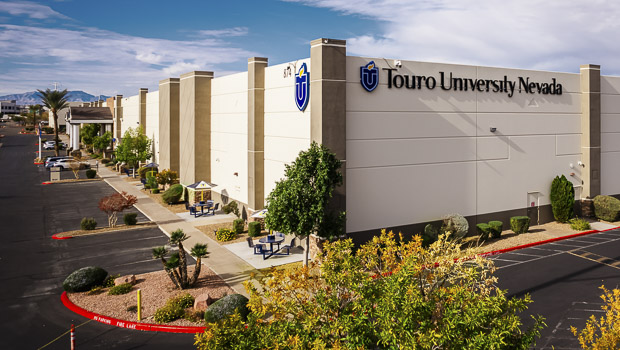
Touro University Nevada
Henderson, NVprivate nonprofitwww.tun.touro.edu/
Touro University Nevada isn't your typical undergraduate college; it's a hyper-specialized, graduate-level health sciences powerhouse in Henderson. With a laser focus on training doctors, physician assistants, nurses, and therapists, its identity is defined by rigorous, clinically intensive programs and a student body of over 1,300 aspiring healthcare professionals. The campus vibe is less about tailgates and more about practical preparation, underscored by a remarkable 98.3% first-time pass rate on a key medical licensing exam—the highest of any medical school in the country.
More details
- Undergrad enrollment
- 22
- Program Focus
- Graduate Health Sciences & Education
- Signature Stat
- 98.3% first-time COMLEX-USA Level 1 pass rate (osteopathic medicine)
- Graduation Rate
- 88%
- Student Body Size
- Over 1,300 students
- Median Earnings (10yr)
- $104,805
Outcomes & value
Outcomes & value
- Median earnings (10 yr)
- $104,805
- Median debt at graduation
- $12,500
- Reducing loan balance (3 yr)
- 80%
- Pell (lower-income) share
- 16%
- First-gen share (among federal-aid recipients)
- 31%
- Endowment / student
- $3,918
Earnings = median of students working ~10 years after entry; debt = median of graduates. Value divides 10-yr earnings by one year’s net price — read it as earnings per dollar of annual cost, not a full lifetime ROI; it favors lower-cost schools. Source: U.S. Dept. of Education College Scorecard. Figures lag ~2 years and reflect all students, not your intended major.
Top-earning majors
Median earnings by field of study (highest credential), ~2 years after completion.
- Registered Nursing, Nursing Administration, Nursing Research and Clinical Nursing$67,812
Source: U.S. Dept. of Education College Scorecard (field-of-study earnings). Figures cover graduates who received federal aid and lag ~2 years; not all programs report data.
Compare on earnings: best colleges for Nursing
Campus & location
Campus safety
- On-campus violent crimes (2024)
- 1
- Per 1,000 students
- 0.63
On-campus criminal offenses classed as violent (murder/non-negligent manslaughter, rape, robbery, aggravated assault) for the most recent reported year. Source: U.S. Dept. of Education Campus Safety and Security (Clery Act). Counts reflect what’s reported to the school, and urban campuses often report more partly due to non-student incidents nearby — read alongside campus size and setting, not as a standalone safety verdict.
Climate
- Pleasant days / yr
- 84
- Summer high
- 104°F
- Winter low
- 39°F
- Annual rain
- 6.2"
- Annual snow
- 0.6"
- Natural-hazard risk
- Very High
Pleasant days counts days per year with a mean temperature of 55–75°F, a high at or below 90°F, a low at or above 45°F, and little precipitation — a transparent comfort measure, not a weighting we invented. Computed from Open-Meteo ERA5 daily history (2019–2023). Natural-hazard risk is the county’s composite rating from the FEMA National Risk Index.
Deep dive — research, future-scholar output & economic mobility
Research output
- Institutional h-index
- 69
- Scholarly works
- 1,436
Institutional research volume and impact from OpenAlex. The h-index reflects large research universities and will be low for teaching-focused liberal-arts colleges — not a measure of undergraduate quality.
Quick answers
- How many undergraduates attend Touro University Nevada?
- Touro University Nevada enrolls approximately 22 undergraduate students.
- Where is Touro University Nevada located?
- Touro University Nevada is located in Henderson, NV.
Admissions
Admissions at Touro University Nevada are almost exclusively a graduate-level affair, with its programs in osteopathic medicine, physician assistant studies, nursing, occupational therapy, and physical therapy drawing highly competitive pools of post-baccalaureate applicants. While the university's overall is reported around 61%, this figure masks the intense selectivity of its flagship programs. For the Doctor of Osteopathic Medicine (DO) program, the entering class typically boasts a strong science GPA of 3.47 and a cumulative GPA of 3.54. The process is holistic but demanding, with successful applicants often presenting SAT scores in the 1218-1453 range or ACT scores between 24 and 32 from their undergraduate careers. The admissions department receives a significant volume of applications, underscoring the institution's prominence in healthcare education.
Academics
Academics at Touro Nevada are singularly devoted to health sciences and education, offering no traditional undergraduate majors. The curriculum is a deep dive into professional practice. The College of Osteopathic Medicine and the College of Health and Human Services provide graduate degrees in osteopathic medicine, physician assistant studies, education, nursing, occupational therapy, physical therapy, and medical health sciences. The osteopathic medicine program, in particular, has established an extraordinary record of student performance, achieving a 98.3 percent average first-time pass rate on the COMLEX-USA Level 1 exam—a rate the university touts as the highest of any medical school in the country. Other programs, like the Master of Physician Assistant Studies, also report high graduation rates, consistently at 95% or above. This is an institution built for clinical competency, where success is measured by board scores and job readiness.
Compare Touro University Nevada
See colleges similar to Touro University Nevada →Sources
- Common Data Set (CDS)
- Common Data Set | Office of Decision Support | UNLV ...
- 2024-2025 UNIVERSITY CATALOG
- Common Data Set Explorer 2026: Compare 100 Colleges
- Common Data Set 2022-2023
- CDS-A
- Admission Requirements | Osteopathic Medicine
- Touro University Admissions - US News Best Colleges
- Touro University Acceptance Rate - Admissions Chances & Data
- Touro University - Nevada Admissions & Acceptance