Admit rate has ranged 8%–11% over the last 5 years. Source: IPEDS via Urban Institute.
Acceptance & SAT from Common Data Set / IPEDS; net price, earnings & graduation from the U.S. Dept. of Education College Scorecard. Figures lag ~1–2 years — verify with the school.
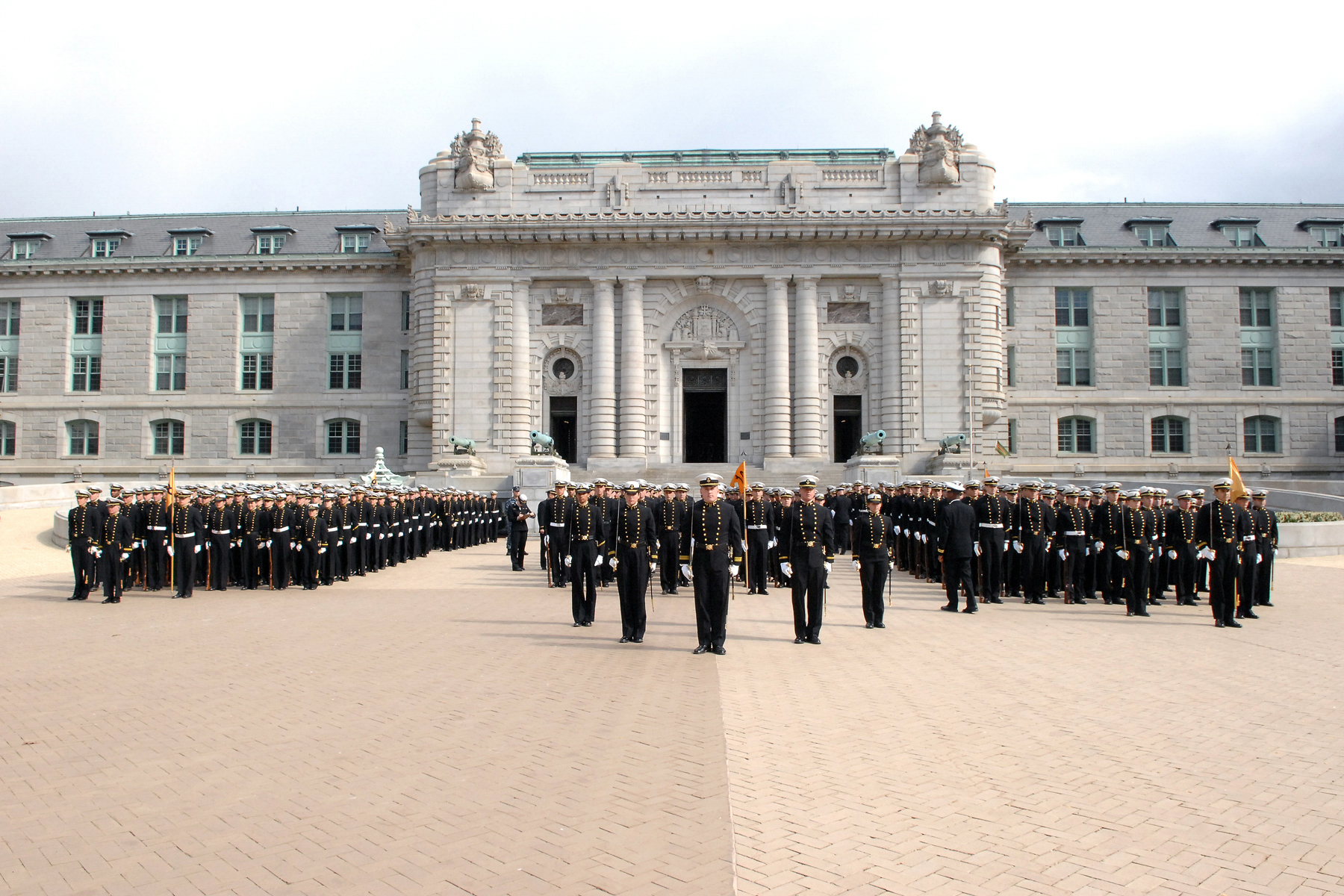
The United States Naval Academy is not a college; it's a four-year leadership crucible where every student is a midshipman on active duty, bound for a commission as a Navy or Marine Corps officer. Its singular mission—forged in the granite of Bancroft Hall and the waters of the Severn River—produces a uniquely intense, regimented, and purpose-driven undergraduate experience, where a STEM-heavy curriculum is inseparable from military training and character development. Graduates leave with a debt of service, not student loans, and join one of the world's most consequential professional networks.
Admission requirements
Test scores required
Required
Grade point average
Class rank
Letters of recommendation
Test scores (SAT/ACT)
TOEFL (non-native English)
Considered (not required)
High school transcript
College-prep program
Source: IPEDS Admissions survey (2022) via Urban Institute. Covers formal factors only — it does not reflect essays, extracurriculars, or other holistic criteria.
Key deadlines (2026-2027)
Regular Decision — Regular Decision
January 31, 2026
Early Action — Early Action
January 31, 2026
Scholarship — Nomination Application Deadline
January 31, 2026
Financial Aid — FAFSA Priority Deadline
February 15, 2026
More details
Undergrad enrollment
4,474
No-Loan Policy
Yes, for all students
Graduation Rate
93%
Meets Full Need
Yes
Service Obligation
5 years minimum active duty
Student Body Title
Midshipmen on Active Duty
Demonstrated Interest
Considered
Legacy in Class of 2029
61 children of alumni
Required Athletic Participation
Yes
Outcomes & value
Outcomes & value
Graduation rate
93%
First-year retention
97%
Earnings = median of students working ~10 years after entry; debt = median of graduates. Value divides 10-yr earnings by one year’s net price — read it as earnings per dollar of annual cost, not a full lifetime ROI; it favors lower-cost schools. Source: U.S. Dept. of Education College Scorecard. Figures lag ~2 years and reflect all students, not your intended major.
Campus & location
Climate
Pleasant days / yr
93
Summer high
84°F
Winter low
33°F
Annual rain
60.7"
Annual snow
10.6"
Natural-hazard risk
Relatively Moderate
Pleasant days counts days per year with a mean temperature of 55–75°F, a high at or below 90°F, a low at or above 45°F, and little precipitation — a transparent comfort measure, not a weighting we invented. Computed from Open-Meteo ERA5 daily history (2019–2023). Natural-hazard risk is the county’s composite rating from the FEMA National Risk Index.
Deep dive — research, future-scholar output & economic mobility▾
Research output
Institutional h-index
195
Scholarly works
13,565
Institutional research volume and impact from OpenAlex. The h-index reflects large research universities and will be low for teaching-focused liberal-arts colleges — not a measure of undergraduate quality.
Quick answers
What is the acceptance rate at United States Naval Academy?
United States Naval Academy's acceptance rate is approximately 9% (Annapolis, MD), based on the most recent figures we compiled from public and primary sources.
What SAT score do you need for United States Naval Academy?
Admitted students at United States Naval Academy typically score 1210–1410 on the SAT (the middle-50% range). Scores outside this band are still admitted, especially with strong applications.
How many undergraduates attend United States Naval Academy?
United States Naval Academy enrolls approximately 4,474 undergraduate students.
Where is United States Naval Academy located?
United States Naval Academy is located in Annapolis, MD.
Admissions
Gaining an appointment to Annapolis is a gauntlet of academic, physical, and political hurdles far beyond the typical college application. The process is famously selective, with an hovering around 9%. For the most recent entering class, the Academy received over 16,000 applications and made approximately 1,416 offers of appointment. The academic bar is high: the middle 50% of admitted students who submitted scores had SAT scores between 1210 and 1410, with the math subsection (610-720) often slightly higher than the verbal (600-710).
What makes USNA admissions unique is the requirement for a nomination, typically from a U.S. Representative, Senator, or the Vice President. This adds a layer of political vetting to the process. Furthermore, every candidate must pass a rigorous medical examination and a physical fitness assessment. Demonstrated leadership, athletic prowess, and a clear commitment to military service are not just nice-to-haves—they are essential, evaluated factors in the . The class profile shows is a factor but not a guarantee; the Class of 2029 included 61 children of alumni.
Every graduate earns a Bachelor of Science degree, regardless of major, underscoring the institution's foundational commitment to technical and analytical rigor. The academic program is structured to meet a critical military need: at least 65% of graduates commissioned into the U.S. Navy must complete a major in a science, technology, engineering, or mathematics (STEM) discipline. This mandate shapes the curriculum, making engineering the dominant field of study; 42% of the Class of 2024 graduated as engineers. Other popular majors include Political Science and Government (categorized under Social Sciences, which accounted for 19% of graduates), Physical Sciences (11%), and Military Science, Leadership and Operational Art (5%).
The course load is heavy and standardized for the first two years, with all midshipmen taking core sequences in calculus, chemistry, physics, engineering, history, and English. The pace is relentless, designed to develop problem-solving under pressure. While majors in the humanities and social sciences exist, they are pursued within the overarching framework of military professionalism and the STEM-centric graduation requirements.
Life as a midshipman is a total institution experience, governed by the mantra of "Duty, Honor, Loyalty." From Induction Day forward, every minute is scheduled. The entire student body lives together in a single massive dormitory, Bancroft Hall, and operates under a strict military hierarchy of classes (freshmen are "plebes"), with upperclassmen providing training and leadership. The day begins at dawn with muster and is segmented into blocks for academic classes, mandatory military training (including seamanship and navigation), athletic participation (every midshipman must play a sport, either varsity or intramural), and study hours.
Social life is almost entirely internal and revolves around company affiliation—each midshipman is assigned to one of 30 companies that serve as a primary social and competitive unit. While the regimen is intense, opportunities for respite exist through over 100 clubs and extracurricular activities, from musical groups and religious organizations to sailing and robotics. The campus, known as the "Yard," is a historic, walled fortress on the Chesapeake Bay, offering a beautiful but insular setting. Weekends allow for limited liberty, but the culture is one of shared sacrifice and collective identity, forging bonds that last a lifetime.
The Naval Academy's outcome metrics are defined by its service mission. The graduation rate is exceptionally high, at 93%. This remarkable retention is a function of the immense screening process and the structured, all-in environment. Upon graduation, 100% of midshipmen are commissioned as Ensigns in the U.S. Navy or Second Lieutenants in the U.S. Marine Corps, embarking on a minimum five-year active duty service obligation.
While starting military pay is standardized and modest, the long-term career trajectory and earnings potential for graduates are significant. The value of the education—a fully-funded undergraduate degree coupled with unparalleled leadership training and a guaranteed officer commission—creates a unique return on investment. The professional network of the Navy and Marine Corps, along with the prestige of the Academy ring, opens doors in the military and, later, in the civilian sector. The focus is on producing leaders of character for the nation, not on conventional postgraduate salary metrics, though mid-career earnings for alumni are consistently strong.
The financial model of the Naval Academy is fundamentally different from any civilian university. There is no tuition, room, board, or fees for midshipmen. Instead, the U.S. Navy covers 100% of these costs. In return, midshipmen are considered active-duty members of the U.S. Navy and receive a monthly stipend (approximately $1,200) to pay for uniforms, books, and personal expenses.
This arrangement means there is no concept of "" or financial aid packages in the traditional sense. The Academy meets the full need of every student by virtue of its structure—it is a fully-funded, no-loan institution by design. The "cost" to the student is not financial, but a commitment to serve as a commissioned officer upon graduation. This creates a powerful economic proposition, eliminating student debt and providing a salary and benefits from day one of a graduate's military career.
The United States Naval Academy stands apart as a total-immersion leadership academy with a singular, non-negotiable output: naval officers. Its distinctiveness lies in the complete integration of its parts—the rigorous STEM-accented academics are not separate from the military training; both are fused with character development in a 24/7, four-year leadership laboratory. The absence of financial cost (and debt) is matched by the profound weight of the service obligation, creating a student body united by a sense of purpose rarely found on a civilian campus.
Its culture is one of disciplined egalitarianism; every student wears the same uniform, lives in the same dorm, and adheres to the same demanding schedule. The result is an unparalleled sense of camaraderie and a network—the "Band of Brothers and Sisters"—that is both professional and deeply personal. It's not for everyone; the loss of personal autonomy is extreme. But for those who thrive, it offers a transformative education that builds not just a resume, but an identity, forging leaders who are technically proficient, physically tough, and ethically anchored for a lifetime of service.
United States Naval Academy seal · sourceVisit Annapolis - Naval Academy · sourceMaps and Directions :: Leaders to Serve the Nation... · sourceMaps and Directions :: Leaders to Serve the Nation... · source