Admit rate has ranged 56%–66% over the last 5 years — notably volatile. Source: IPEDS via Urban Institute.
Acceptance & SAT from Common Data Set / IPEDS; net price, earnings & graduation from the U.S. Dept. of Education College Scorecard. Figures lag ~1–2 years — verify with the school.
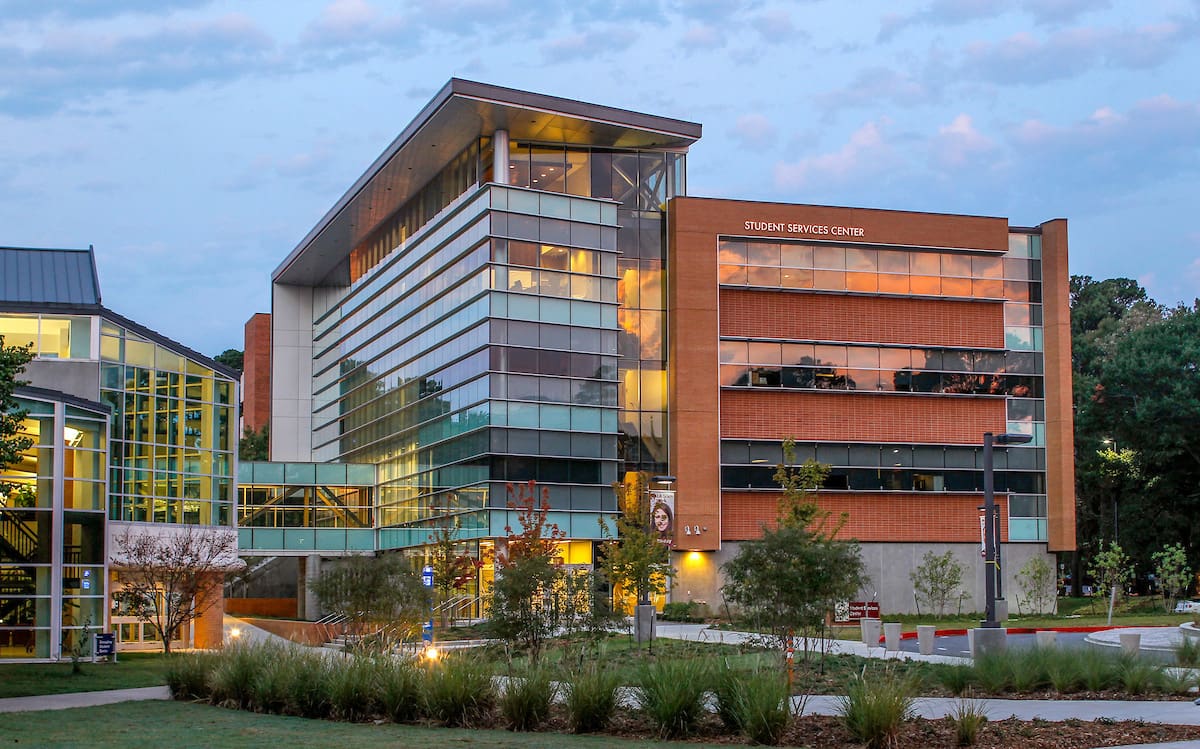
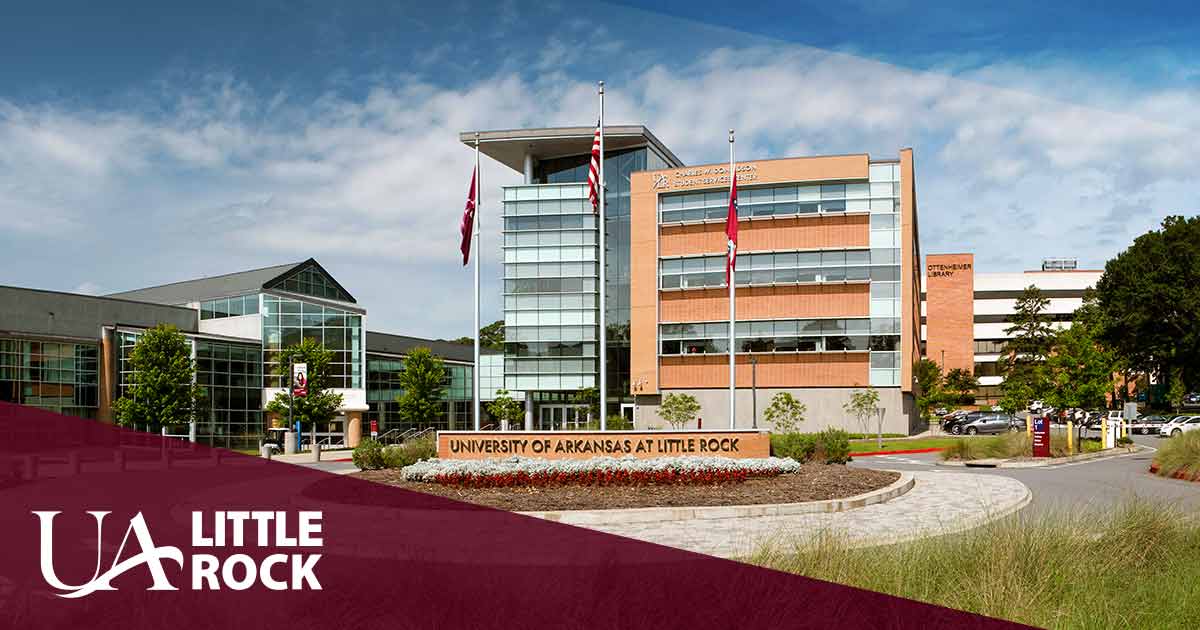
The University of Arkansas at Little Rock is a metropolitan research university that serves as a pragmatic, accessible engine of upward mobility in the state's capital. It operates with a mission of flexibility and community connection, offering a slate of professionally oriented programs—from nursing to computer science—to a largely local and non-traditional student body. The campus vibe is commuter-focused and diverse, with student life orbiting around organizations, intramurals, and the resources of a mid-sized city, rather than a rah-rah residential experience.
Admission requirements
Test scores required
Required
High school transcript
Grade point average
Test scores (SAT/ACT)
TOEFL (non-native English)
Considered (not required)
College-prep program
Source: IPEDS Admissions survey (2022) via Urban Institute. Covers formal factors only — it does not reflect essays, extracurriculars, or other holistic criteria.
More details
Undergrad enrollment
4,949
In-state tuition
$9,748
Out-of-state tuition
$22,158
Graduation Rate
42%
Student-Faculty Ratio
11:1
Freshmen Receiving Aid
92%
Median Earnings (10yr)
$45,265
First-Year Retention Rate
70%
Outcomes & value
Outcomes & value
Median earnings (10 yr)
$45,265
Value (earnings ÷ net price)
2.6×
Median debt at graduation
$22,000
Graduation rate
42%
First-year retention
76%
Reducing loan balance (3 yr)
58%
Pell (lower-income) share
41%
First-gen share (among federal-aid recipients)
39%
Top-earning majors
Median earnings by field of study (highest credential), ~2 years after completion.
Registered Nursing, Nursing Administration, Nursing Research and Clinical Nursing$70,536
Management Information Systems and Services$60,161
Construction Engineering Technology/Technician$55,512
Marketing$48,823
Accounting and Related Services$48,667
Finance and Financial Management Services
Campus & location
Campus safety
On-campus violent crimes (2024)
2
Per 1,000 students
0.28
On-campus criminal offenses classed as violent (murder/non-negligent manslaughter, rape, robbery, aggravated assault) for the most recent reported year. Source: U.S. Dept. of Education Campus Safety and Security (Clery Act). Counts reflect what’s reported to the school, and urban campuses often report more partly due to non-student incidents nearby — read alongside campus size and setting, not as a standalone safety verdict.
Climate
Pleasant days / yr
81
Summer high
90°F
Winter low
37°F
Annual rain
52.3"
Annual snow
3.4"
Natural-hazard risk
Relatively High
Pleasant days counts days per year with a mean temperature of 55–75°F, a high at or below 90°F, a low at or above 45°F, and little precipitation — a transparent comfort measure, not a weighting we invented. Computed from Open-Meteo ERA5 daily history (2019–2023). Natural-hazard risk is the county’s composite rating from the FEMA National Risk Index.
Deep dive — research, future-scholar output & economic mobility▾
Research output
Institutional h-index
263
Scholarly works
11,788
Institutional research volume and impact from OpenAlex. The h-index reflects large research universities and will be low for teaching-focused liberal-arts colleges — not a measure of undergraduate quality.
Economic mobility
Mobility rate
2.1%
Bottom → top quintile
14%
From bottom quintile
15%
Mobility rate = the share of students who both start in the bottom household-income quintile and reach the top quintile; bottom → top is that chance conditional on starting at the bottom. Source: Opportunity Insights Mobility Report Cards (Chetty, Friedman, Saez, Turner & Yagan). Reflects 1980–82 birth cohorts, so it’s directional, not current.
Quick answers
What is the acceptance rate at University of Arkansas at Little Rock?
University of Arkansas at Little Rock's acceptance rate is approximately 59% (Little Rock, AR), based on the most recent figures we compiled from public and primary sources.
What SAT score do you need for University of Arkansas at Little Rock?
Admitted students at University of Arkansas at Little Rock typically score 960–1210 on the SAT (the middle-50% range). Scores outside this band are still admitted, especially with strong applications.
How much does University of Arkansas at Little Rock cost?
At University of Arkansas at Little Rock, the average net price (after aid) is about $17,248 per year. Actual cost varies with financial aid and residency.
How many undergraduates attend University of Arkansas at Little Rock?
University of Arkansas at Little Rock enrolls approximately 4,949 undergraduate students.
Where is University of Arkansas at Little Rock located?
University of Arkansas at Little Rock is located in Little Rock, AR.
Admissions
UA Little Rock's admissions process is designed for accessibility, reflecting its mission as a metropolitan university. The university reports an of 59%, positioning it as a moderately selective institution where most applicants are admitted. The middle 50% SAT range for admitted students is 960–1210, though the university is , accepting the ACT, SAT, CLT, or a minimum 1010 SAT total score for admission consideration. The admissions office is located at 2801 S. University Ave. in Little Rock and can be reached at 501-916-3127 or [email protected]. The process emphasizes academic preparation, with high school GPA evaluated on a 4.00 scale as a primary factor.
Academics at UA Little Rock are characterized by a practical, career-focused curriculum and a notably close 11:1 student-faculty ratio, which facilitates more direct interaction in classrooms. The university offers 99 undergraduate majors, with several programs earning national recognition in the 2026 U.S. News & World Report rankings: its undergraduate business program ranked #194, computer science #245, and nursing also featured among the top programs. The institution describes itself as providing "accessibility to a quality education through flexible learning and unparalleled" opportunities, catering to both traditional and non-traditional students. The average freshman retention rate, a common indicator of student satisfaction, is 70%.
Earnings = median of students working ~10 years after entry; debt = median of graduates. Value divides 10-yr earnings by one year’s net price — read it as earnings per dollar of annual cost, not a full lifetime ROI; it favors lower-cost schools. Source: U.S. Dept. of Education College Scorecard. Figures lag ~2 years and reflect all students, not your intended major.
$44,869
Business Administration, Management and Operations$44,765
Communication Disorders Sciences and Services$36,848
Source: U.S. Dept. of Education College Scorecard (field-of-study earnings). Figures cover graduates who received federal aid and lag ~2 years; not all programs report data.
Campus life at UA Little Rock is active but shaped by its urban, commuter-heavy setting. The Office of Campus Life facilitates connection through over a dozen student organizations, Greek life, student government, campus publications, and recreation. Key hubs include the Student Experience Center, housing, dining facilities, and a fitness center. The university promotes its "dynamic learning environment in Arkansas's thriving capital city," leveraging the resources and internships of Little Rock. Students often describe the campus as having a "strong sense of community and diversity, creating a welcoming and inclusive" atmosphere. Athletics compete at the NCAA Division I level as the Trojans, and intramural sports are a popular offering.
Outcomes for UA Little Rock graduates reflect the profile of a university serving many and part-time students. The six-year graduation rate is 42%. The median earnings for graduates ten years after entry is $45,265. The first-year retention rate is reported at 76%, suggesting that students who persist beyond the first year are on a track toward completion. These figures underscore the university's role in providing a pathway to the middle class for its predominantly regional student body.
Affordability is a central tenet of the UA Little Rock value proposition. The average after aid is $17,248. The university reports that 92% of full-time beginning undergraduates receive some form of grant or scholarship aid. Financial aid offerings include the "Trojan Guarantee" scholarship program, which promises no tuition cost for eligible students, and other awards that can cover up to 50% of tuition and fees. The financial aid office states that "whenever possible, aid will be offered to meet the full amount of the student's eligibility," though the university does not advertise a formal "no-loan" policy for all needy students. Students can contact the office at 501-916-3035 or [email protected].
UA Little Rock stands out as an unapologetically metropolitan university—a place where the boundary between campus and city is deliberately porous. It doesn't try to mimic the classic residential college experience; instead, it leans into its identity as Arkansas's capital city university. Its strengths are practical and immediate: a 11:1 student-faculty ratio that ensures attention in key programs like nursing, business, and computer science; a deep commitment to affordability through programs like the Trojan Guarantee; and a student body celebrated for its diversity and community spirit. This is a school for strivers—for working adults, students, and career-changers who need a flexible, supportive, and relevant education anchored in the professional opportunities of a state capital.
University of Arkansas at Little Rock seal · sourceUA Little Rock Campus - Maps and Parking - About UA Little Rock - UA Little Rock · sourceUA Little Rock - UA Little Rock - UA Little Rock · sourceAbout the University - About UA Little Rock - UA Little Rock · source