Loading…
← All schools
University of Arkansas for Medical Sciences
Little Rock, ARpublicuams.edu
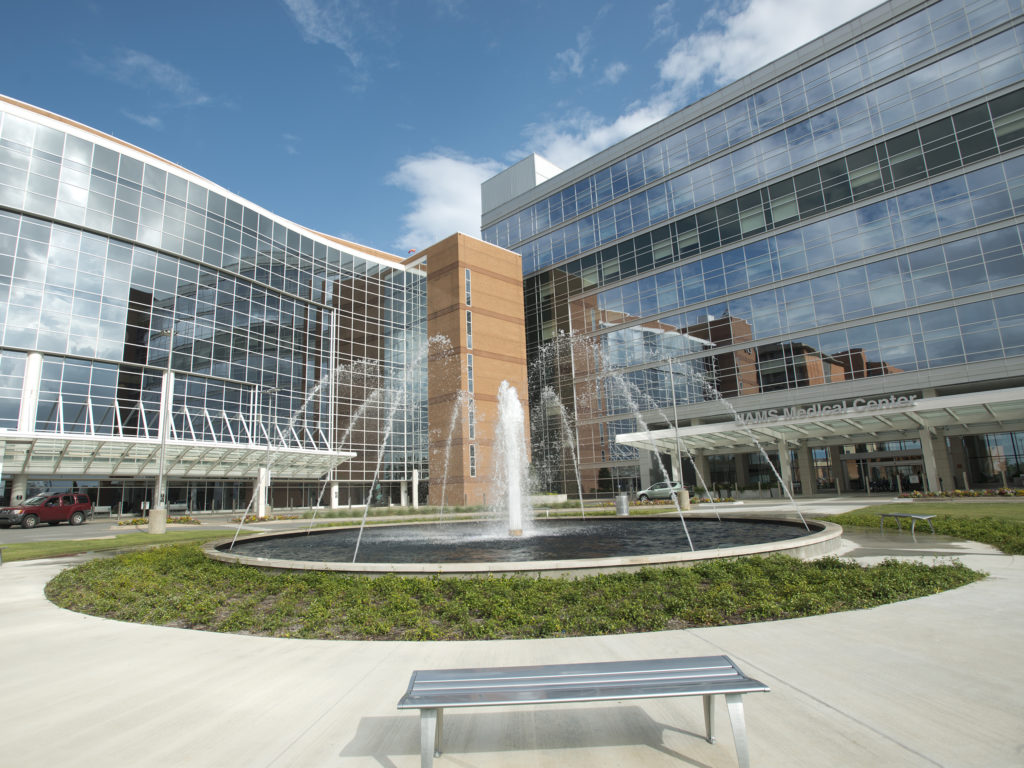
The University of Arkansas for Medical Sciences (UAMS) isn't your typical undergraduate campus; it's Arkansas's only academic health sciences center, a high-stakes, professional-training powerhouse anchored in Little Rock. Its identity is defined by a singular mission: to educate the state's future doctors, nurses, and allied health professionals. The atmosphere is intensely focused and collaborative, built around a sprawling medical campus rather than a quad, where students are training for specific, high-demand careers from day one.
More details
- Undergrad enrollment
- 1,571
- Campus Vibe
- Professional health sciences center
- Early Decision Plan
- Not offered
- Median Earnings (10yr)
- $73,827
- Student-to-Faculty Ratio
- 16:1
- Average UGPA (College of Medicine)
- 3.60
Outcomes & value
Outcomes & value
- Median earnings (10 yr)
- $73,827
- Median debt at graduation
- $14,000
- Reducing loan balance (3 yr)
- 81%
- Pell (lower-income) share
- 28%
- First-gen share (among federal-aid recipients)
- 40%
- Endowment / student
- $111,015
Earnings = median of students working ~10 years after entry; debt = median of graduates. Value divides 10-yr earnings by one year’s net price — read it as earnings per dollar of annual cost, not a full lifetime ROI; it favors lower-cost schools. Source: U.S. Dept. of Education College Scorecard. Figures lag ~2 years and reflect all students, not your intended major.
Top-earning majors
Median earnings by field of study (highest credential), ~2 years after completion.
- Registered Nursing, Nursing Administration, Nursing Research and Clinical Nursing$58,013
- Dental Support Services and Allied Professions$55,512
- Allied Health Diagnostic, Intervention, and Treatment Professions$53,358
- Clinical/Medical Laboratory Science/Research and Allied Professions$50,499
Source: U.S. Dept. of Education College Scorecard (field-of-study earnings). Figures cover graduates who received federal aid and lag ~2 years; not all programs report data.
Compare on earnings: best colleges for Nursing
Campus & location
Campus safety
- On-campus violent crimes (2024)
- 4
- Per 1,000 students
- 1.15
On-campus criminal offenses classed as violent (murder/non-negligent manslaughter, rape, robbery, aggravated assault) for the most recent reported year. Source: U.S. Dept. of Education Campus Safety and Security (Clery Act). Counts reflect what’s reported to the school, and urban campuses often report more partly due to non-student incidents nearby — read alongside campus size and setting, not as a standalone safety verdict.
Climate
- Pleasant days / yr
- 81
- Summer high
- 90°F
- Winter low
- 36°F
- Annual rain
- 51.6"
- Annual snow
- 3.2"
- Natural-hazard risk
- Relatively High
Pleasant days counts days per year with a mean temperature of 55–75°F, a high at or below 90°F, a low at or above 45°F, and little precipitation — a transparent comfort measure, not a weighting we invented. Computed from Open-Meteo ERA5 daily history (2019–2023). Natural-hazard risk is the county’s composite rating from the FEMA National Risk Index.
Deep dive — research, future-scholar output & economic mobility
Research output
- Institutional h-index
- 574
- Scholarly works
- 45,185
Institutional research volume and impact from OpenAlex. The h-index reflects large research universities and will be low for teaching-focused liberal-arts colleges — not a measure of undergraduate quality.
Quick answers
- How many undergraduates attend University of Arkansas for Medical Sciences?
- University of Arkansas for Medical Sciences enrolls approximately 1,571 undergraduate students.
- Where is University of Arkansas for Medical Sciences located?
- University of Arkansas for Medical Sciences is located in Little Rock, AR.
Admissions
Admissions at UAMS is a story of two distinct pathways: the highly competitive, direct-entry professional programs and the broader undergraduate landscape. For its flagship College of Medicine, the process is notoriously selective. The Princeton Review reports an of 25% for the medical school, with an average undergraduate GPA of 3.60 for admitted students. The competition is fierce even for special pipelines; the university's Accelerated 6-Year BS to MD program requires incoming freshmen to have a near-perfect 3.9 weighted high school GPA and a 32 ACT (or 1430 SAT) score or higher. For other programs, the overall institutional acceptance rate is significantly higher, reported between 57.7% and 58.1% for recent application cycles. The framework is used for reporting, though specific factor importance grids for UAMS are not detailed in the provided sources. The institution does not appear to offer a binding Early Decision plan for undergraduate admissions, per Peterson's. Demonstrated interest is a common factor considered by many colleges, but its specific rating (Very Important, Important, Considered, Not Considered) for UAMS is not explicitly stated in the provided Common Data Set snippets.
Compare University of Arkansas for Medical Sciences
vs Citadel Military College of South Carolinavs University of Florida-Onlinevs Rutgers University-Camdenvs United States Air Force Academy
See colleges similar to University of Arkansas for Medical Sciences →Sources
- Common Data Set - Office of Strategic Analytics & Insights
- Common Data Set - Institutional Research and Analytics - UA Little ...
- [PDF] Common Data Set 2024-2025 - Office of Strategic Analytics & Insights
- [XLS] Excel - Office of Strategic Analytics & Insights - University of Arkansas
- Common Data Set: Home
- [PDF] A. General Information - University of Arkansas
- University of Arkansas for Medical Sciences - College of Medicine
- Admissions Statistics - UAMS College of Pharmacy
- University of Arkansas for Medical Sciences - Niche
- University of Arkansas for Medical Sciences: Statistics - EduRank