Loading…
← All schools
University of Maryland Baltimore
Baltimore, MDpublicwww.umaryland.edu/
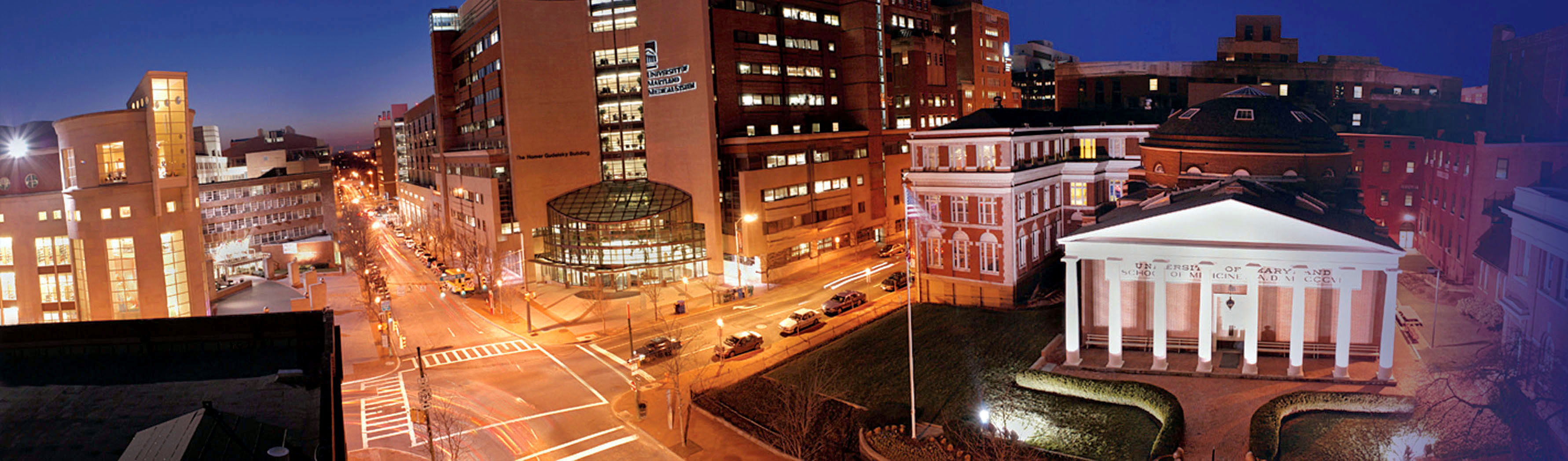
The University of Maryland, Baltimore (UMB) is not a traditional undergraduate college. It is a specialized, urban powerhouse dedicated exclusively to graduate and professional education in the health sciences, law, and social work. With nearly 6,800 students across six nationally ranked schools, its identity is defined by interprofessional collaboration, a deep commitment to serving the public good in Baltimore, and a campus culture oriented toward adult learners and aspiring practitioners.
More details
- Undergrad enrollment
- 958
- Schools
- Six nationally ranked professional schools
- Student Body
- Exclusively graduate and professional students
- Academic Focus
- Health sciences, law, social work, graduate research
- Campus Setting
- Urban, downtown Baltimore
- Institution Type
- Graduate/Professional University
Outcomes & value
Outcomes & value
- Median earnings (10 yr)
- $88,174
- Median debt at graduation
- $15,000
- Reducing loan balance (3 yr)
- 84%
- Pell (lower-income) share
- 15%
- First-gen share (among federal-aid recipients)
- 38%
- Endowment / student
- $78,618
Earnings = median of students working ~10 years after entry; debt = median of graduates. Value divides 10-yr earnings by one year’s net price — read it as earnings per dollar of annual cost, not a full lifetime ROI; it favors lower-cost schools. Source: U.S. Dept. of Education College Scorecard. Figures lag ~2 years and reflect all students, not your intended major.
Top-earning majors
Median earnings by field of study (highest credential), ~2 years after completion.
- Dental Support Services and Allied Professions$69,338
- Registered Nursing, Nursing Administration, Nursing Research and Clinical Nursing$66,069
- Clinical/Medical Laboratory Science/Research and Allied Professions$63,005
Source: U.S. Dept. of Education College Scorecard (field-of-study earnings). Figures cover graduates who received federal aid and lag ~2 years; not all programs report data.
Compare on earnings: best colleges for Nursing
Campus & location
Campus safety
- On-campus violent crimes (2024)
- 3
- Per 1,000 students
- 0.45
On-campus criminal offenses classed as violent (murder/non-negligent manslaughter, rape, robbery, aggravated assault) for the most recent reported year. Source: U.S. Dept. of Education Campus Safety and Security (Clery Act). Counts reflect what’s reported to the school, and urban campuses often report more partly due to non-student incidents nearby — read alongside campus size and setting, not as a standalone safety verdict.
Climate
- Pleasant days / yr
- 87
- Summer high
- 85°F
- Winter low
- 31°F
- Annual rain
- 62.5"
- Annual snow
- 12.7"
- Natural-hazard risk
- Relatively High
Pleasant days counts days per year with a mean temperature of 55–75°F, a high at or below 90°F, a low at or above 45°F, and little precipitation — a transparent comfort measure, not a weighting we invented. Computed from Open-Meteo ERA5 daily history (2019–2023). Natural-hazard risk is the county’s composite rating from the FEMA National Risk Index.
Deep dive — research, future-scholar output & economic mobility
Research output
- Institutional h-index
- 1,083
- Scholarly works
- 129,427
Institutional research volume and impact from OpenAlex. The h-index reflects large research universities and will be low for teaching-focused liberal-arts colleges — not a measure of undergraduate quality.
Quick answers
- How many undergraduates attend University of Maryland Baltimore?
- University of Maryland Baltimore enrolls approximately 958 undergraduate students.
- Where is University of Maryland Baltimore located?
- University of Maryland Baltimore is located in Baltimore, MD.
Admissions
Admissions at UMB are fundamentally different from a typical undergraduate institution because it does not enroll first-time, first-year students. The university is a graduate and professional school campus. Therefore, concepts like a first-year , SAT ranges, or high school GPA profiles are not applicable. Admission is handled separately by each of its six professional schools (Dentistry, Law, Medicine, Nursing, Pharmacy, and Social Work) and the Graduate School, each with its own highly competitive criteria tailored to specific advanced degrees and doctorates. Prospective students apply directly to these individual programs.
It is critical to distinguish UMB from other University System of Maryland institutions with similar names. Sources discussing a ~72% acceptance rate, SAT scores, or first-year class demographics (e.g., showing 27.1% Black, 26.9% Asian students) refer explicitly to the University of Maryland, Baltimore County (UMBC), a separate undergraduate university in Catonsville. UMB itself does not publish a for undergraduate admissions because it has no undergraduate admissions process in the conventional sense.
Compare University of Maryland Baltimore
vs Saint Joseph's University - Lancastervs Rutgers University-Camdenvs United States Air Force Academyvs CUNY Graduate School and University Center
See colleges similar to University of Maryland Baltimore →Sources
- Common Data Set (CDS) - [email protected] - University of Maryland
- Common Data Set
- IRPA | University of Maryland
- University of Maryland, College Park 2026 Common Data Set
- Common Data Set: Home
- Common Data Sets - Loyola University Maryland
- University of Maryland: Baltimore County Admissions - BigFuture
- University of Maryland Baltimore County Admissions
- UMBC SAT Scores and GPA
- University of Maryland - Baltimore Admissions & Acceptance
- First-Year Students - UMBC: University Of Maryland ...