Admit rate has ranged 48%–58% over the last 5 years — notably volatile. Source: IPEDS via Urban Institute.
Acceptance & SAT from Common Data Set / IPEDS; net price, earnings & graduation from the U.S. Dept. of Education College Scorecard. Figures lag ~1–2 years — verify with the school.
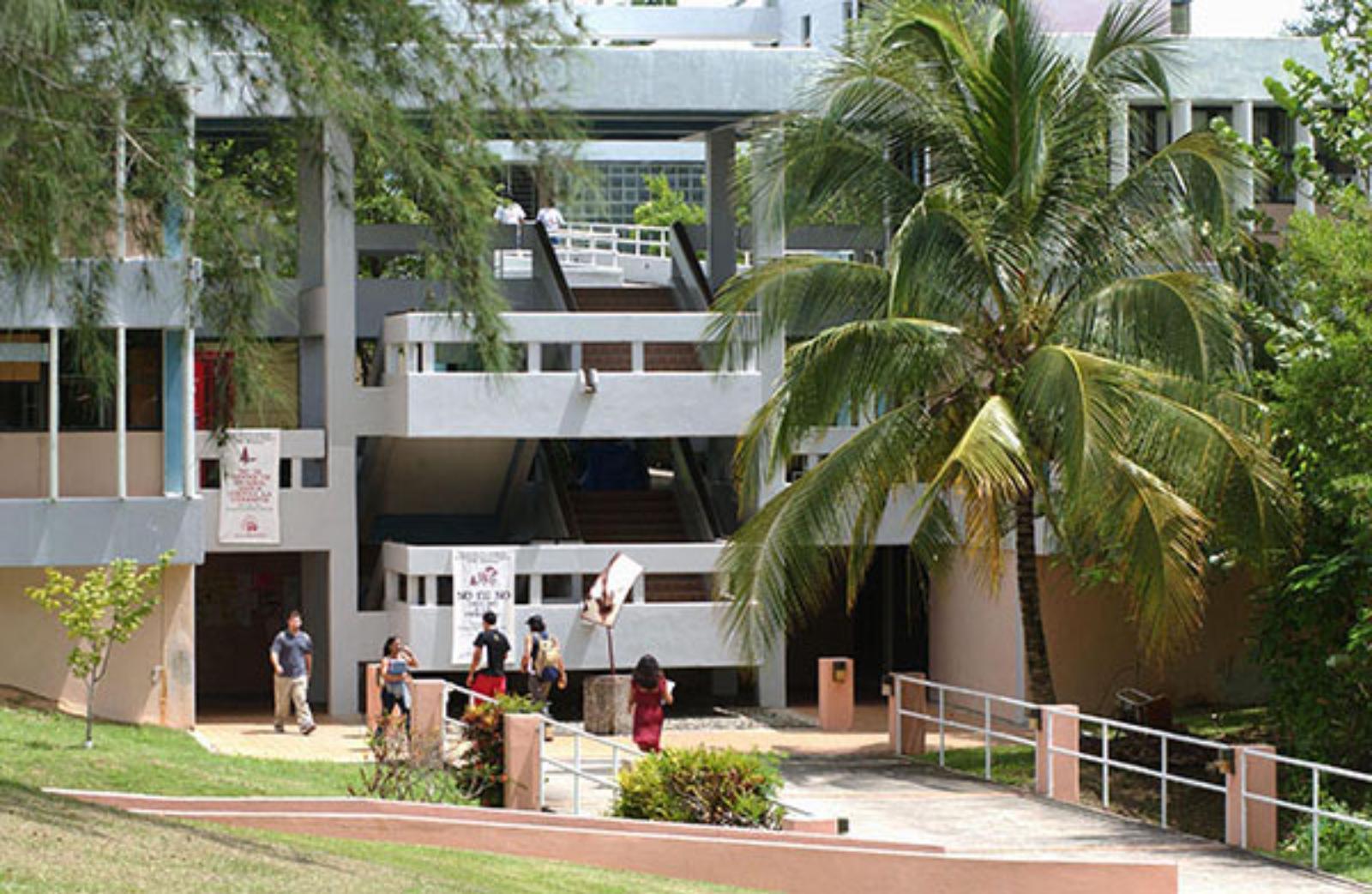
The University of Puerto Rico-Humacao is a public, science-intensive institution on the island's eastern coast, known for its distinctive, hands-on programs in coastal marine biology, wildlife management, and applied physics. With a student body of just over 2,600 and a tight-knit, suburban campus vibe, it offers a focused, research-oriented undergraduate experience at a notably low net price, though graduation rates and post-graduate earnings reflect the significant economic challenges facing Puerto Rico. This is a school for students drawn to its unique scientific niches and the immersive cultural context of Puerto Rico, not for those seeking a traditional, high-resourced mainland U.S. college experience.
Admission requirements
Test-blind — scores not considered
Required
High school transcript
Grade point average
Source: IPEDS Admissions survey (2022) via Urban Institute. Covers formal factors only — it does not reflect essays, extracurriculars, or other holistic criteria.
More details
Undergrad enrollment
2,529
In-state tuition
$5,364
Out-of-state tuition
$5,364
Setting
Suburban
Graduation Rate
47%
Gender Distribution
66.5% Female, 33.5% Male
Median Earnings (10yr)
$29,521
Student-to-Faculty Ratio
11:1
Outcomes & value
Outcomes & value
Median earnings (10 yr)
$29,521
Value (earnings ÷ net price)
2.3×
Median debt at graduation
$5,500
Graduation rate
47%
First-year retention
81%
Reducing loan balance (3 yr)
62%
Pell (lower-income) share
81%
First-gen share (among federal-aid recipients)
22%
Top-earning majors
Median earnings by field of study (highest credential), ~2 years after completion.
Microbiological Sciences and Immunology$25,967
Accounting and Related Services$17,387
Social Work$11,388
Business Operations Support and Assistant Services$11,234
Source: U.S. Dept. of Education College Scorecard (field-of-study earnings). Figures cover graduates who received federal aid and lag ~2 years; not all programs report data.
On-campus criminal offenses classed as violent (murder/non-negligent manslaughter, rape, robbery, aggravated assault) for the most recent reported year. Source: U.S. Dept. of Education Campus Safety and Security (Clery Act). Counts reflect what’s reported to the school, and urban campuses often report more partly due to non-student incidents nearby — read alongside campus size and setting, not as a standalone safety verdict.
Climate
Pleasant days / yr
12
Summer high
84°F
Winter low
73°F
Annual rain
64.8"
Pleasant days counts days per year with a mean temperature of 55–75°F, a high at or below 90°F, a low at or above 45°F, and little precipitation — a transparent comfort measure, not a weighting we invented. Computed from Open-Meteo ERA5 daily history (2019–2023).
Quick answers
What is the acceptance rate at University of Puerto Rico-Humacao?
University of Puerto Rico-Humacao's acceptance rate is approximately 55% (Humacao, PR), based on the most recent figures we compiled from public and primary sources.
How much does University of Puerto Rico-Humacao cost?
At University of Puerto Rico-Humacao, the average net price (after aid) is about $12,675 per year. Actual cost varies with financial aid and residency.
How many undergraduates attend University of Puerto Rico-Humacao?
University of Puerto Rico-Humacao enrolls approximately 2,529 undergraduate students.
Where is University of Puerto Rico-Humacao located?
University of Puerto Rico-Humacao is located in Humacao, PR.
Admissions
Admissions at UPR Humacao are moderately selective, with an hovering in the mid-50s. For the 2024 cycle, the undergraduate acceptance rate was reported at 54.8%, with 725 admissions from 1,323 applications. The process is ; SAT and ACT scores are not required for admission. The university does not appear to have a binding Early Decision program, and the provided sources do not indicate that demonstrated interest is a formal factor in admissions decisions. The rate—the percentage of admitted students who enroll—is not explicitly stated in the provided sources for UPR Humacao, though one source referencing a similarly named institution suggests a yield between 50% and 60%.
UPR Humacao defines itself as a science-intensive institution, boasting more chemistry, physics, and mathematics majors than any other university in Puerto Rico. It offers 24 academic programs, with a student-to-faculty ratio of 11:1, fostering a relatively intimate classroom environment. The curriculum is distinguished by several programs unique to the island, including Wildlife Management, Coastal Marine Biology, and Physics Applied to Electronics. The campus places a strong emphasis on undergraduate research, particularly in biology, chemistry, and environmental sciences, leveraging its coastal location. This focus creates a hands-on, applied learning culture for students in STEM fields.
Earnings = median of students working ~10 years after entry; debt = median of graduates. Value divides 10-yr earnings by one year’s net price — read it as earnings per dollar of annual cost, not a full lifetime ROI; it favors lower-cost schools. Source: U.S. Dept. of Education College Scorecard. Figures lag ~2 years and reflect all students, not your intended major.
With a total undergraduate enrollment of 2,611 students as of fall 2023, UPR Humacao has a compact, suburban campus community. The student body is predominantly female, with a gender distribution of 66.5% female and 33.5% male students. The setting is suburban, situated in the city of Humacao on the eastern coast of Puerto Rico. The provided sources do not detail specific clubs, traditions, or Greek life, painting a picture of a campus where academic and scientific pursuits are central. The university's non-discrimination policy states it does not discriminate in academic offerings or job opportunities based on sex, race, color, age, and other protected categories.
Post-graduation outcomes are a critical point of context for UPR Humacao, deeply intertwined with Puerto Rico's economic landscape. The six-year graduation rate is reported at 47%, though other sources note rates around 49% and 54%. Alumni earnings are significantly below U.S. national medians. One source reports median earnings six years after enrollment at $20,013, roughly 54% below the national median. Another cites earnings five years after graduation at $29,478 per year. These figures highlight the economic challenges graduates may face locally, though the university's specialized scientific training aims to build specific, in-demand skills within the Puerto Rican and broader contexts.
The defining feature of UPR Humacao's cost structure is its low average . The average annual cost after aid is $12,675, which includes tuition, living costs, books, supplies, and fees. A very high percentage of students receive financial aid; one source indicates 93.3% of freshmen receive some form of it. Students apply for federal aid using the FAFSA, and aid packages are built based on demonstrated financial need as established by federal and state regulations. The provided sources do not indicate the university has a "no-loan" policy or that it meets 100% of demonstrated financial need solely with grants. The net price calculator on the university's website is intended to provide families with estimated cost information after factoring in potential aid.
UPR Humacao stands out for its unapologetically specific academic identity. It is not a liberal arts college or a comprehensive university; it is a public, coastal Puerto Rican institution built around scientific inquiry and applied research. Its claim to having more chemistry, physics, and math majors than any other school on the island isn't just a statistic—it defines the campus culture. The programs you can't find elsewhere, like Coastal Marine Biology and Wildlife Management, are directly tied to Puerto Rico's unique ecology, offering students a chance to become stewards and experts of their local environment. This creates an educational experience that is deeply contextual, hands-on, and mission-driven. The trade-off is reflected in the outcomes data: graduates enter a challenging economic territory, but they do so with highly specialized training rooted in the place they call home. For a student passionate about environmental science, biology, or physics and committed to Puerto Rico, UPR Humacao offers a singular, affordable, and immersive path.
University of Puerto Rico-Humacao seal · sourceUniversity of Puerto Rico at Humacao - Wikipedia · sourceUniversity of Puerto Rico at Humacao · sourceUniversity of Puerto Rico-Humacao - Unigo.com · source