Admit rate has ranged 49%–53% over the last 5 years, though the latest figure above (55%) falls outside that window. Source: IPEDS via Urban Institute.
Acceptance & SAT from Common Data Set / IPEDS; net price, earnings & graduation from the U.S. Dept. of Education College Scorecard. Figures lag ~1–2 years — verify with the school.
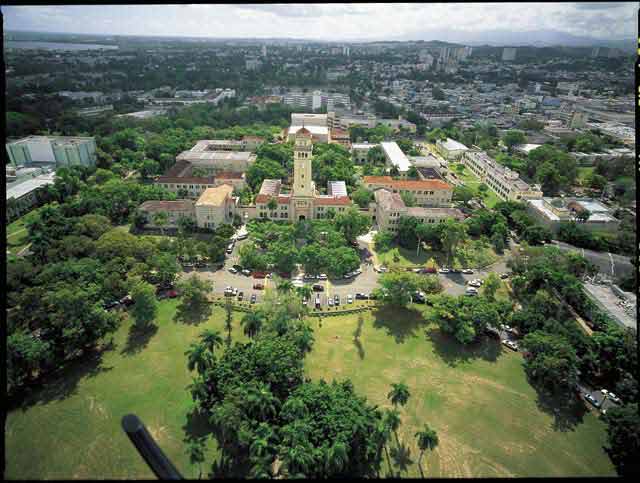
The University of Puerto Rico-Río Piedras is the flagship public university of Puerto Rico, a sprawling, historic campus in the heart of San Juan where academic intensity meets Caribbean vibrancy. Founded in 1903, it's known for its strong programs in the sciences and humanities, a politically and culturally engaged student body, and a deep connection to the island's identity. With a moderately selective admissions process and a remarkably low net price, it serves as a critical engine of social mobility and intellectual life for Puerto Rico.
Admission requirements
Test-blind — scores not considered
Required
High school transcript
Grade point average
Demonstrated competencies
Source: IPEDS Admissions survey (2022) via Urban Institute. Covers formal factors only — it does not reflect essays, extracurriculars, or other holistic criteria.
More details
Undergrad enrollment
8,572
In-state tuition
$5,354
Out-of-state tuition
$5,354
Campus Setting
Urban
Graduation Rate
50%
Most Popular Majors
Biology, Psychology, Accounting
Median Earnings (10yr)
$35,723
Regular Application Due
January 22
Student-to-Faculty Ratio
12:1
First-Year Retention Rate
81%
Outcomes & value
Outcomes & value
Median earnings (10 yr)
$35,723
Value (earnings ÷ net price)
3.9×
Median debt at graduation
$5,500
Graduation rate
50%
First-year retention
77%
Reducing loan balance (3 yr)
60%
Pell (lower-income) share
66%
First-gen share (among federal-aid recipients)
16%
Top-earning majors
Median earnings by field of study (highest credential), ~2 years after completion.
Marketing$23,340
Finance and Financial Management Services$22,087
Special Education and Teaching$20,140
Public Relations, Advertising, and Applied Communication$18,498
Psychology, General$18,498
Multi/Interdisciplinary Studies, Other$17,624
Campus & location
Campus safety
On-campus violent crimes (2024)
0
Per 1,000 students
0.00
On-campus criminal offenses classed as violent (murder/non-negligent manslaughter, rape, robbery, aggravated assault) for the most recent reported year. Source: U.S. Dept. of Education Campus Safety and Security (Clery Act). Counts reflect what’s reported to the school, and urban campuses often report more partly due to non-student incidents nearby — read alongside campus size and setting, not as a standalone safety verdict.
Climate
Pleasant days / yr
15
Summer high
91°F
Winter low
69°F
Annual rain
38.2"
Pleasant days counts days per year with a mean temperature of 55–75°F, a high at or below 90°F, a low at or above 45°F, and little precipitation — a transparent comfort measure, not a weighting we invented. Computed from Open-Meteo ERA5 daily history (2019–2023).
Quick answers
What is the acceptance rate at University of Puerto Rico-Rio Piedras?
University of Puerto Rico-Rio Piedras's acceptance rate is approximately 55% (San Juan, PR), based on the most recent figures we compiled from public and primary sources.
How much does University of Puerto Rico-Rio Piedras cost?
At University of Puerto Rico-Rio Piedras, the average net price (after aid) is about $9,175 per year. Actual cost varies with financial aid and residency.
How many undergraduates attend University of Puerto Rico-Rio Piedras?
University of Puerto Rico-Rio Piedras enrolls approximately 8,572 undergraduate students.
Where is University of Puerto Rico-Rio Piedras located?
University of Puerto Rico-Rio Piedras is located in San Juan, PR.
Admissions
Admissions at UPR Río Piedras are moderately selective, with an of 55%. The process draws a substantial applicant pool, with recent data showing 4,799 applications resulting in 2,620 admissions. On average, the campus enrolls over 2,000 new students each fall. While the university does not consider SAT or ACT scores for admission, academic preparation is key; the average high school GPA of admitted students is reported to be 3.6, with half of enrolled freshmen having a GPA of 3.75 or higher. The regular decision application deadline is January 22. The admissions rate—the percentage of admitted students who enroll—is reported to be 71.3%, indicating that the vast majority of students who are admitted choose to attend, underscoring its position as the island's premier public institution.
Earnings = median of students working ~10 years after entry; debt = median of graduates. Value divides 10-yr earnings by one year’s net price — read it as earnings per dollar of annual cost, not a full lifetime ROI; it favors lower-cost schools. Source: U.S. Dept. of Education College Scorecard. Figures lag ~2 years and reflect all students, not your intended major.
Teacher Education and Professional Development, Specific Subject Areas$16,957
Teaching English or French as a Second or Foreign Language$15,922
Source: U.S. Dept. of Education College Scorecard (field-of-study earnings). Figures cover graduates who received federal aid and lag ~2 years; not all programs report data.
The academic environment at Río Piedras is defined by its comprehensive offerings and historic role as Puerto Rico's leading research university. Students can choose from 93 majors, with Biology, Psychology, and Accounting standing out as the most popular. The campus fosters a close-knit learning environment with a student-to-faculty ratio of 12:1 (or 8:1, according to some sources), though introductory lectures in popular fields can be large. Student satisfaction is reflected in a solid first-year retention rate of 79% to 81%. The six-year graduation rate is 50%, though the four-year rate is notably lower at 20%, a figure that reflects both the economic challenges many students face and a cultural norm of extended study. The curriculum is deeply rooted in the liberal arts and sciences, with strong programs across philosophy, exercise science, and many other disciplines.
Life on the Río Piedras campus is a unique fusion of intense academic pursuit and vibrant, politically charged Caribbean culture. The setting is urban, nestled in the bustling metropolitan area of San Juan, with the campus itself described as a mix of antique and modern buildings surrounded by beautiful landscaping. The undergraduate student body is sizable, with over 11,600 students. Campus housing is available, costing an average of $11,161 per year. Students report a lively and diverse social scene fueled by numerous student organizations, cultural events, academic conferences, and accessible nightlife options in the surrounding commercial and cultural district. This is not a cloistered residential college; the campus is deeply integrated into the fabric of San Juan, and student life often reflects the island's broader social and political currents.
Graduates of UPR Río Piedras enter the workforce with a degree that carries significant weight on the island, though early-career earnings are modest. The median earnings ten years after entry are $35,723. Shorter-term data shows earnings one year after graduation averaging $15,537, rising to $33,369 after five years. The six-year graduation rate is 50%, a figure that has improved over the last decade across the UPR system. It's important to contextualize these outcomes within Puerto Rico's economic landscape; for many students, the university provides a critical, affordable pathway to professional careers and advanced degrees that directly serve their communities. The outcomes score in national rankings is heavily weighted toward graduation rates, where the university's 50% rate places it in the bottom half nationally.
For in-state students, UPR Río Piedras represents one of the most significant values in American higher education. The average after aid—what families actually pay—is just $9,175. A large majority of students (67.42%) receive financial aid, with the average aid package totaling $6,773 per year. This aid comes from a mix of institutional, federal, and state grants. The full , including tuition, fees, room, and board, is estimated at over $26,000, making the discount from aid substantial. The university offers a net price calculator on its website to help families estimate their actual cost. This aggressive subsidization through grants, rather than loans, makes a bachelor's degree accessible to a broad socioeconomic spectrum within Puerto Rico, fulfilling a core public mission.
The University of Puerto Rico-Río Piedras stands out not for conforming to mainland U.S. college rankings criteria, but for being the unequivocal intellectual and cultural heart of Puerto Rico. Its identity is inseparable from the island's history, politics, and Spanish-language tradition. The campus is a living archive and a lively forum, where the energy of San Juan meets the gravitas of a century-old flagship university. It offers a rigorous, comprehensive education at a net cost that is often less than a tenth of comparable mainland flagships, making elite-level academics accessible. Its student body is not just studying Puerto Rico; they are its next generation of leaders, scientists, artists, and professionals, learning in the very epicenter of Puerto Rican life. For students seeking a world-class education deeply connected to place, identity, and public purpose, Río Piedras is singular.
University of Puerto Rico-Rio Piedras seal · sourceUniversity of Puerto Rico, Río Piedras Campus - Wikipedia · sourceUniversity of Puerto Rico, Río Piedras Campus - Wikipedia · sourceUniversity of Puerto Rico: Rio Piedras - Direct Enrollment & Exchange · source