Admit rate has ranged 36%–64% over the last 5 years — notably volatile, though the latest figure above (66%) falls outside that window. Source: IPEDS via Urban Institute.
Acceptance & SAT from Common Data Set / IPEDS; net price, earnings & graduation from the U.S. Dept. of Education College Scorecard. Figures lag ~1–2 years — verify with the school.
The University of Science and Arts of Oklahoma is Oklahoma's singular public liberal arts college, a small, scrappy institution in Chickasha that educates about 800 students with a distinctive, integrated core curriculum. It's a place where business majors share seminars with fine artists, and where a remarkably low average net price—under $7,000—makes a personalized, broad-based education accessible. While graduation rates are a challenge, the school delivers solid mid-career earnings for graduates, many of whom stay in-state to teach, manage, and lead.
Admission requirements
Test-optional — scores considered if submitted
Required
High school transcript
Grade point average
TOEFL (non-native English)
Considered (not required)
Class rank
Letters of recommendation
Test scores (SAT/ACT)
Source: IPEDS Admissions survey (2022) via Urban Institute. Covers formal factors only — it does not reflect essays, extracurriculars, or other holistic criteria.
More details
Undergrad enrollment
941
In-state tuition
$9,000
Out-of-state tuition
$20,190
Top Majors
Business (19%), Psychology (11%), Elementary Ed (9%)
Graduation Rate
44%
Student-Faculty Ratio
Small classes (10-19 in labs/sections)
Early Decision Offered
No
Median Earnings (10yr)
$41,913
Students Receiving Aid
90%
Demonstrated Interest Considered
Not considered
Students Receiving Institutional Scholarships
83%
Outcomes & value
Outcomes & value
Median earnings (10 yr)
$41,913
Value (earnings ÷ net price)
6.3×
Median debt at graduation
$21,750
Graduation rate
44%
First-year retention
66%
Reducing loan balance (3 yr)
60%
Pell (lower-income) share
51%
First-gen share (among federal-aid recipients)
43%
Campus & location
Campus safety
On-campus violent crimes (2024)
1
On-campus criminal offenses classed as violent (murder/non-negligent manslaughter, rape, robbery, aggravated assault) for the most recent reported year. Source: U.S. Dept. of Education Campus Safety and Security (Clery Act). Counts reflect what’s reported to the school, and urban campuses often report more partly due to non-student incidents nearby — read alongside campus size and setting, not as a standalone safety verdict.
Climate
Pleasant days / yr
82
Summer high
93°F
Winter low
33°F
Annual rain
33.4"
Annual snow
6.8"
Natural-hazard risk
Relatively Low
Pleasant days counts days per year with a mean temperature of 55–75°F, a high at or below 90°F, a low at or above 45°F, and little precipitation — a transparent comfort measure, not a weighting we invented. Computed from Open-Meteo ERA5 daily history (2019–2023). Natural-hazard risk is the county’s composite rating from the FEMA National Risk Index.
Deep dive — research, future-scholar output & economic mobility▾
Research output
Institutional h-index
36
Scholarly works
424
Institutional research volume and impact from OpenAlex. The h-index reflects large research universities and will be low for teaching-focused liberal-arts colleges — not a measure of undergraduate quality.
Economic mobility
Mobility rate
2.0%
Bottom → top quintile
14%
From bottom quintile
15%
Mobility rate = the share of students who both start in the bottom household-income quintile and reach the top quintile; bottom → top is that chance conditional on starting at the bottom. Source: Opportunity Insights Mobility Report Cards (Chetty, Friedman, Saez, Turner & Yagan). Reflects 1980–82 birth cohorts, so it’s directional, not current.
Quick answers
What is the acceptance rate at University of Science and Arts of Oklahoma?
University of Science and Arts of Oklahoma's acceptance rate is approximately 66% (Chickasha, OK), based on the most recent figures we compiled from public and primary sources.
What SAT score do you need for University of Science and Arts of Oklahoma?
Admitted students at University of Science and Arts of Oklahoma typically score 1090–1280 on the SAT (the middle-50% range). Scores outside this band are still admitted, especially with strong applications.
How much does University of Science and Arts of Oklahoma cost?
At University of Science and Arts of Oklahoma, the average net price (after aid) is about $6,624 per year. Actual cost varies with financial aid and residency.
How many undergraduates attend University of Science and Arts of Oklahoma?
University of Science and Arts of Oklahoma enrolls approximately 941 undergraduate students.
Where is University of Science and Arts of Oklahoma located?
University of Science and Arts of Oklahoma is located in Chickasha, OK.
Admissions
Admissions at USAO are moderately selective, with an that reflects its role as Oklahoma's public liberal arts college. The process is test-flexible, with admitted students presenting a middle 50% SAT range of 1090–1280 and an ACT range of 21–26. Academic performance in high school is a primary driver; a significant portion of admitted students boast GPAs of 3.75 or higher. The university does not offer an Early Decision or Early Action program, so all applicants are evaluated within the same regular decision pool. Demonstrated interest is not a factor considered in admissions decisions, per standards. The admissions office collects personally identifiable data as part of its process, but the evaluation leans heavily on academic readiness.
Earnings = median of students working ~10 years after entry; debt = median of graduates. Value divides 10-yr earnings by one year’s net price — read it as earnings per dollar of annual cost, not a full lifetime ROI; it favors lower-cost schools. Source: U.S. Dept. of Education College Scorecard. Figures lag ~2 years and reflect all students, not your intended major.
Academics
USAO's academic identity is defined by its status as Oklahoma's public liberal arts college, built around a unique, interdisciplinary core curriculum that all students complete. The college emphasizes small classes and a commitment to undergraduate education taught by highly-qualified faculty. Students can pursue Bachelor of Arts, Bachelor of Science, or Bachelor of Fine Arts degrees across a focused set of majors. The most popular programs for recent graduates are in Business Administration and Management (19%), Psychology (11%), and Elementary Education and Teaching (9%). Lab and discussion sections are intentionally small, frequently in the 10-19 student range, fostering close interaction. The curriculum is designed to provide both depth within a major and breadth across the liberal arts and sciences.
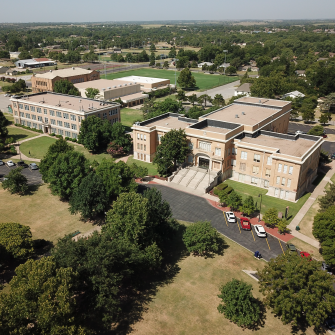
Life on the Chickasha campus revolves around a tight-knit community of approximately 800 students. The university works hard to foster a vibrant arts and culture scene, hosting award-winning performers, speakers, art exhibits, and student productions. Student Life provides services and activities aimed at supporting students in a caring environment. There is a club for nearly every interest—academic, athletic, social, performance, and philanthropic—and students are encouraged to start new organizations if they don't see one that appeals. This is not a typical large state school experience; it's a small-college vibe where it's hard to be anonymous and easy to get involved.
Graduation rates are a noted challenge at USAO, with a four-year rate significantly below the national average. The university reports that after 150% of the normal time for degree completion, 42% of a cohort had graduated. Other sources cite a six-year graduation rate around 40-44%. However, the return on investment for those who do graduate is positive. Median earnings ten years after entry are solid, particularly given the region's cost of living. The college provides a "Student's Right to Know" disclosure on its website, being transparent about these outcomes. For graduates, the path often leads to roles in business, education, and psychology within Oklahoma and the surrounding region.
Affordability is a cornerstone of the USAO value proposition. The average after grants and scholarships is remarkably low, making it one of the more accessible four-year colleges in the country. This is achieved through robust institutional aid: 90% of students receive some form of financial aid, and 83% receive an institutional scholarship, with the average annual scholarship award per student estimated at over $16,000. The average financial aid package totals about $12,524. It is important to note that USAO does not have a "no-loan" policy; federal Direct Loans (both subsidized and unsubsidized) are part of the aid options presented to students who demonstrate need. Students are responsible for understanding the criteria for maintaining financial aid eligibility.
USAO stands out as an anomaly: Oklahoma's only public liberal arts college, a small, mission-driven institution that provides a broad, integrated education at a community college price. Its defining feature is the mandatory interdisciplinary core curriculum, which ensures every student—whether a business major or a biologist—engages deeply with the arts, sciences, and humanities. This creates a shared intellectual experience uncommon at most public universities. The scale is intimate, with labs and seminars often under 20 students, allowing for genuine mentorship. While it grapples with retention and graduation, its success is measured in the accessible pathway it provides to a true liberal arts degree and the solid mid-career earnings of its graduates. For a student seeking a small-college, idea-focused environment without the sticker shock of a private liberal arts school, USAO is a unique and compelling option.
University of Science and Arts of Oklahoma seal · sourceHome | University of Science and Arts of Oklahoma - Chickasha, OK · sourceUniversity of Oklahoma College of Arts and Sciences - Wikipedia · sourceUniversity of Science & Arts of Oklahoma | Chickasha OK · source