Admit rate has ranged 76%–84% over the last 5 years — notably volatile. Source: IPEDS via Urban Institute.
Acceptance & SAT from Common Data Set / IPEDS; net price, earnings & graduation from the U.S. Dept. of Education College Scorecard. Figures lag ~1–2 years — verify with the school.
The University of Scranton is a Catholic, Jesuit institution where a pragmatic, career-focused education meets a tight-knit, residential community vibe. It’s a place where business and health sciences dominate the academic landscape, and students tend to stick around on weekends, forging the kind of friendships that define the undergraduate experience. While not highly selective, its strong graduation and post-graduate earnings outcomes suggest a formula that works for the students who enroll.
Admission requirements
Test-optional — scores considered if submitted
Required
High school transcript
Grade point average
Class rank
Letters of recommendation
TOEFL (non-native English)
Considered (not required)
Test scores (SAT/ACT)
College-prep program
Source: IPEDS Admissions survey (2022) via Urban Institute. Covers formal factors only — it does not reflect essays, extracurriculars, or other holistic criteria.
More details
Undergrad enrollment
3,554
In-state tuition
$53,983
Out-of-state tuition
$53,983
Popular Majors
Business (24%), Health Professions (17%)
Graduation Rate
80%
Median Earnings (10yr)
$74,652
Early Decision Available
Yes
Financial Aid Recipients
72.47%
Outcomes & value
Outcomes & value
Median earnings (10 yr)
$74,652
Value (earnings ÷ net price)
2.3×
Median debt at graduation
$27,000
Graduation rate
80%
First-year retention
85%
Reducing loan balance (3 yr)
79%
Pell (lower-income) share
24%
First-gen share (among federal-aid recipients)
20%
Financial health
2.4 / 3.0Meets the federal financial-responsibility standard
U.S. Dept. of Education Financial Responsibility Composite Score (FY2022-23). Scale −1.0 to 3.0; ≥1.5 meets the standard. Reported for private nonprofit & for-profit institutions only — public universities are state-backed and not scored, so this is a stability signal, not a ranking.
Top-earning majors
Median earnings by field of study (highest credential), ~2 years after completion.
Registered Nursing, Nursing Administration, Nursing Research and Clinical Nursing$80,779
Accounting and Related Services$63,997
Finance and Financial Management Services$62,260
Economics$47,260
Human Resources Management and Services$47,260
Business Administration, Management and Operations
Campus & location
Campus safety
On-campus violent crimes (2024)
6
Per 1,000 students
1.29
On-campus criminal offenses classed as violent (murder/non-negligent manslaughter, rape, robbery, aggravated assault) for the most recent reported year. Source: U.S. Dept. of Education Campus Safety and Security (Clery Act). Counts reflect what’s reported to the school, and urban campuses often report more partly due to non-student incidents nearby — read alongside campus size and setting, not as a standalone safety verdict.
Climate
Pleasant days / yr
97
Summer high
81°F
Winter low
25°F
Annual rain
48.6"
Annual snow
39.9"
Natural-hazard risk
Relatively Moderate
Pleasant days counts days per year with a mean temperature of 55–75°F, a high at or below 90°F, a low at or above 45°F, and little precipitation — a transparent comfort measure, not a weighting we invented. Computed from Open-Meteo ERA5 daily history (2019–2023). Natural-hazard risk is the county’s composite rating from the FEMA National Risk Index.
Deep dive — research, future-scholar output & economic mobility▾
Research output
Institutional h-index
145
Scholarly works
4,571
Institutional research volume and impact from OpenAlex. The h-index reflects large research universities and will be low for teaching-focused liberal-arts colleges — not a measure of undergraduate quality.
Economic mobility
Mobility rate
1.6%
Bottom → top quintile
48%
From bottom quintile
3%
Mobility rate = the share of students who both start in the bottom household-income quintile and reach the top quintile; bottom → top is that chance conditional on starting at the bottom. Source: Opportunity Insights Mobility Report Cards (Chetty, Friedman, Saez, Turner & Yagan). Reflects 1980–82 birth cohorts, so it’s directional, not current.
Quick answers
What is the acceptance rate at University of Scranton?
University of Scranton's acceptance rate is approximately 81% (Scranton, PA), based on the most recent figures we compiled from public and primary sources.
What SAT score do you need for University of Scranton?
Admitted students at University of Scranton typically score 1160–1318 on the SAT (the middle-50% range). Scores outside this band are still admitted, especially with strong applications.
How much does University of Scranton cost?
At University of Scranton, the average net price (after aid) is about $32,568 per year. Actual cost varies with financial aid and residency.
How many undergraduates attend University of Scranton?
University of Scranton enrolls approximately 3,554 undergraduate students.
Where is University of Scranton located?
University of Scranton is located in Scranton, PA.
Admissions
Scranton’s admissions process is best described as accessible rather than fiercely competitive. The university offers an Early Decision option, which requires a binding commitment if accepted, and decisions are promised within two weeks of a completed application beginning September 15. The admissions office can be reached at 1-888-SCRANTON or [email protected].
While the is the definitive source for how admissions factors are weighted, the provided sources do not contain the specific C7 table for Scranton that would detail the importance of factors like demonstrated interest, class rank, or interviews. The process appears to be holistic, with the university stating it looks for students who meet certain academic benchmarks, such as a high school GPA of 3.61 or an SAT score of 1263, to guarantee admission.
Scranton’s academic identity is firmly rooted in practical, high-demand fields, structured across three undergraduate colleges. Students choose from 70 bachelor’s degree programs, 47 minors, and 38 concentrations. The curriculum is not an abstract liberal arts exploration; it’s a direct pipeline to professional life.
This focus is reflected in the most popular majors. For the class of 2024, nearly a quarter (24%) of graduates majored in Business, Management, Marketing, and Related Support Services, while another 17% pursued Health Professions and Related Programs. Other sources list Registered Nursing and Biology/Biological Sciences as top choices. The humanities and sciences are represented—with programs in English, History, Philosophy, Theatre, and International Studies—but they play a supporting role to the main attractions of business and health. The Jesuit tradition informs the educational approach, aiming for a ‘formation of mind, body, and soul,’ but the degree map is unmistakably career-oriented.
Earnings = median of students working ~10 years after entry; debt = median of graduates. Value divides 10-yr earnings by one year’s net price — read it as earnings per dollar of annual cost, not a full lifetime ROI; it favors lower-cost schools. Source: U.S. Dept. of Education College Scorecard. Figures lag ~2 years and reflect all students, not your intended major.
$47,025
Marketing$46,790
Health and Medical Administrative Services$43,240
Source: U.S. Dept. of Education College Scorecard (field-of-study earnings). Figures cover graduates who received federal aid and lag ~2 years; not all programs report data.
Life at Scranton is defined by an active, on-campus community. The Division of Student Life explicitly aims to foster ‘extraordinary student formation’ through a ‘distinctly Jesuit educational experience.’ This isn’t a suitcase school; students report that most people stay on campus on weekends, which fosters a relaxed dorm life and makes it easy to build meaningful friendships.
The vibe is described as tight-knit, inclusive, and proud, centered around a beautiful campus. Student life is ‘vibrant and varied,’ encompassing ministry-based programs, leadership initiatives, and a wide array of student-run clubs and organizations. The cultural and social hubs are managed from the DeNaples Center, the heart of campus activity.
This is where Scranton’s value proposition comes into sharp focus. The university delivers strong results for its students. It was ranked #125 out of 500 institutions in Money's ‘2025 Best Colleges in the U.S.’ list, recognized specifically for its impact on graduation rates and graduates' salaries.
Post-graduation, the outcomes are solid. One report states that 99% of the class of 2024 graduates were employed. Other sources cite a median salary for graduates, though the canonical figure for median earnings 10 years after entry overrides any other specific number. The university's ability to shepherd students to graduation and into the workforce is a central part of its institutional identity and marketing.
Scranton is a private institution with a significant sticker price, but it uses institutional aid aggressively to bring down the net cost for many families. The university offers a Calculator to help families estimate their actual cost, emphasizing that the results are an estimate and not a guarantee.
Merit-based scholarships are a key lever. The Presidential Scholarship covers full tuition, while the Dean's, Loyola, and Faber Scholarships offer average awards ranging from $28,000 to $33,000. A large majority of students (72.47%) receive financial aid, with an average aid package reported at $42,765. The sources provided do not specify a ‘no-loan’ policy or a commitment to meet 100% of demonstrated need without loans; the university participates in federal loan programs and its own need-based grant aid, which can be canceled if requirements are not met.
The University of Scranton stands out for its potent combination of accessibility, focus, and community. It doesn’t pretend to be an ultra-selective liberal arts college. Instead, it offers a clear, no-nonsense path: a moderately selective admissions process leads into professionally aligned majors within a supportive, all-in campus culture, which in turn drives strong graduation and employment outcomes. It’s a Jesuit school where the ‘cura personalis’ (care for the whole person) manifests as much in weekend dorm life and club involvement as it does in ensuring students are employable. For students seeking a traditional college experience with a definitive career trajectory—particularly in business or health sciences—within a close-knit environment, Scranton represents a compelling and effective choice.
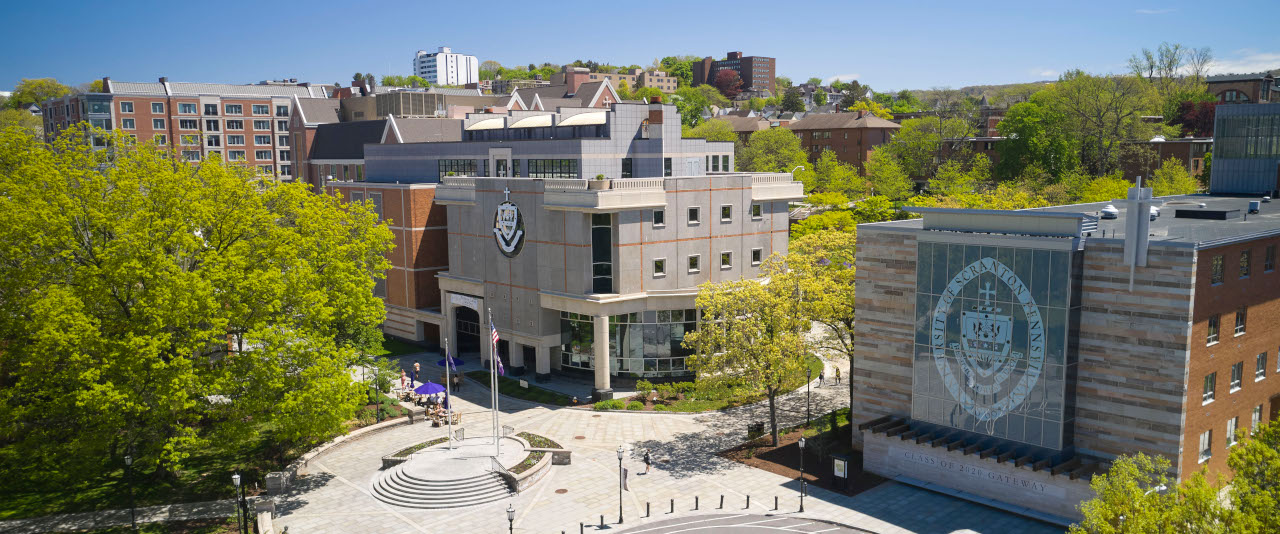
University of Scranton seal · sourceFacts About Us | About Us | The University of Scranton · sourceOur Campus | Student Experience | The University of Scranton · sourceCampus Maps | Our Campus · source