Admit rate has ranged 56%–84% over the last 5 years — notably volatile. Source: IPEDS via Urban Institute.
Acceptance & SAT from Common Data Set / IPEDS; net price, earnings & graduation from the U.S. Dept. of Education College Scorecard. Figures lag ~1–2 years — verify with the school.
The University of South Carolina Aiken is a regional public university that defines itself by access and affordability, offering a practical, hands-on education in a small-campus setting. It’s a place where a 16:1 student-to-faculty ratio and a 79% acceptance rate create a path for a broad range of students, though that open door is paired with a significant challenge: only about 40% of students graduate within six years. The vibe is supportive and active, with over 100 student clubs and a strong emphasis on NCAA Division II athletics, but the academic experience is decidedly no-frills, focused on preparing graduates for immediate entry into the regional workforce.
Admission requirements
Test-optional — scores considered if submitted
Required
High school transcript
Grade point average
Class rank
College-prep program
Considered (not required)
Test scores (SAT/ACT)
TOEFL (non-native English)
Source: IPEDS Admissions survey (2022) via Urban Institute. Covers formal factors only — it does not reflect essays, extracurriculars, or other holistic criteria.
More details
Undergrad enrollment
2,962
In-state tuition
$10,760
Out-of-state tuition
$21,218
Graduation Rate
40%
On-Campus Housing
24%
Median Earnings (10yr)
$45,603
Student-to-Faculty Ratio
16:1
Classes Under 20 Students
49%
First-Year Retention Rate
67%
Outcomes & value
Outcomes & value
Median earnings (10 yr)
$45,603
Value (earnings ÷ net price)
3.9×
Median debt at graduation
$24,275
Graduation rate
40%
First-year retention
67%
Reducing loan balance (3 yr)
52%
Pell (lower-income) share
39%
First-gen share (among federal-aid recipients)
33%
Top-earning majors
Median earnings by field of study (highest credential), ~2 years after completion.
Registered Nursing, Nursing Administration, Nursing Research and Clinical Nursing$60,689
Applied Mathematics$50,439
Business Administration, Management and Operations$37,748
Teacher Education and Professional Development, Specific Levels and Methods$35,559
Biology, General$33,993
Communication and Media Studies
Campus & location
Campus safety
On-campus violent crimes (2024)
0
Per 1,000 students
0.00
On-campus criminal offenses classed as violent (murder/non-negligent manslaughter, rape, robbery, aggravated assault) for the most recent reported year. Source: U.S. Dept. of Education Campus Safety and Security (Clery Act). Counts reflect what’s reported to the school, and urban campuses often report more partly due to non-student incidents nearby — read alongside campus size and setting, not as a standalone safety verdict.
Climate
Pleasant days / yr
114
Summer high
89°F
Winter low
42°F
Annual rain
45"
Natural-hazard risk
Relatively Moderate
Pleasant days counts days per year with a mean temperature of 55–75°F, a high at or below 90°F, a low at or above 45°F, and little precipitation — a transparent comfort measure, not a weighting we invented. Computed from Open-Meteo ERA5 daily history (2019–2023). Natural-hazard risk is the county’s composite rating from the FEMA National Risk Index.
Deep dive — research, future-scholar output & economic mobility▾
Research output
Institutional h-index
83
Scholarly works
1,893
Institutional research volume and impact from OpenAlex. The h-index reflects large research universities and will be low for teaching-focused liberal-arts colleges — not a measure of undergraduate quality.
Quick answers
What is the acceptance rate at University of South Carolina Aiken?
University of South Carolina Aiken's acceptance rate is approximately 79% (Aiken, SC), based on the most recent figures we compiled from public and primary sources.
What SAT score do you need for University of South Carolina Aiken?
Admitted students at University of South Carolina Aiken typically score 980–1220 on the SAT (the middle-50% range). Scores outside this band are still admitted, especially with strong applications.
How much does University of South Carolina Aiken cost?
At University of South Carolina Aiken, the average net price (after aid) is about $11,641 per year. Actual cost varies with financial aid and residency.
How many undergraduates attend University of South Carolina Aiken?
University of South Carolina Aiken enrolls approximately 2,962 undergraduate students.
Where is University of South Carolina Aiken located?
University of South Carolina Aiken is located in Aiken, SC.
Admissions
USC Aiken is a decidedly accessible public institution, admitting nearly four out of every five applicants. The admissions process is characterized as "somewhat competitive" but leans heavily toward being inclusive. The middle 50% SAT range for admitted students is 980–1220, and the ACT range is 19–26. The university does not have a binding Early Decision program, and none of the provided sources mention an Early Action option, indicating a standard rolling or regular decision process is the norm. For highly qualified students, the university offers a direct path via its Freshman admission criteria: graduating in the top 15% of one's high school class with a minimum 3.5 GPA and an SAT score of 1100 or ACT of 24. The is the definitive source for the university's specific admission factors, though the provided snippets do not detail the relative importance of items like essays, recommendations, or demonstrated interest.
Earnings = median of students working ~10 years after entry; debt = median of graduates. Value divides 10-yr earnings by one year’s net price — read it as earnings per dollar of annual cost, not a full lifetime ROI; it favors lower-cost schools. Source: U.S. Dept. of Education College Scorecard. Figures lag ~2 years and reflect all students, not your intended major.
$30,650
Sociology$29,995
Sports, Kinesiology, and Physical Education/Fitness$26,121
Source: U.S. Dept. of Education College Scorecard (field-of-study earnings). Figures cover graduates who received federal aid and lag ~2 years; not all programs report data.
Academics at USC Aiken are built around practicality and direct student-faculty interaction. The university offers over 30 undergraduate majors, with popular and well-regarded programs in Nursing, Kinesiology, Business Administration, and Biological Sciences. The student-to-faculty ratio is a favorable 16:1, and nearly half of all classes have fewer than 20 students, facilitating a hands-on learning environment. The curriculum emphasizes applied learning experiences; 100% of programs incorporate writing in the disciplines, 45% offer undergraduate research or creative projects, and 43% include service learning. A smaller majority, 53%, require a senior capstone or culminating academic experience. This structure suggests an education focused on developing immediately applicable skills, though the range of academic offerings is typical of a comprehensive regional university rather than a specialized one.
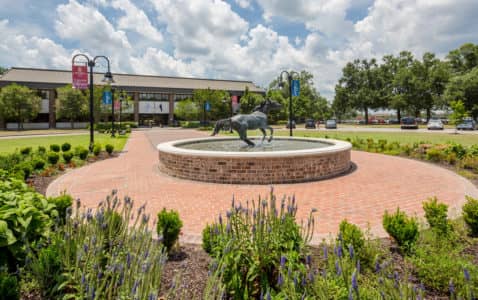
Life on the Aiken campus is active and community-oriented, pitched as a classic small-college experience. The university boasts over 100 student clubs and organizations, covering interests from sports and music to drama, publications, community service, and multicultural activities. Greek life is also present. A significant majority of students—76%—live off-campus, which shapes a commuter-heavy atmosphere, while 24% live in college-owned or -affiliated housing. The university promotes its "championship athletic teams" as a central point of pride, competing in NCAA Division II. The overall tone from official materials is one of a "supportive and vibrant campus community" where students can easily find their niche, whether through intramural sports, student government, or cultural events. The Instagram presence highlights campus events and student support services, reinforcing this image of an engaged, accessible environment.
Outcomes data reveals a university grappling with student persistence. The six-year graduation rate is a central challenge. Post-graduation, the median earnings for alumni ten years after entry is $45,603. Other sources cite figures like $53,299 or $41,170, indicating a range but consistently below the national midpoint for four-year colleges. The university's own institutional research tracks retention, progression, and graduation rates, disaggregating them by factors like status, suggesting an institutional awareness of these challenges. The career outcomes emphasized are those aligned with its popular majors—nursing, business, and the sciences—preparing graduates for direct entry into the regional job market rather than elite graduate programs. The data paints a picture of a university whose value proposition is rooted in affordability and access, with earnings outcomes that reflect its regional and practical focus.
Affordability is a cornerstone of USC Aiken's identity. The average after aid—the average cost to students after grants and scholarships are applied—is $11,641. A vast majority of students receive financial aid, with one source indicating 93% of full-time beginning undergraduates receive grant or scholarship aid, and another stating 99% of undergraduates receive financial aid. is available through the completion of the FAFSA (school code 003448), and 37% of students benefit from federal Pell grants. The university offers merit-based scholarships, some of which require South Carolina residency, a minimum GPA, and demonstrated financial need. There is no indication in the provided sources of a "no-loan" policy or a commitment to meet 100% of demonstrated financial need without loans; the aid philosophy appears to be a mix of federal, state, and institutional grants and scholarships aimed at reducing cost burden.
USC Aiken stands out for its unambiguous mission: to be an accessible, affordable, and supportive public university for the region. It doesn't pretend to be highly selective or a research powerhouse. Instead, it leans into its strengths: small classes with a 16:1 ratio, a teaching-focused faculty, and a campus life rich with NCAA D-II athletics and over 100 student organizations. Its identity is a study in contrasts—high acceptance and high involvement paired with a low graduation rate. It’s a school for the student who prioritizes a close-knit, hands-on learning environment and low debt over prestige, and who is prepared to actively navigate the academic resources to succeed. For a certain student—particularly one from South Carolina looking for a practical degree in nursing, business, or the sciences without the cost or size of the flagship campus—USC Aiken offers a clear, no-frills value proposition.
University of South Carolina Aiken seal · sourceUniversity of South Carolina--Aiken - Profile, Rankings and Data | US News Best Colleges · sourceUniversity of South Carolina--Aiken - Profile, Rankings and Data | US News Best Colleges · sourceUniversity of South Carolina Aiken | College of Distinction · source