Admit rate has ranged 63%–84% over the last 5 years — notably volatile. Source: IPEDS via Urban Institute.
Acceptance & SAT from Common Data Set / IPEDS; net price, earnings & graduation from the U.S. Dept. of Education College Scorecard. Figures lag ~1–2 years — verify with the school.
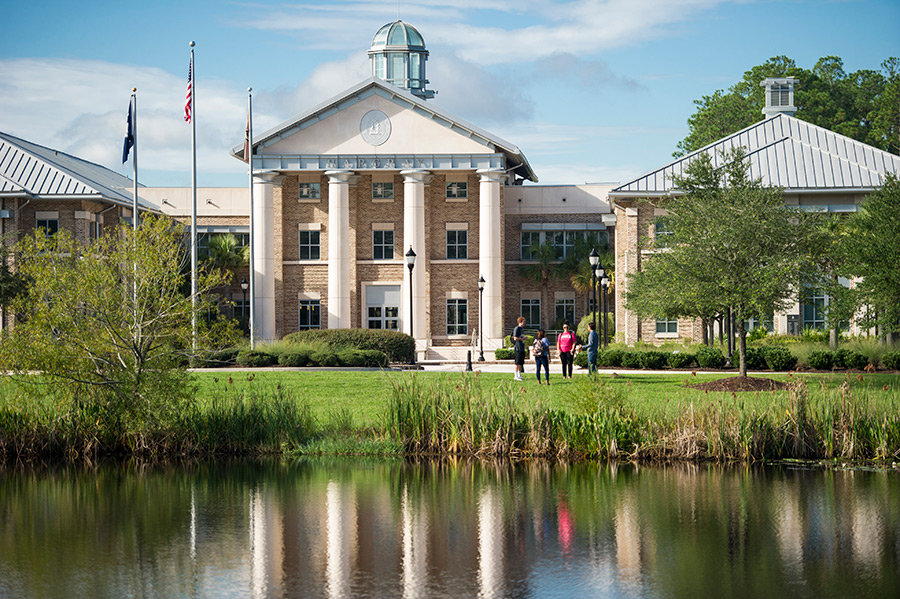
The University of South Carolina Beaufort is a small, public coastal campus where the Lowcountry's relaxed pace defines the student experience. It's a place where students can pursue a practical degree in business or nursing while living minutes from the beach, but the trade-off is a notably low graduation rate and a campus life that students themselves describe as quiet. This is a university for the self-directed learner who values location and affordability over a bustling traditional college scene.
Admission requirements
Test-blind — scores not considered
Required
High school transcript
Grade point average
College-prep program
Source: IPEDS Admissions survey (2022) via Urban Institute. Covers formal factors only — it does not reflect essays, extracurriculars, or other holistic criteria.
More details
Undergrad enrollment
2,052
In-state tuition
$10,730
Out-of-state tuition
$21,776
Popular Majors
Psychology, Business, Nursing
Graduation Rate
34%
On-Campus Housing
48%
Median Earnings (10yr)
$48,088
Outcomes & value
Outcomes & value
Median earnings (10 yr)
$48,088
Value (earnings ÷ net price)
3.3×
Median debt at graduation
$24,000
Graduation rate
34%
First-year retention
61%
Reducing loan balance (3 yr)
47%
Pell (lower-income) share
40%
First-gen share (among federal-aid recipients)
31%
Top-earning majors
Median earnings by field of study (highest credential), ~2 years after completion.
Computational Science$67,660
Registered Nursing, Nursing Administration, Nursing Research and Clinical Nursing$57,318
Teacher Education and Professional Development, Specific Levels and Methods$35,060
Biology, General$33,993
Business Administration, Management and Operations$33,459
Hospitality Administration/Management
Campus & location
Campus safety
On-campus violent crimes (2024)
0
Per 1,000 students
0.00
On-campus criminal offenses classed as violent (murder/non-negligent manslaughter, rape, robbery, aggravated assault) for the most recent reported year. Source: U.S. Dept. of Education Campus Safety and Security (Clery Act). Counts reflect what’s reported to the school, and urban campuses often report more partly due to non-student incidents nearby — read alongside campus size and setting, not as a standalone safety verdict.
Climate
Pleasant days / yr
127
Summer high
89°F
Winter low
46°F
Annual rain
52.6"
Natural-hazard risk
Relatively High
Pleasant days counts days per year with a mean temperature of 55–75°F, a high at or below 90°F, a low at or above 45°F, and little precipitation — a transparent comfort measure, not a weighting we invented. Computed from Open-Meteo ERA5 daily history (2019–2023). Natural-hazard risk is the county’s composite rating from the FEMA National Risk Index.
Deep dive — research, future-scholar output & economic mobility▾
Research output
Institutional h-index
143
Scholarly works
1,773
Institutional research volume and impact from OpenAlex. The h-index reflects large research universities and will be low for teaching-focused liberal-arts colleges — not a measure of undergraduate quality.
Quick answers
What is the acceptance rate at University of South Carolina Beaufort?
University of South Carolina Beaufort's acceptance rate is approximately 73% (Bluffton, SC), based on the most recent figures we compiled from public and primary sources.
How much does University of South Carolina Beaufort cost?
At University of South Carolina Beaufort, the average net price (after aid) is about $14,656 per year. Actual cost varies with financial aid and residency.
How many undergraduates attend University of South Carolina Beaufort?
University of South Carolina Beaufort enrolls approximately 2,052 undergraduate students.
Where is University of South Carolina Beaufort located?
University of South Carolina Beaufort is located in Bluffton, SC.
Admissions
USCB is a relatively accessible public university, with an consistently reported between 69% and 74%. The process is test-flexible; students indicate on their application whether they want the university to consider their standardized test scores. For those who do submit scores, the middle 50% SAT range is typically between 900 and 1170 (or 940-1110 per other sources), with an ACT range of 18 to 24. The average unweighted GPA of admitted students is around 3.68. The university does not appear to offer an Early Decision program, and while the provided sources for the main USC system discuss admission factors, specific data on how heavily USCB weighs demonstrated interest is not detailed in the snippets. The —the percentage of admitted students who enroll—is not explicitly stated in the provided sources.
Earnings = median of students working ~10 years after entry; debt = median of graduates. Value divides 10-yr earnings by one year’s net price — read it as earnings per dollar of annual cost, not a full lifetime ROI; it favors lower-cost schools. Source: U.S. Dept. of Education College Scorecard. Figures lag ~2 years and reflect all students, not your intended major.
$32,772
Social Sciences, General$28,433
Psychology, General$28,055
Source: U.S. Dept. of Education College Scorecard (field-of-study earnings). Figures cover graduates who received federal aid and lag ~2 years; not all programs report data.
USCB offers more than 50 undergraduate majors, minors, certifications, and concentrations. The academic profile is pragmatic, with the most popular majors including Psychology, General Business Administration and Management, and Registered Nursing. The university organizes its programs into areas like Innovation, Business & Communication Studies, Computer Science & Mathematics, Education, and English, the Arts & Interdisciplinary Studies. It promotes global understanding through immersive academic experiences, both domestically and abroad. However, the defining characteristic of the academic experience is its setting; the campus's proximity to the ocean is a significant draw, as noted in parent discussions, suggesting the environment is part of the educational appeal.
Life at USCB is intimate and coastal, but not necessarily bustling. The student body is nearly evenly split between those living on campus (48%) and off campus (52%). The university provides a state-of-the-art recreation facility with a fitness center, group exercise room, gymnasium, and outdoor courts. Student Life organizes campus-wide programming, fraternity and sorority life, student organizations, and community-service initiatives. An active Instagram account promotes events. Yet, the consensus from student reviews paints a picture of a "close-knit but relatively quiet" atmosphere, with students noting "fewer social events and activities compared to larger universities." This suggests a campus where students must often create their own social momentum.
Graduation rates are USCB's most significant challenge. Historical six-year rates have been low, ranging from 20% to 27% for cohorts in the late 2000s. More recent four-year graduation rates are reported at 29%, with an overall rate around 39-40%. For those who do persist, career outcomes show promise. Median earnings for graduates four years after leaving are reported at $49,235, and 85.3% of alumni are employed within three years of departure. Another source cites a median salary of $39,214 six years after graduation, while others report annual incomes for graduates in the mid-$50,000s. The data indicates that while getting to the finish line is a hurdle for many, those who complete their degrees find their footing in the workforce.
The average after aid—the out-of-pocket cost for the average student—is a central part of USCB's value proposition. Funding options include federal grants and loans, the federal work-study program, state aid, athletic awards, and community and institutional scholarships. All federal aid requires submission of the FAFSA. The university provides a Net Price Calculator to help families estimate their annual cost, which accounts for tuition, fees, books, supplies, and living expenses minus expected aid. There is no indication in the provided sources that USCB has a "no-loan" policy or commits to meeting 100% of demonstrated financial need without loans. Aid is awarded according to federal, state, and institutional policies.
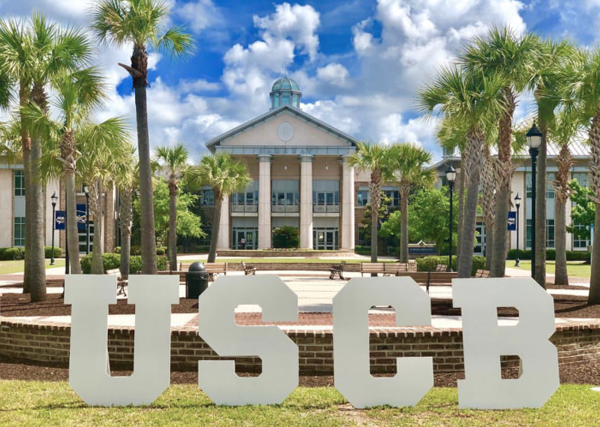
USCB stands out for one undeniable reason: its location in the South Carolina Lowcountry. It is a beach-adjacent university where the environment is woven into the campus identity, appealing directly to students seeking a coastal college experience. This comes with a specific trade-off. It offers the affordability and accessibility of a public regional campus and focuses on hands-on, career-oriented majors like nursing and business. However, it does not provide the robust, traditional residential college experience or the high graduation rates of larger flagship schools. It's a match for a particular student: one who is self-motivated, values a small, quiet community, and is willing to trade some collegiate intensity for life near the marsh and ocean.
University of South Carolina Beaufort seal · sourceVisit Campus - Our Campuses | USCB · sourceUniversity of South Carolina--Beaufort - Profile, Rankings and Data | US News Best Colleges · sourceThe University of South Carolina Beaufort · source