Loading…
← All schools
Upstate Medical University
Syracuse, NYpublicwww.upstate.edu/
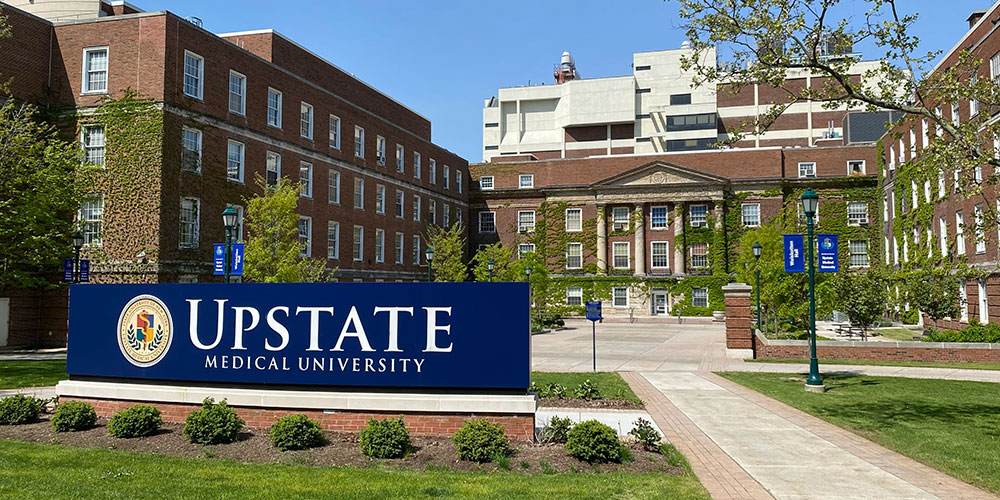
Upstate Medical University isn't your typical undergraduate college; it's a specialized, upper-division academic medical center where the campus is the hospital and the curriculum is a direct pipeline to clinical practice. As the only such institution in Central New York, it offers an intensely focused, hands-on environment for students pursuing careers in nursing, medical imaging, and other allied health professions, where rigorous training in scientific and clinical practices is the norm. The vibe is professional, collaborative, and deeply immersed in healthcare from day one, with student life revolving around a close-knit community of future practitioners.
More details
- Undergrad enrollment
- 159
- Institution Type
- Public Academic Medical Center
- Average Aid Awarded
- $10,457
- Median Earnings (10yr)
- $92,257
- Early Decision (College of Medicine)
- Binding program, small portion of class
Outcomes & value
Outcomes & value
- Median earnings (10 yr)
- $92,257
- Median debt at graduation
- $15,000
- Reducing loan balance (3 yr)
- 83%
- Pell (lower-income) share
- 27%
- First-gen share (among federal-aid recipients)
- 35%
- Endowment / student
- $85,275
Earnings = median of students working ~10 years after entry; debt = median of graduates. Value divides 10-yr earnings by one year’s net price — read it as earnings per dollar of annual cost, not a full lifetime ROI; it favors lower-cost schools. Source: U.S. Dept. of Education College Scorecard. Figures lag ~2 years and reflect all students, not your intended major.
Top-earning majors
Median earnings by field of study (highest credential), ~2 years after completion.
- Registered Nursing, Nursing Administration, Nursing Research and Clinical Nursing$63,005
- Allied Health Diagnostic, Intervention, and Treatment Professions$60,771
- Clinical/Medical Laboratory Science/Research and Allied Professions$52,733
Source: U.S. Dept. of Education College Scorecard (field-of-study earnings). Figures cover graduates who received federal aid and lag ~2 years; not all programs report data.
Compare on earnings: best colleges for Nursing
Campus & location
Campus safety
- On-campus violent crimes (2024)
- 5
- Per 1,000 students
- 3.75
On-campus criminal offenses classed as violent (murder/non-negligent manslaughter, rape, robbery, aggravated assault) for the most recent reported year. Source: U.S. Dept. of Education Campus Safety and Security (Clery Act). Counts reflect what’s reported to the school, and urban campuses often report more partly due to non-student incidents nearby — read alongside campus size and setting, not as a standalone safety verdict.
Climate
- Pleasant days / yr
- 93
- Summer high
- 79°F
- Winter low
- 22°F
- Annual rain
- 43.1"
- Annual snow
- 53.3"
- Natural-hazard risk
- Relatively Moderate
Pleasant days counts days per year with a mean temperature of 55–75°F, a high at or below 90°F, a low at or above 45°F, and little precipitation — a transparent comfort measure, not a weighting we invented. Computed from Open-Meteo ERA5 daily history (2019–2023). Natural-hazard risk is the county’s composite rating from the FEMA National Risk Index.
Quick answers
- How many undergraduates attend Upstate Medical University?
- Upstate Medical University enrolls approximately 159 undergraduate students.
- Where is Upstate Medical University located?
- Upstate Medical University is located in Syracuse, NY.
Admissions
Admissions at Upstate Medical University is a highly selective, program-specific process, reflecting its status as an upper-division transfer and graduate school. The university does not admit traditional first-year students; instead, it focuses on students transferring in for professional bachelor's degrees or entering graduate programs. For its competitive direct-admit partnerships, such as the one with Purchase College, expectations are exceptionally high: candidates need a 90% average or higher, extracurriculars in a healthcare setting, and SAT scores of 1360+ or an ACT of 29+. for its core medical programs are notoriously low; the Norton College of Medicine reported an acceptance rate of about 2.59% for one recent cycle, with roughly 90% of matriculants being in-state applicants. The College of Medicine also operates a binding Early Decision (ED) program, but cautions that only a small portion of the entering class is filled this way and it should only be pursued by applicants with an excellent chance of admission. One recent ED cohort had an average MCAT of 509.86 and an average GPA of 3.64. The admitted student body is diverse, with some classes comprising 77% in-state residents and 23% out-of-state, and a gender distribution favoring women (e.g., 60% women, 40% men).
Compare Upstate Medical University
vs United States Merchant Marine Academyvs Maine Maritime Academyvs United States Coast Guard Academyvs SUNY Maritime College
See colleges similar to Upstate Medical University →Sources
- Consumer Information | Prospective Students | SUNY Upstate
- Common Data Set: Home
- Common Data Set Explorer 2026: Compare 100 Colleges
- How To Use a Common Data Set
- Common Data Set, 2020-2021
- Upstate Medical University - IPEDS - Department of Education
- Upstate Medical University
- Upstate
- UPSTATE | definition in the Cambridge English Dictionary
- USC Upstate - Spartanburg
- Upstate Medical University (@upstatemedical) · Syracuse, NY
- Academics | SUNY Upstate
- Undergraduate Programs | Prospective Students | SUNY ...