Admit rate has ranged 72%–79% over the last 5 years. Source: IPEDS via Urban Institute.
Acceptance & SAT from Common Data Set / IPEDS; net price, earnings & graduation from the U.S. Dept. of Education College Scorecard. Figures lag ~1–2 years — verify with the school.
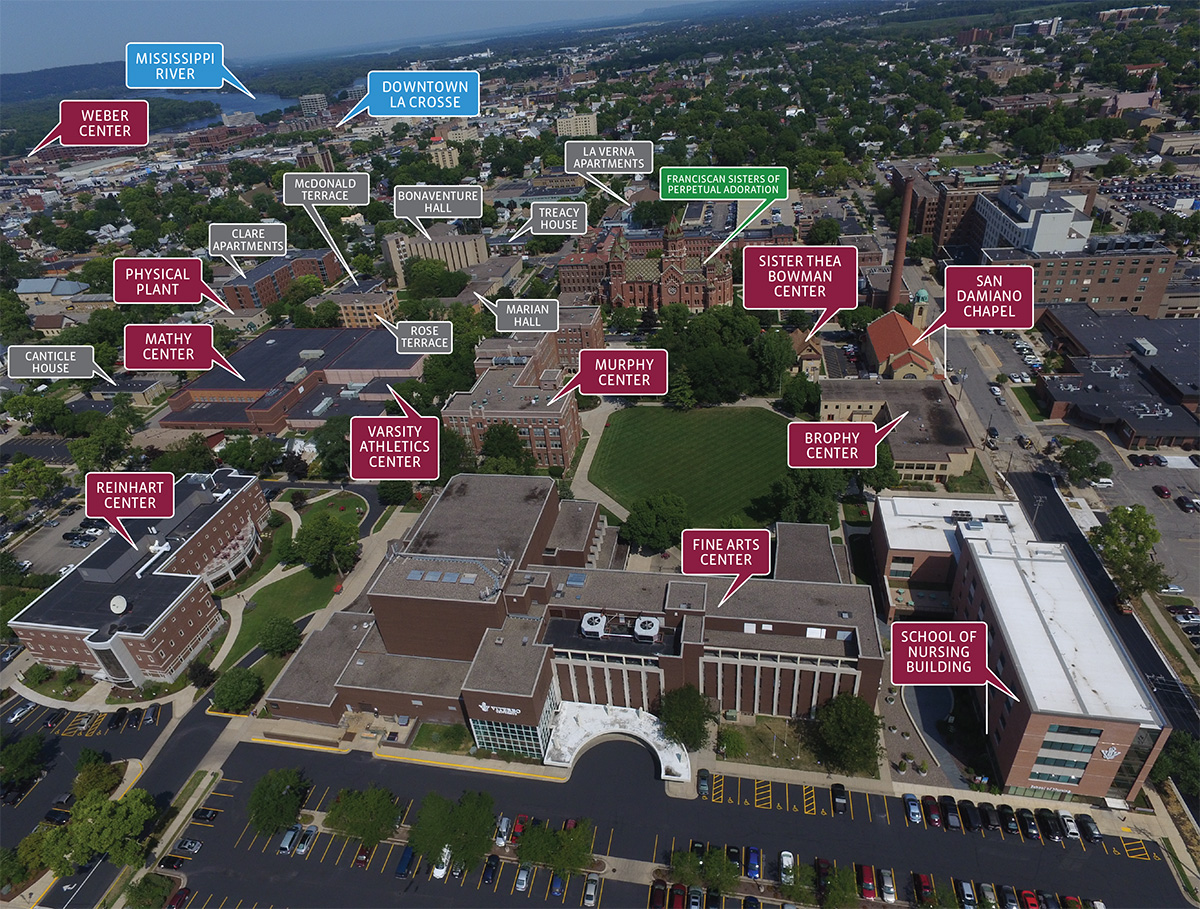
Viterbo University is a small, Franciscan Catholic university in La Crosse, Wisconsin, where a values-based education meets surprisingly strong career outcomes. With a 98% placement rate and a tight-knit campus culture built on hospitality and service, Viterbo offers a practical, hands-on alternative to impersonal mega-universities. It's a place where the student-faculty ratio is 11:1, research is a 1:1 proposition, and graduates leave with a degree that pays off, ranking among the top five Wisconsin institutions for early-career earnings.
Admission requirements
Test-optional — scores considered if submitted
Required
High school transcript
Grade point average
TOEFL (non-native English)
Considered (not required)
Class rank
Letters of recommendation
Test scores (SAT/ACT)
College-prep program
Demonstrated competencies
Source: IPEDS Admissions survey (2022) via Urban Institute. Covers formal factors only — it does not reflect essays, extracurriculars, or other holistic criteria.
2.4 / 3.0Meets the federal financial-responsibility standard
U.S. Dept. of Education Financial Responsibility Composite Score (FY2022-23). Scale −1.0 to 3.0; ≥1.5 meets the standard. Reported for private nonprofit & for-profit institutions only — public universities are state-backed and not scored, so this is a stability signal, not a ranking.
Top-earning majors
Median earnings by field of study (highest credential), ~2 years after completion.
Registered Nursing, Nursing Administration, Nursing Research and Clinical Nursing$65,052
Management Information Systems and Services$54,322
Dietetics and Clinical Nutrition Services$52,107
Accounting and Related Services$48,432
Business Administration, Management and Operations$47,595
Social Work
Campus & location
Campus safety
On-campus violent crimes (2024)
0
Per 1,000 students
0.00
On-campus criminal offenses classed as violent (murder/non-negligent manslaughter, rape, robbery, aggravated assault) for the most recent reported year. Source: U.S. Dept. of Education Campus Safety and Security (Clery Act). Counts reflect what’s reported to the school, and urban campuses often report more partly due to non-student incidents nearby — read alongside campus size and setting, not as a standalone safety verdict.
Climate
Pleasant days / yr
95
Summer high
81°F
Winter low
14°F
Annual rain
34.8"
Annual snow
35.1"
Natural-hazard risk
Relatively Low
Pleasant days counts days per year with a mean temperature of 55–75°F, a high at or below 90°F, a low at or above 45°F, and little precipitation — a transparent comfort measure, not a weighting we invented. Computed from Open-Meteo ERA5 daily history (2019–2023). Natural-hazard risk is the county’s composite rating from the FEMA National Risk Index.
Deep dive — research, future-scholar output & economic mobility▾
Research output
Institutional h-index
75
Scholarly works
1,241
Institutional research volume and impact from OpenAlex. The h-index reflects large research universities and will be low for teaching-focused liberal-arts colleges — not a measure of undergraduate quality.
Economic mobility
Mobility rate
0.8%
Bottom → top quintile
13%
From bottom quintile
6%
Mobility rate = the share of students who both start in the bottom household-income quintile and reach the top quintile; bottom → top is that chance conditional on starting at the bottom. Source: Opportunity Insights Mobility Report Cards (Chetty, Friedman, Saez, Turner & Yagan). Reflects 1980–82 birth cohorts, so it’s directional, not current.
Quick answers
What is the acceptance rate at Viterbo University?
Viterbo University's acceptance rate is approximately 72% (La Crosse, WI), based on the most recent figures we compiled from public and primary sources.
How much does Viterbo University cost?
At Viterbo University, the average net price (after aid) is about $21,260 per year. Actual cost varies with financial aid and residency.
How many undergraduates attend Viterbo University?
Viterbo University enrolls approximately 1,249 undergraduate students.
Where is Viterbo University located?
Viterbo University is located in La Crosse, WI.
Admissions
Viterbo's admissions process is accessible and straightforward, reflecting its mission to serve a broad range of students. The university is test-optional for undergraduate admissions, meaning applicants do not need to submit an ACT or SAT score to be considered. For those who do submit scores, the middle 50% range for the ACT is between 22 and 28, and for the SAT, it's between 1040 and 1380. The admissions office can be reached at 608-796-3010 or via email at [email protected]. While the process is not highly selective, the yield rate—the percentage of admitted students who enroll—is reported to be medium, at around 16%. The does not list Early Decision as a policy, and demonstrated interest is not a formal factor in admissions decisions.
Earnings = median of students working ~10 years after entry; debt = median of graduates. Value divides 10-yr earnings by one year’s net price — read it as earnings per dollar of annual cost, not a full lifetime ROI; it favors lower-cost schools. Source: U.S. Dept. of Education College Scorecard. Figures lag ~2 years and reflect all students, not your intended major.
$41,937
Teacher Education and Professional Development, Specific Levels and Methods$36,848
Sports, Kinesiology, and Physical Education/Fitness$32,563
Source: U.S. Dept. of Education College Scorecard (field-of-study earnings). Figures cover graduates who received federal aid and lag ~2 years; not all programs report data.
Academics at Viterbo are intimate, applied, and geared toward direct career preparation. The university offers over 40 majors and programs at the undergraduate level, spanning fields from Accounting and Acting to Applied Mathematics and Arts Management. The defining feature is the scale: an 11:1 student-to-faculty ratio ensures close mentorship, and the university boasts that 100% of students have the opportunity for 1:1 faculty research. This hands-on philosophy translates into results; Viterbo reports a 98% placement rate for graduates within six months of completing their degree. While the curriculum is comprehensive, popular majors include Psychology and Engineering, each comprising about 3% of graduates. The approach is unapologetically practical, blending a liberal arts foundation with the professional skills needed to land a job swiftly.
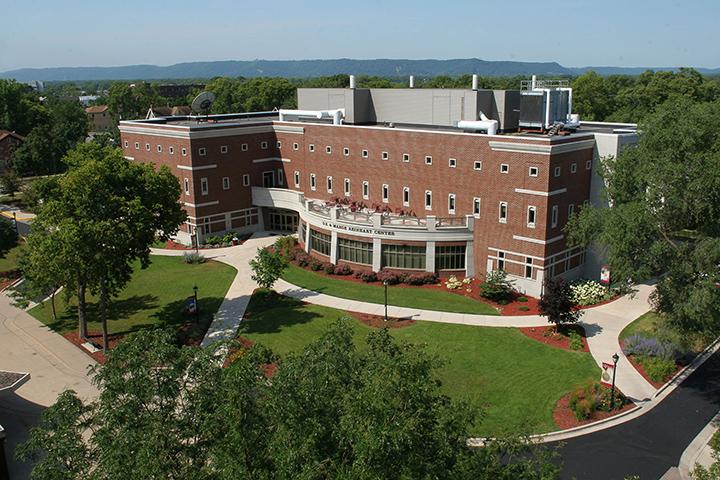
Life at Viterbo revolves around a small, warm, and welcoming campus community where it's easy to see familiar faces and get involved. The university fosters this environment through its Franciscan values of hospitality, integrity, stewardship, contemplation, and service, which are woven into campus life. Students can choose from over 35 student organizations and activities. Residence life is actively promoted, with the university asserting that students who live on campus earn better grades than those who live off-campus, thanks to easier access to study groups, professors, and campus events. The overall vibe, as described by students, is that of a tight-knit community where support is the norm, not the exception.
Viterbo's strongest selling point might be its outcomes, which are robust for a regional university. The institution reports an overall success rate of 98% for undergraduates who completed their degree between 2020 and 2022, with a 94% in-field success rate. This aligns with the 98% placement rate within six months of graduation. For career earnings, Viterbo has been recognized among the top five Wisconsin institutions whose graduates earn the highest median salaries four years after graduation. The six-year graduation rate is reported at 65-66%, and the first-year retention rate is 76%. The message is clear: a Viterbo degree is designed to lead directly to employment, often in a student's chosen field, with a solid financial return.
Viterbo works to make its private education accessible through financial aid. A substantial 98% of full-time undergraduate students receive financial aid in the form of scholarships, grants, and loans. The university offers merit-based scholarships that are awarded on a non-need basis, ranging from $2,000 to full tuition. To help families plan, Viterbo provides a Calculator on its financial aid website. The financial aid process is described as using institutional, federal, and state resources to help bridge the gap when family resources do not cover total educational costs. The university's aid packages typically include a mix of grants, scholarships, and loans.
Viterbo University stands out as a rare hybrid: a values-centered, small liberal arts college with the career placement stats of a technical institute. Its Franciscan identity isn't just branding; it shapes a campus culture of genuine hospitality and support, creating an environment where students are known by name. The academic model is ruthlessly effective—prioritizing 1:1 faculty interaction and hands-on learning to achieve a near-perfect 98% job placement rate. This isn't a school for the theoretical; it's for the practical student who wants a close community, direct mentorship, and a clear, high-value pathway from the classroom to a career. In a higher education landscape often divided between elite liberal arts colleges and large research universities, Viterbo carves a compelling third path: a compassionate, career-focused proving ground where success is measured not just in degrees conferred, but in graduates employed.