Admit rate has ranged 61%–64% over the last 5 years. Source: IPEDS via Urban Institute.
Acceptance & SAT from Common Data Set / IPEDS; net price, earnings & graduation from the U.S. Dept. of Education College Scorecard. Figures lag ~1–2 years — verify with the school.
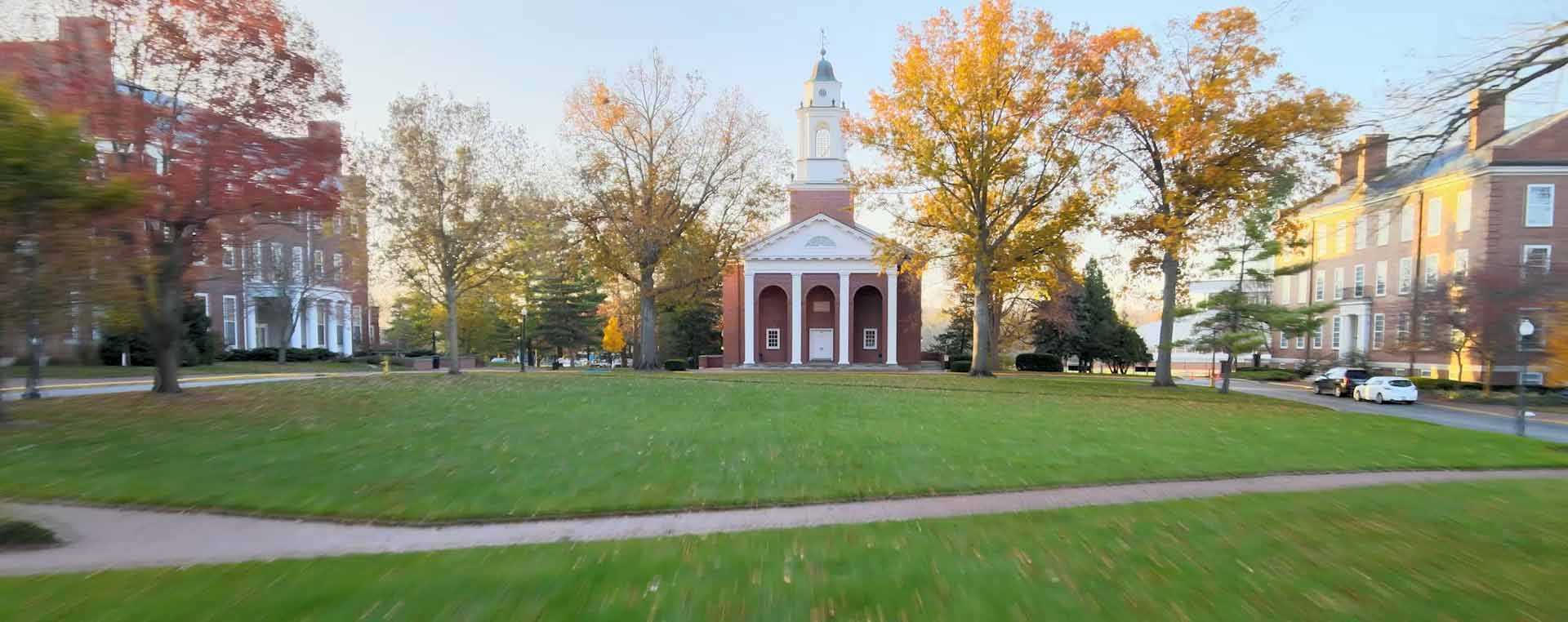
Wabash College is a singular institution in American higher education: a fiercely proud, all-male liberal arts college in rural Indiana that cultivates a tight-knit, confident brotherhood. It combines a surprisingly accessible admissions process with a rigorous academic culture and a stunning 98.3% post-graduation placement rate, producing graduates who are disproportionately successful in law, medicine, and business. This is a place where tradition runs deep, relationships are everything, and the mission is unapologetically focused on turning boys into men of character and consequence.
Admission requirements
Test-optional — scores considered if submitted
Required
High school transcript
Grade point average
College-prep program
TOEFL (non-native English)
Considered (not required)
Class rank
Letters of recommendation
Test scores (SAT/ACT)
Source: IPEDS Admissions survey (2022) via Urban Institute. Covers formal factors only — it does not reflect essays, extracurriculars, or other holistic criteria.
More details
Undergrad enrollment
866
In-state tuition
$50,800
Out-of-state tuition
$50,800
Graduation Rate
77%
On-Campus Housing
99%
First-Year Retention
93%
Demonstrated Interest
Not considered
Median Earnings (10yr)
$69,952
First-Destination Placement Rate
98.3%
Outcomes & value
Outcomes & value
Median earnings (10 yr)
$69,952
Value (earnings ÷ net price)
2.9×
Median debt at graduation
$27,000
Graduation rate
77%
First-year retention
93%
Reducing loan balance (3 yr)
70%
Pell (lower-income) share
24%
Earnings = median of students working ~10 years after entry; debt = median of graduates. Value divides 10-yr earnings by one year’s net price — read it as earnings per dollar of annual cost, not a full lifetime ROI; it favors lower-cost schools. Source: U.S. Dept. of Education College Scorecard. Figures lag ~2 years and reflect all students, not your intended major.
Financial health
2.8 / 3.0Meets the federal financial-responsibility standard
U.S. Dept. of Education Financial Responsibility Composite Score (FY2022-23). Scale −1.0 to 3.0; ≥1.5 meets the standard. Reported for private nonprofit & for-profit institutions only — public universities are state-backed and not scored, so this is a stability signal, not a ranking.
Top-earning majors
Median earnings by field of study (highest credential), ~2 years after completion.
Economics$52,107
Mathematics$51,482
Rhetoric and Composition/Writing Studies$49,058
Biology, General$41,565
Psychology, General$41,007
Political Science and Government$37,208
History
Campus & location
Campus safety
On-campus violent crimes (2024)
0
On-campus criminal offenses classed as violent (murder/non-negligent manslaughter, rape, robbery, aggravated assault) for the most recent reported year. Source: U.S. Dept. of Education Campus Safety and Security (Clery Act). Counts reflect what’s reported to the school, and urban campuses often report more partly due to non-student incidents nearby — read alongside campus size and setting, not as a standalone safety verdict.
Climate
Pleasant days / yr
91
Summer high
83°F
Winter low
25°F
Annual rain
39.3"
Annual snow
18.1"
Natural-hazard risk
Very Low
Pleasant days counts days per year with a mean temperature of 55–75°F, a high at or below 90°F, a low at or above 45°F, and little precipitation — a transparent comfort measure, not a weighting we invented. Computed from Open-Meteo ERA5 daily history (2019–2023). Natural-hazard risk is the county’s composite rating from the FEMA National Risk Index.
Deep dive — research, future-scholar output & economic mobility▾
Research output
Institutional h-index
94
Scholarly works
1,928
Institutional research volume and impact from OpenAlex. The h-index reflects large research universities and will be low for teaching-focused liberal-arts colleges — not a measure of undergraduate quality.
Economic mobility
Mobility rate
1.7%
Bottom → top quintile
40%
From bottom quintile
4%
Mobility rate = the share of students who both start in the bottom household-income quintile and reach the top quintile; bottom → top is that chance conditional on starting at the bottom. Source: Opportunity Insights Mobility Report Cards (Chetty, Friedman, Saez, Turner & Yagan). Reflects 1980–82 birth cohorts, so it’s directional, not current.
Quick answers
What is the acceptance rate at Wabash College?
Wabash College's acceptance rate is approximately 63% (Crawfordsville, IN), based on the most recent figures we compiled from public and primary sources.
What SAT score do you need for Wabash College?
Admitted students at Wabash College typically score 1060–1270 on the SAT (the middle-50% range). Scores outside this band are still admitted, especially with strong applications.
How much does Wabash College cost?
At Wabash College, the average net price (after aid) is about $24,336 per year. Actual cost varies with financial aid and residency.
How many undergraduates attend Wabash College?
Wabash College enrolls approximately 866 undergraduate students.
Where is Wabash College located?
Wabash College is located in Crawfordsville, IN.
Admissions
Wabash presents a compelling admissions paradox: it is 'less selective' with a 63% , yet it enrolls a class with strong academic credentials and achieves a remarkably high 93% freshman retention rate. The college is , meaning applicants are not required to submit SAT or ACT scores. For those who do submit, the middle 50% SAT range is 1060–1270, and the middle 50% ACT range is 22–28. The average GPA of enrolled freshmen is around 3.7. The college offers an Early Decision plan with a November 15 deadline, and data suggests a significant advantage for ED applicants, with one source citing an 86% Early Decision acceptance rate compared to the overall 63% rate. Demonstrated interest is explicitly marked as 'not considered' in the (C7), meaning visiting campus or contacting admissions does not formally impact an applicant's evaluation. The process seems designed to identify students who are a strong fit for its unique, all-male, residential liberal arts environment.
Source: U.S. Dept. of Education College Scorecard (field-of-study earnings). Figures cover graduates who received federal aid and lag ~2 years; not all programs report data.
Wabash offers a classic, intensive liberal arts curriculum through 40 academic programs, including 36 majors and minors. The academic experience is defined by close faculty mentorship and a demanding workload designed to cultivate rigorous thinkers and effective communicators. Popular majors include Biology, Mathematics, Religion, Computer Science, and Spanish. Notably, the interdisciplinary major in Philosophy, Politics, and Economics (PPE) is the institution's most popular, awarding around 24 degrees annually. The college also provides structured pathways for pre-professional students, with a dual-degree program in engineering and dedicated pre-law and pre-medicine programs. Its success in these areas is staggering: the college reports a 94% medical school and a 96% law school acceptance rate for its graduates. This is not a place for passive learning; the curriculum and culture are explicitly engineered to produce 'outspoken, confident men' prepared for leadership and advanced study.
Life at Wabash is an all-encompassing, residential brotherhood. The college describes its culture as 'intensely student-centered,' built on 'close relationships and personalized attention.' This is not a metaphor: 99% of students live in college-owned, -operated, or -affiliated housing, creating a 24/7 campus community where social, academic, and personal lives are deeply intertwined. Living on campus is seen as integral to adjusting to academic rigors and participating in the full spectrum of campus events and intramural sports. Athletics play a significant role in campus culture, fostering school spirit and camaraderie. The experience is intentionally designed to be immersive, demanding, and formative, pushing students to engage fully with their peers and professors. It's a world unto itself in Crawfordsville, Indiana, where the bonds formed are lifelong and the shared identity as 'Wabash men' is powerfully defining.
Wabash's ultimate proof point is the extraordinary success of its graduates. The college's first-destination placement rate is exceptional: 98.3% of the Class of 2024 secured employment, graduate school admission, or a fellowship within six months of graduation, far exceeding the national average. Its four-year graduation rate of 77% places it in the top 15% of colleges nationally, indicating students are supported to finish their degrees on time. This academic foundation translates into strong financial outcomes. While the median earnings ten years after entry are $69,952, the trajectory is positive, with earnings five years after graduation reported at $64,747 per year. The college's performance in graduation rates and career outcomes contributed to it recently being named the best liberal arts college in Indiana. Simply put, a Wabash degree works; it opens doors to top graduate programs and meaningful careers at a rate that rivals institutions with far more selective admissions.
Wabash is committed to making its education accessible through substantial financial aid. The average after aid is $24,336. A significant majority of students receive support, with 100% of full-time beginning undergraduates receiving grant or scholarship aid, and 65.7% of all students receiving financial aid with an average aid package of $51,269. The college offers a range of merit-based scholarships, such as the Dean's Scholarship (up to $27,000) and higher-tier scholarships ($30,000–$33,000) for students with GPAs between 3.25 and 3.79. It is important to note that while Wabash meets a high percentage of demonstrated need for many students, the available sources do not explicitly state that it meets 100% of need for all admitted students or that it has a universal 'no-loan' policy where loans are eliminated from aid packages. Students should use the college's net price calculator and consult directly with the Financial Aid Office to understand their specific package, which may include federal loans.
Wabash College stands out as a defiant anachronism and a proven model. In an era of coeducation, it remains proudly and purposefully all-male, arguing that this focused environment best cultivates the specific kind of intellectual courage and brotherhood it seeks. It defies easy categorization by pairing an accessible 63% with outcomes—a 98.3% placement rate and 94% med school acceptance—that are the envy of far more 'selective' schools. This is not a country club; it's a boot camp for the mind and character, set on a residential campus where 99% of students live. The education is intensely personal, the traditions are deeply felt, and the network is fiercely loyal. For a young man who thrives on challenge, values close mentorship, and isn't afraid of a demanding, all-in community, Wabash offers a transformative experience that reliably translates into postgraduate success. It proves that exclusivity in admissions is not a prerequisite for excellence in outcomes.
Wabash College seal · sourceWabash College: Crawfordsville, Indiana · sourceGetting Around | Student Life | Wabash College · sourceWabash College – Colleges That Change Lives · source