Admit rate has ranged 59%–100% over the last 5 years — notably volatile. Source: IPEDS via Urban Institute.
Acceptance & SAT from Common Data Set / IPEDS; net price, earnings & graduation from the U.S. Dept. of Education College Scorecard. Figures lag ~1–2 years — verify with the school.
Warner Pacific University is a small, Christ-centered liberal arts college in Portland, Oregon, that operates less like a selective fortress and more like a mission-driven community. With a 10:1 student-faculty ratio and a focus on personal growth within a faith-based framework, it offers a distinctly intimate alternative to the region's larger universities. Its profile is defined by accessibility—a rolling admissions policy and a high acceptance rate—and a commitment to serving a diverse student body, over half of whom receive federal Pell Grants.
Admission requirements
Test-optional — scores considered if submitted
Required
High school transcript
Grade point average
TOEFL (non-native English)
Considered (not required)
Test scores (SAT/ACT)
Source: IPEDS Admissions survey (2022) via Urban Institute. Covers formal factors only — it does not reflect essays, extracurriculars, or other holistic criteria.
More details
Undergrad enrollment
375
In-state tuition
$22,220
Out-of-state tuition
$22,220
Graduation Rate
49%
Standardized Tests
Not required
Application Deadline
Rolling
Pell Grant Recipients
51%
Student-Faculty Ratio
10:1
Early Decision Offered
No
Median Earnings (10yr)
$55,204
Financial Aid Recipients
99%
First-Year Retention Rate
77%
Outcomes & value
Outcomes & value
Median earnings (10 yr)
$55,204
Value (earnings ÷ net price)
2.2×
Median debt at graduation
$25,000
Graduation rate
49%
First-year retention
92%
Reducing loan balance (3 yr)
49%
Pell (lower-income) share
48%
First-gen share (among federal-aid recipients)
47%
Earnings = median of students working ~10 years after entry; debt = median of graduates. divides 10-yr earnings by net price — read it as earnings per dollar of annual cost, not a full lifetime ROI; it favors lower-cost schools. Source: U.S. Dept. of Education College Scorecard. Figures lag ~2 years and reflect all students, not your intended major.
Financial health
1.6 / 3.0Meets the federal financial-responsibility standard
U.S. Dept. of Education Financial Responsibility Composite Score (FY2022-23). Scale −1.0 to 3.0; ≥1.5 meets the standard. Reported for private nonprofit & for-profit institutions only — public universities are state-backed and not scored, so this is a stability signal, not a ranking.
Top-earning majors
Median earnings by field of study (highest credential), ~2 years after completion.
Accounting and Related Services$50,856
Business Administration, Management and Operations$49,683
Health and Medical Administrative Services$42,682
Human Development, Family Studies, and Related Services$33,382
Sports, Kinesiology, and Physical Education/Fitness$28,816
Source: U.S. Dept. of Education College Scorecard (field-of-study earnings). Figures cover graduates who received federal aid and lag ~2 years; not all programs report data.
Campus & location
Campus safety
On-campus violent crimes (2024)
0
On-campus criminal offenses classed as violent (murder/non-negligent manslaughter, rape, robbery, aggravated assault) for the most recent reported year. Source: U.S. Dept. of Education Campus Safety and Security (Clery Act). Counts reflect what’s reported to the school, and urban campuses often report more partly due to non-student incidents nearby — read alongside campus size and setting, not as a standalone safety verdict.
Climate
Pleasant days / yr
115
Summer high
81°F
Winter low
36°F
Annual rain
52"
Annual snow
16.3"
Natural-hazard risk
Relatively High
Pleasant days counts days per year with a mean temperature of 55–75°F, a high at or below 90°F, a low at or above 45°F, and little precipitation — a transparent comfort measure, not a weighting we invented. Computed from Open-Meteo ERA5 daily history (2019–2023). Natural-hazard risk is the county’s composite rating from the FEMA National Risk Index.
Quick answers
What is the acceptance rate at Warner Pacific University?
Warner Pacific University's acceptance rate is approximately 71% (Portland, OR), based on the most recent figures we compiled from public and primary sources.
How much does Warner Pacific University cost?
At Warner Pacific University, the average net price (after aid) is about $25,629 per year. Actual cost varies with financial aid and residency.
How many undergraduates attend Warner Pacific University?
Warner Pacific University enrolls approximately 375 undergraduate students.
Where is Warner Pacific University located?
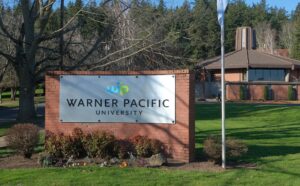
Warner Pacific University is located in Portland, OR.
Admissions
Warner Pacific's admissions process is characterized by its accessibility and rolling timeline. The university admits a significant majority of its applicants, with an of 71%. In a recent cycle, 318 students were admitted from a pool of 447 applicants. The process is straightforward: the university does not offer Early Decision, and while Early Action is not offered, the regular admission deadline is rolling, allowing for flexible application timing. Standardized test scores (SAT/ACT) are not a required part of the application. The admissions office supports students, staff, and faculty through its Office of Assessment and Institutional Research.
Academics at Warner Pacific are built on a liberal arts core curriculum designed to challenge students and expand their understanding of society, community, and faith. The university offers a notably intimate learning environment with a student-faculty ratio of 10:1. Students can choose from a wide variety of undergraduate and postgraduate programs, with 42 degree options that provide flexibility for both in-person and online learning. Undergraduate majors span fields from Accounting and Biological Science to Biblical and Theological Studies and a Bachelor of Social Work (BSW). The average freshman retention rate, an indicator of student satisfaction, is 77%.
Life at Warner Pacific revolves around a small, close-knit campus of about 350 undergraduate students, with a gender distribution of 36.3% male and 63.7% female. The Campus Activities Board (CAB) serves as a key student leadership vehicle, aiming to create a welcoming, diverse, and inclusive environment through organized events. While the campus lacks extensive nightlife or large parties, students enjoy organized late-night events like movie nights and informal social gatherings. The university encourages students to pursue their passions, hone leadership skills, and build college memories through various engagement opportunities. A campus tour is available for prospective students to get a feel for the environment.
Student outcomes at Warner Pacific show a mixed picture. The six-year graduation rate is reported at 49.2% and 51% in different sources. The university's overall outcomes score is 57 out of 100. For graduates, median earnings six years after enrollment are $45,660. A longer-term projection estimates that graduates earn a median of $55,204 ten years after entry, with a projected net gain over a 20-year career. The first-year retention rate is a solid 77%, suggesting students who enroll are generally satisfied with their initial experience.
Warner Pacific is proactive in providing financial assistance, with 99% of all students receiving some form of financial aid. The university awards a substantial $12.3 million in financial aid annually, including $2 million in WPU scholarships each year. A significant portion of the student body receives federal support, with 51% of students receiving Federal Pell Grants and 32% receiving Federal Student Loans. The average financial aid package is $10,826. Students are encouraged to use the Calculator for estimates and to seek out external scholarship opportunities, notifying the financial aid office of any awards they receive.
Warner Pacific stands out as a purposefully small, Christ-centered university that prioritizes access and community over prestige and selectivity. Its identity is forged in its 10:1 student-faculty ratio, which promises personalized attention, and its core curriculum that explicitly integrates faith with learning about society and community. It serves a population that is often overlooked elsewhere, with over half of its students qualifying for Pell Grants. Unlike institutions with cutthroat admissions, Warner Pacific's rolling, policy and high reflect a commitment to finding a place for mission-aligned students. It offers a specific vibe: not a party school, but a place where organized campus activities and intimate gatherings define social life, creating a tight-knit environment for students seeking a values-based education in the Pacific Northwest.
Warner Pacific University seal · sourceLocation | Warner Pacific University · sourceWarner Pacific University - Profile, Rankings and Data | US News Best Colleges · sourceWelcome to our beautiful campus at Warner Pacific University! 💚🩵, Follow us on TikTok for more video content! @warner.pacific.u · source