Loading…
← All schools
Watts College of Nursing
Durham, NCprivate nonprofitwattscollegeofnursing.edu/
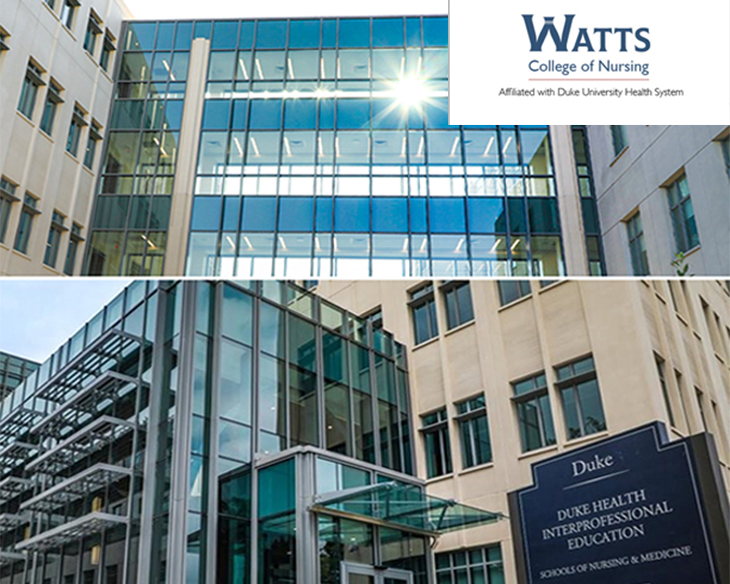
Watts College of Nursing is a single-purpose, career-launching institution in Durham, North Carolina, with a pragmatic, no-frills focus on turning out practice-ready nurses. Its identity is defined by a direct pipeline to clinical careers, a tight-knit cohort model, and an imminent, high-profile move onto the Duke University campus in 2025—a relocation that promises to deepen its clinical resources and prestige. This is a school for students who know exactly what they want to do and want a streamlined, immersive education to get them there, fast.
More details
- Undergrad enrollment
- 124
- Location
- Durham, NC
- Demonstrated Interest
- Not considered
- Early Decision Program
- Not offered
- Singular Academic Focus
- Bachelor of Science in Nursing (BSN)
- Job Placement Rate (2024)
- 97%
- NCLEX-RN Pass Rate (2024)
- 91%
- Relocating to Duke Campus
- July 2025
- Median Earnings 1 Year After Graduation
- $36,427
Outcomes & value
Outcomes & value
- Pell (lower-income) share
- 35%
Earnings = median of students working ~10 years after entry; debt = median of graduates. Value divides 10-yr earnings by one year’s net price — read it as earnings per dollar of annual cost, not a full lifetime ROI; it favors lower-cost schools. Source: U.S. Dept. of Education College Scorecard. Figures lag ~2 years and reflect all students, not your intended major.
Financial health
2.3 / 3.0Meets the federal financial-responsibility standard
U.S. Dept. of Education Financial Responsibility Composite Score (FY2022-23). Scale −1.0 to 3.0; ≥1.5 meets the standard. Reported for private nonprofit & for-profit institutions only — public universities are state-backed and not scored, so this is a stability signal, not a ranking.
Campus & location
Campus safety
- On-campus violent crimes (2024)
- 0
On-campus criminal offenses classed as violent (murder/non-negligent manslaughter, rape, robbery, aggravated assault) for the most recent reported year. Source: U.S. Dept. of Education Campus Safety and Security (Clery Act). Counts reflect what’s reported to the school, and urban campuses often report more partly due to non-student incidents nearby — read alongside campus size and setting, not as a standalone safety verdict.
Climate
- Pleasant days / yr
- 113
- Summer high
- 88°F
- Winter low
- 36°F
- Annual rain
- 34.3"
- Annual snow
- 2.8"
- Natural-hazard risk
- Relatively Moderate
Pleasant days counts days per year with a mean temperature of 55–75°F, a high at or below 90°F, a low at or above 45°F, and little precipitation — a transparent comfort measure, not a weighting we invented. Computed from Open-Meteo ERA5 daily history (2019–2023). Natural-hazard risk is the county’s composite rating from the FEMA National Risk Index.
Quick answers
- How many undergraduates attend Watts College of Nursing?
- Watts College of Nursing enrolls approximately 124 undergraduate students.
- Where is Watts College of Nursing located?
- Watts College of Nursing is located in Durham, NC.
Admissions
Admissions at Watts College of Nursing are notably accessible, especially when compared to the fiercely competitive direct-entry nursing programs at large universities. While sources provide varying figures, the consensus points to a high . One source states the acceptance rate is around 77.62%, while another review on a nursing forum characterizes it as "nearly 100%." A third source lists an acceptance rate of 57%. This relative openness reflects the school's mission to educate future nurses rather than engage in hyper-selective screening.
The process is straightforward and centered on readiness for a rigorous nursing curriculum. Admitted students must submit a $100 non-refundable enrollment fee to secure their spot. While standardized test scores are considered, the middle 50% ACT range is reported as 15-22, and the middle 50% SAT range is 840-1100, indicating a broad academic profile among accepted students. The school does not appear to offer an Early Decision program, focusing instead on standard admission cycles for its Bachelor of Science in Nursing (BSN) program. Demonstrated interest—a factor tracked by some colleges in the (Section C7)—is not a consideration in the admissions process here; the evaluation is based on academic credentials and preparedness for the nursing field.
Compare Watts College of Nursing
vs Livingstone Collegevs Emory University-Oxford Collegevs Thomas Universityvs Hampden-Sydney College
See colleges similar to Watts College of Nursing →Sources
- CONSUMER INFORMATION
- Common Data Set: Home
- Common Data Set 2024-2025
- Common Data Set Guide: Use it to Find the Right College
- Where to find Common Data Set (CDS) for college ...
- Common Data Set: 2023-2024
- Watts College of Nursing Acceptance Rate - Admissions Chances ...
- ADMISSIONS | Watts College of Nursing
- Watts College of Nursing Admissions & Acceptance - Niche
- Watts School of Nursing Admissions - allnurses
- Watts College of Nursing Statistics - Overgrad